Author Archives: bhyde

Phase Changes in the Factors of Production

50524

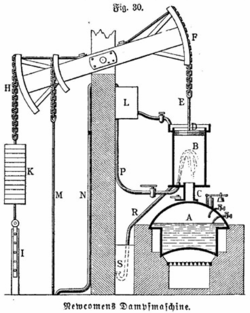
The Newcomen fire water pump consumed vast amounts of coal, but waste coal was free at the mine head.

I enjoyed this video (ht Brad) of Professor R.C. Allen outline the theory he presents in his recent book.  The question at hand is what triggered the Industrial Revolution.  Why Britian and associated questions.  To hear him tell it the existing theory seems to be that they finally stumbled into the right institutional frameworks; reasonably good governance, property rights, etc.  That theory has always struck me as suspect since it smells too much like what everybody says about the others.

His alternative theory is, roughly, that Britian was pregnant with possibility when something happened and the resulting babe thrived.  Why it thrived is another story.

The fertile context amounted to two things.  Northeastern Europe’s rising standards of living had created a consumer/commercial economy with urbanization, literacy, and consumer demand.  He suggests that had happened before, say during the Roman era.  Secondly a few key general technologies had emerged.  Computers are the modern exemplar of a general, i.e. extremely widely applicable, technology.  In this story a good example of a general technology was precision gears and rollers an outgrowth of clocks.  Clocks emerged for navigational purposes and consumer demand goosed up the supply.

The trigger was a sky rocketing cost of labor in Britain, it happened thru out North Eastern Europe but was most severe in Britain.  Rising labor costs always the calculus of production.  If labor is expensive then substituting capital equipment becomes more attractive.  Actually there is a more general statement.  If the cost of any input rises or falls that changes the shape of how best to configure your production.  So if labor gets horribly expensive, and fuel gets really cheap then you get a shift to production techniques that reduce labor, increase capital equipment by using fuel.  And that’s the trigger.  The Brits started building equipment which traded coal for labor costs.

He has a nice example.  The French were making plate glass and cheerfully helped the Brits setup a production facility.  It was obvious to the French that given the cost of labor in Britian there was no way they could become a serious competitor.  What they miscalculated was how cheap coal was.

He highlights a key point about how these shifts in the factors of production play out.  The new forms of production need only clear a minimal profit.  Such schemes can survive only in the new niche; they can not be exported to the rest of the planet.  If early in the industrial revolution you visited England, admired their cool new machines for spinning cotton, you might be tempted to head home and try the same trick.  But it wouldn’t work out; absent a high cost of labor the numbers just don’t work for you.  Casual observers back home will pen editorials about how your falling behind.  But there is something else: learning curve.  New production scheme but a babe, it has a lot to learn.  That’s because it’s new.  So while you get started with a minimal profit as you climb the learning curve those profits grow.  Which sets up a virtuous cycle, particularly for the owners of the means of production.  We used to call these guys capitalist mill owners, but now we call them VC.  And as that plays out the scheme becomes exportable to countries of progressively lower and lower labor costs.  The late adopters don’t get to capture the benefits of climbing the easy part of the learning curve; they don’t even get learn how to climb it.

How the Brits climbed the learning curve is another story.  Having a literate urban population was good.  It may have been important that the rich had fallen into a fad of amateur science and taken up hobbies involving the building of mechanisms; but this was engineering, a craft of tedious hill climbing.

It is fun, and useful, remixing this model with other models of innovation.  It is surprising how often the trick of juggling the means of production into some patently inefficient, but yet slightly profitable, repeats it’s self.  We are seeing a lot of that in cloud computing these days and that card was played when FPLAs where invented or in the invention of Ethernet.
Any x Any

Having spent far too much time thinking, writing, and attempting to bootstrap some two sided network businesses I’m impressed by this slogan from Google’s efforts to become the hub of bookville: “buy anywhere, read anywhere”, very clever.

Widening Gyre

Gosh.

When I was doing my reading on standards, identity, and highly skewed distributions one of the many places they all come together is around names.  Names powerlaw distributed, and there are some amusing stories of about extreme cases.  For example at one point in England so many males came to be named after the King that they had to introduce last names just to be able to differentiate.

Brad DeLong caught a good story of this kind today.  The remains of Super Typhoon Melor, brought unseasonable rains to Berkeley.  Classic blog posting material.  But then he gets this single comment.

kaleidescope said…

Typhoon Melor. During the Thirties, scores of Soviet citizens named their children Melsor, which stood for Marx, Engels, Stalin, October Revolution. After Khruschev’s 1956 speech to the 20th Party Conference, the Melsors changed their names to Melor.

I love the Internet, Surely some revelation is at hand.

Walk in the Woods

Mimi posts so I don’t have to:  Walk in the Woods.

The mushrooms were excellent.  Lots of single mushrooms, so that was fun.  That collection of logs covered in mushrooms, those are puffballs.  That was the only place we saw a bunch that might have been worth eating; though those were just pass their prime.  And, so far all the puffball’s I’ve tried have been unremarkable, Wonderbread(tm).

Joking == Industrial Revolution

Asked what the earliest known joke is Robert Mankoff, here in this long geeky video on cartoon humor, spins a tail saying:  Shortly after the Civil War.  He tells a two awful early proto-jokes, one from the Greeks along with another from the century before the Civil War.  He’s wrong about this as you can see from this article from last May reporting the discovery of a Roman joke book.

We are talking here about jokes, not humor.  Obviously Pride and Prejudice and much of Shakespeare is hilarious, but the jokes are nonexistent.  Let’s give a joke by example to help clarify, lifted from the that article on the Roman joke book:

a barber, a bald man and an absent-minded professor taking a journey together. They have to camp overnight, so decide to take turns watching the luggage. When it’s the barber’s turn, he gets bored, so amuses himself by shaving the head of the professor. When the professor is woken up for his shift, he feels his head, and says “How stupid is that barber? He’s woken up the bald man instead of me.”

A joke is very brief, even one line; and it’s not really the same as a quip, like say the amusing rye observations that Jane’s father makes in Pride and Prejudice.  A joke is a little stand along machine designed to trap it’s audience into laughing.

But obviously Mankoff’s version must have some grain of truth in it, since watching the video it’s clear that he has deep familiarity with the history and theory of humor.  I can accept that the discovery of an ancient joke book is in fact an extremely exceptional event.  Which I find entirely bizzare.  If asked to guess I’d have presumed that joke books would be close on the heels of pornography as one of the first things an entrepreneurial  book printer would print up for his customers.  And, I gather, that many great Universities have significant collections of dusty books of porn; so why no similar collections of jokes?

That says something,  I’m just not sure what.  Joking seems to fundamentally human that I can’t help but presume that some serious social controls censored the behavior so it was extremely exceptional for the behavior to get up enough steam that joke books survived.  Maybe something about the state of the art in joking, which is largely consistent with Mankoff’s model.  Maybe something about the nature of self censorship, e.g. maybe joking was treated as more sinful than pornography and or the demand for porn displaces the limited time for making possibly sinful books for resale.  Maybe it says something about archivists.  Maybe all these and others?

All this reminds me of another example of human activity unknown until modern times, i.e. political demonstrations.    For which similar questions could presumably be asked.  I joke that it’s my right as an American to complain, and apparently it is in fact a very modern right.  Maybe the right to joke is similarly modern.  There are days when I think modern human culture really is entirely different from what passed prior to say 1750.

Are all these modern activities fundamentally out of scope, i.e. sufficiently suspect as to be worth vigorous suppression, for a true conservative?

Tell it to the Blog

We have a little joke around the house.  When somebody starts complaining we occationally lean back and mumble – “Tell it to the blog.”  It’s s cruel and unsympathetic pleasure.  So … I’m here to tell it to the blog.

I love my MacBook Air but for the last week we have fallen into a very abusive relationship.

Little over  a week ago the hinge broke.  Mine was purchased a year and half ago and it has a twin bought on the same purchase order.  It’s twin’s hinge broke two weeks before mine.  There were small signs of a problem, a slight looseness in the hinge.  But that’s all and that problem had existed for at least a year.

We had little problem getting Apple to fix either of these machines.  They both had the extended warrenty.  I dropped mine off on a Monday afternoon and got it back on Thursday evening.  The visit to the Apple store was tedious with a hour plus wait followed by a half hour just to fill in the forms on their very slow computers.  I was delighted that they also fixed a slight stickiness that had developed on the left side of the ‘mouse’ button.

Before returning it I let Time Machine finish a backup to my time capsule.  I then mounted the backup and poked around, copying a few essentials to a temporary user account on another Mac in the house.  I then wiped the disk and installed a virgin release of Leopard with an account for the repair guys to use.

While it was in the shop I pulled one or two needed files from the backup.  That was the first time I noticed a problem.  When i went to mount the backup from the Time Capsule via wifi to another laptop it fell into a check the disk image.  I let that run for twelve hours, overnight plus, and finally lost patience.  I hit the skip button on the dialog and while later it mounted the image and I pulled the files I needed.

When I got the repaired machine home had a load of trouble right out of the box.  I plugged in a USB hub and plugged in the Apple Superdrive and the USB-Ethernet dongle.  That didn’t work.  In fact nothing worked on the USB.  Not my headset, not my printer, not with or without the dongle.  But then I noticed that the System Profiler could see these devices come and go as I plugged them in.  So I fire up an insta-theory that the USB firmware was updated at some point and the virgin copy of Leopard doesn’t like that.  So I take the full suite of updates.  That involves a hour plus in the status “running script” but afterward my USB devices are working again.

Well, except.  I now discover that the Apple Superdrive will not work across a USB hub.  You see Apple decided to make this widget non-standard; presumably for some compelling reason involving my aspirations to be a DVD producer.  Since it won’t work over a hub you can’t have both the machine booted from the install DVD and get the advantages of restoring via the Ethernet dongle.  Well maybe I can mount the DVD remotely.  That doesn’t work for me.  I can mount the disk remotely but when I goes to reboot off the disk that doesn’t work.  Much later I puzzle out that you need to be running a special application on the machine that is providing the DVD to do these installs.

You may have noticed that at this point I haven’t gotten to trying to use my backup at all.  But I decide to grab a few more files off the backup so I can get something done in the midst of restoring the machine.  So I try to mount the backup and this time I think I really ought to let that checking run to completion.  So I hook up the Ethernet dongle and let it run.  A few hours later it announces that the backup is broken and suggests I should run Disk Utility to fix it.

So I do.  Hours pass.  It fails.  I try again.  Hours pass.  If fails.

There are numerous discussions on the net of troubles with Time Capsule backups getting corrupted, and there are other discussions of Mac disk images and disk drives getting corrupted.  In fact there are plenty of postings about all file systems getting into bogus states and what to do.  I read lots of these.

Time Machine, at least when backup up to a Time Capsule, writes into a disk image who’s format is known as a sparse bundle.  On the Mac bundles are file system folders full of stuff, and the folder is marked so the UI shows it as a single object.  That’s all sort of irrelevant except that if you want to copy or move a bundle you need to be sure to use a tool that respects those markings and of course you’d want to be sure you move all the soft and hard links without changing them.  The command rsync with the -aE (or -avE) switches is a candidate for doing that.  But when I do it I don’t get the special markings, i.e the extended attributes that the -E switch is intended to get.  And, yes, I did it as root.  Of course you’d rather do your repair attempts on a copy, and better yet if you can get that copy on a fast directly connected drive.  I tried a bit but so far I haven’t puzzled out how to get a working copy of one of these sparse bundles off the Time Capsule.

The advise on how to repair disks or disk images that get corrupted come in stages.  Stage one: run disk util.  Stage two: run fsck_hfs.  Stage two is actually no different than stage one; but it’s hard to be sure so you try it.  Did I mention that each one of these experiments takes hours and you want to do it twice since you cling to the hope each run is actually improving something.  Stage three: run fsck_hfs and ask it to rebuild the catalog.

At this point I have three complains from various checking programs.  Something about threads, something about inode size, and something about corrupted journal.  So stage four: turn off the journaling and try again.  Doesn’t help.

Stage five: dispair.

Stage six: Consider running some other disk repair software.  There are two.  One is called Disk Warrior (~$100 and they mail you the software), and the other is called TechTool Deluxe.  You get a copy of TechTool Deluxe with your extended warranty.  It’s no help since apparently it can’t see the disk unless I can mount the disk, which I can’t.

Stage seven: try to force the sparse bundle to mount without checking.  I fail at my attempts to do this using the unix command line and return to dispair.

Stage eight: try via the Finder.  Doesn’t work on two Macs, but it does work on a third.  That machine says the drive is damaged and that I should backup, erase the drive, etc. immediately.  This makes me snort.

I then copy the latest backup file hierarchy off and heave a huge sigh of relief.

So that’s what I did with most of the last four days of my life.  Still to do is to check all the other sparse bundles on that time capsule, i.e. the backups of other machines in the house.  And then I have to decide what to do so that next time this happens all the details will be different.  I hate computers.

The dangers of running a specialty shop

Yesterday my wife and I drove some distance to visit a specialty supply store.  It’s the kind of place which I used to visit in Manhattan in the 1960s, but what with the way the world is now we visit them on the Internet or as in this case in the depressed atmosphere of an abandoned town across the street from an decaying falling water mill.  As we became friendly with the woman helping her she related a story which as is my tendency I’ve over generalized.

If you run a store that serves the needs of some esoteric old craft you will attract down upon your shoulders a particular kind of frustrating event like the one she told us about.  From time to time an innocent soul will wander into your store carrying a box and they will say “I bought this for 5 dollars at a yard sale.” or “I found this clearing out my mother’s attic.”  and of course “I’d like to try my hand at …”    They will then open the box and inside will be the tool.  It was made in the 19th century.  It’s better than any tool you can buy today.  It has a hand made wooden box, with brass fittings.  And you, working in the store have wanted one for years if not decades.  And here is this damn amateur with no idea what they have got!

She paused possibly savoring the bittersweet slightly nostalgic self pity and then she brightened up and said.  “Thank god for ebay.”  So I guess she has one now.

The rich consume more stupid than the poor

Chris points out a provocative idea.  No doubt I’m getting this wrong, I’ll need to read the paper (pdf).  But the idea is that an animal’s problems with hyperbolic discounting are more severe for some goods v.s. others.  Further the poor tend to live in circumstances where the goods most effected by the problem account for a large slice of their consumption.  That smells a bit like a tautology to me, but yeah.

So this raise the idea that the rich have all their impulsive desires met, well before they get into serious money.  Well serious money for them.  For most of their money they then act in accordance with the more functional exponential discounting.  It’s not that the rich are different from the poor, they are just luck enough to be able to pay the tax demanded by their inner dysfunctional investor.

Amusingly this implies that people have say a hundred units of stupid dysfunctional behaviors they will do if they can fund them.  For example ruin their dinner with junk food rather than wait for the good meal.  The poor get to do some subset of the stupid; but they run out money before their done.  The rich get to do all 100 units and then move into the more rational game.  So, the rich do more stupid than the poor.  Ironically they then turn around and mutter – ‘Yeah, why are you doing those stupid things!”

Community Stress Metrics

When dealing with communities it’s nice to have some frame works.  For example I like both the one from Collaborative Circles and  this one.  And I often highlight how the common cause that binds a community can be outward facing (defensive) or inward facing (building something).  Here is another one: a dozen metrics for sensing when a nation is going to hell in a hand basket.  The combination of a community of that scale with a failure of that magnitude means the list is full of exaggerated speech.  But clearly it’s useful for smaller communities, for lesser stressors.  It’s kind of amusing in fact to apply for more trivial things:  The death of the goldfish created the demographic pressure that lead to Debbie considering running away from home.

  • Social
  1. Demographic Pressure
  2. Displacement
  3. Group Grievance/Paranoia
  4. Flight
  • Economic
  1. Changing Inequality
  2. Decline
  • Politics
  1. Club losing it’s legitimacy
  2. Deterioration of club services
  3. Arbitrary rules and abuse of member rights
  4. Failed oversight/auditing of those who enforce the rules
  5. Polarization of Elite members
  6. Loss of the club autonomy, intervention by outsiders.

All these pressures ebb and flow in communities.  You get demographic pressure when every you hire or fire employees, or when the students come and go.  Bureaucracies often fall back on arbitrary or abusive enforcement.  Oversight is always spotty.  The elites are rarely always on the same page.  These are always a matter of degree.

When the going get’s rough these all get tangled, so a list helps to tease them apart.    But they certainly reinforce each other.

For example.  Harvard, about whom I have zero personal knowledge, has suffered a substantial decline in it’s economics.  I gather there has been a decline in the services (no hot breakfasts) the university provides to it’s students.  Is talent in flight?  I’ve no idea if any of the other metrics have taken a hit.

Actors seeking to increase the level of discontent, i.e. violence entrepreneurs, can talk up all these to create an impression of pending failure.  For example talk up fear of foreign influences, immigrants, police abuse, battling elites, reduction of public services.  Sounds like the insurance industries and it’s right-wing agent’s battle against healthcare, eh?


Thinking about Unemployment

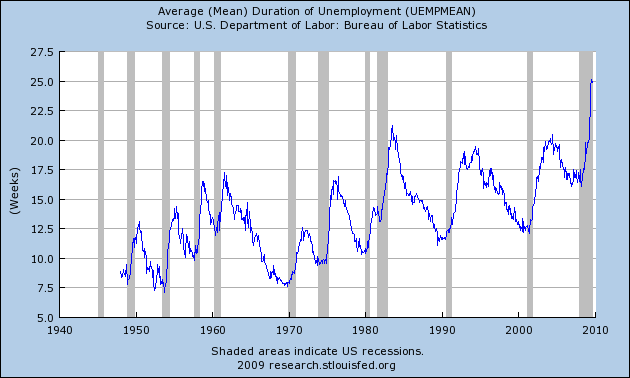
Since the end of World War II each time the business cycle throws a lot of people out of work it has taken longer and longer for them get back into the work force.  Six months at the present time.

UEMPMEAN_Max_630_378

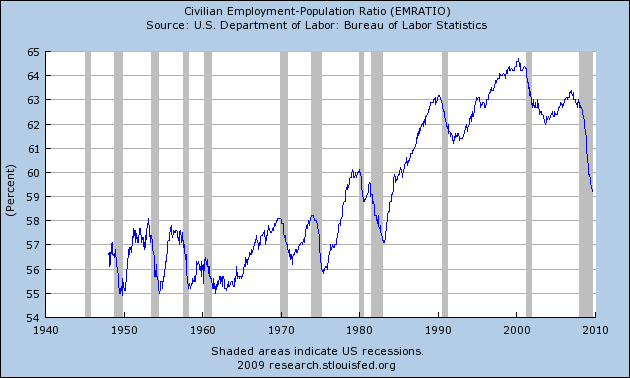
When the economic engine slows you get a recession.  It’s shocking how much labor is going underutilized right now.  This chart shows what percentage of the population is working.

EMRATIO_Max_630_378

These two charts aren’t looking at exactly the same thing.  The second chart is looking at the entire population.    The first chart is only looking at the slice of population which self identifies as participating in the labor market.

Incidentally and amazing is the big 20 year change (starting about 1975) was women entering the workforce so that another 7% of the population is now in the game.  But each business cycle pushes that along a bit more and the mix has changed, a lot.  Men have suffered 82% of the job losses so that now men and women are 50/50 in the workforce.  That’s a huge transformation of the society.  We now draw on the entire population, but the percentage of that population we employ is only up by a few percentage points.

Not illustrated here is the huge transformation in the wealth distribution since the mid 70s.  The labor force has crappier jobs than they did 40 years ago.

Note how the recent fall off is the largest in the post World War II era.

There is something else interesting to note in the shape V shape of each recession.  The recession in the mid-50s is uniquely symmetric as is the one in the 1980s.  The mid 1970’s recession tossed people out of the workforce fast, and the recovery brought them back slowly.  The recession just after 2000 is frightening.  How’s that for something to worry about!

You can make your own charts like this here.