 During the depression people hoarded cash with great vigor. Prices were falling. Employment was uncertain. it made sense to wait, if you could. And so, the velocity of money plummeted. Transactions deferred are equivalent to idle economic capacity; i.e. this kind of hoarding is codependent with a depression. Money is like oil in the economic gears, Drain it out, the machine ceases to turn over. When the economic machine seizes up the puzzle is how to keep the oil in the machine. Add more and the participants will just horde that as well.
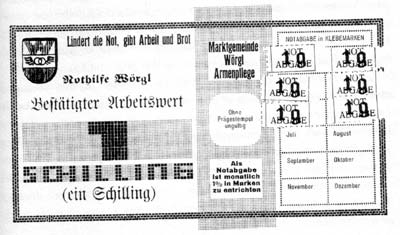
During the depression there were multiple experiments with trying to force the money out of hiding, to increase it’s velocity. For example: a village might issue scrip dollars, say by paying their employees with scrip. This scrip can be converted at any time to real currency at 3% less than it’s face value; or at full value after a year. So far this is just a local currency. The next bit is the clever part.
This scrip requires some maintenance. Once a week, on Tuesday at noon, you have to affix a stamp to the dollar note, and these stamps cost a penny. This creates an incentive to spend the bill quickly, so as to avoid the chore of affixing the stamp. There are stories of towns reborn after this kind of scrip was introduced; i.e. where entire area’s economy machine had ground to a halt and apparently all that was needed was to find a way to force the oil to stay in the machine. These notes and stamps are a currency with a negative interest rate. These schemes are a local version of the macro economic trick of adjusting the interest rate to control the unemployment rate. I.e. you lower the interest rate to force idle currency into use as it’s owners seek a better return. There is a nice little book, a pamphlet really, written in 1933 about these schemes. You can read it online: “STAMP SCRIP” By Irving Fisher (Professor of Economics, Yale University). It has some fun stories in it.
Charles Zylstra, the enterprising man who first introduced Stamp Scrip to America (in a small western town) tells this story. A travelling salesman stopped at a hotel and handed the clerk a hundred dollar bill to be put in the safe, saying he would call for it in twenty-four hours. The clerk, whose name was A, owed $100 to B and clandestinely he used this bill for the liquidation of his debt, thinking that before the expiration of 24 hours he could collect $100 from his own debtor, whose name was Z. So this 100 dollar bill went to B, who, greatly surprised, used it to pay his own 100 dollar debt to one C, who (equally surprised) . . . and so on, and so on, all the way down to Z, who, with much pleasure, returned the bill to A, the clerk, who, in the morning, restored it to the salesman. And then did A, the clerk, stand petrified with horror to see the salesman light a cigar with it. “Counterfeit,” said the salesman, “a fake gift from a crazy friend, Abner; but he didn’t put it over, did he?”
Many failed attempts to add money to the system using scrip are mentioned, but many failed because they didn’t include this trick with the stamp. This story is full of lessons:
In Evanston, Illinois, it was a merchants’ association that inaugurated the Stamp Scrip. They inscribed it with a new word: “Eirma.” This is composed of the initials of the organization name: “Evanston Independent Retail Merchants Association.” In this long title, the word “Independent” expresses the motive for the scrip; for what the merchants meant to be independent of was the shopping in Chicago instead of Evanston and at the chain stores which had invaded their territory. They thought they could, by an appeal to town loyalty, prevent the scrip from circulating among their rivals. Accordingly, after getting a sufficient number of consents, they printed $5000 worth of “Eirma” and “sold” it to the members according to their respective requirements – for paying their employees and dealing with one another. In other words, the local members put up a guaranty fund of $5000 which was held in escrow by a bank. Fifty stamps, at 2 cents, retired the scrip, which was to he redeemed by the “Eirma” organization. In this instance the banks in general did not cooperate. The bankers’ motive of loyalty to a municipal enterprise was lacking. Neither did the town offer to receive the scrip for tax payments. Nevertheless the town lent its moral support, as the result of a very ingenious bid which was made by the Eirma organization. It so happened that the town’s own finances were in such poor shape that it had been obliged to defray some of its expenses by means of “tax anticipation warrants,” later redeemable by the town in cash. So the Eirma organization agreed to buy these warrants with the cash proceeds of the stamps as fast as these should be sold.(1) Thus, when the redemption date should arrive, for the Eirma the redemption would have to be effected with the initial guarantee fund, not with the proceeds of the stamps. This would leave the tax anticipation warrants still in the Eirma treasury for distribution to the members according to their purchases of stamps. The net result, therefore, of the Eirma dollars amounted to a purchase on the instalment plan of tax-anticipation-warrants, by the members of the Eirma Association. But in Evanston there crops out the first unfortunate result of copying the Hawarden precedent (of making the stamps affixable, not at set intervals, but with each transaction). Evanston is a larger place than Hawarden, so that it is not so easy in Evanston to detect the small disloyalties of the citizens. Accordingly the chain stores made a flank attack on the local merchants by agreeing with their patrons to receive the scrip, without stamps, provided the patrons would receive them back without stamps. Therefore, at last advices, the stamps were not selling as they should. The Eirma organization now concedes the superiority of dated scrip, and would like to pass the whole enterprise over to the municipality.
It would be interesting, but I’m not quite able to yet, build the ties between these schemes modern private currency systems, i.e. things like gift cards, airline miles, and coupons. Some have the goal of increasing transaction rates, and some hope to decrease it. Clearly airline miles and gift card issuers are happy if the transactions never happen. Coupons, like the one I got from Paypal/Ebay for a 10% discount (CPPJUNE0810P good only for 7 days), are intended to increase the rate. These effects are disjoint from the localization/loyalty goals of such micro-currency schemes. Could you create a Internet payment system along these lines? Now that would be quite a hack! See also vendor selling old scrip notes, and a nod to John.
See also: Demurrage



 Mark Twain provides a disclaimer in the introduction to “