Dyslexia, another model and a therapy

I suspect my readers have figured out I suffer from dyslexia, well regarding that this work by Gadi Geiger, Jerry Lettvin, and others is thought provoking.

They found interesting visual test you can run to test for dyslexia. You have the subject stare at a dot a screen, and then you briefly flash a single letter in place of the dot. At the same time you also flash another letter a some distance away from the centered letter. You then ask the subject to enter the two letters. A series of these samples allows you to build a map of how the subject’s visual focus ranges across his visual field.

Not surprisingly people skill at catching that second letter varies with how far from the centered letter it appears. But dyslexics, apparently, tend to drop off more rapidly in near the center while they are better at catching the letters further off from the center. This matches up nicely with the experiance of dyslexia, i.e. that it’s difficult to see the individual words and one is often skittering about on the page noticing items that if you could manage your attention more successfully would be ignored. I also am amused by how this ties into some of the stuff I’ve been thinking recently about attention managment.

They also noticed that the focus of attention across the field of vision is shaped differently for people who read English v.s. Hebrew (which is read left to right).

They also noticed that dyslexics who have managed to learn to be effective readers, like me, will have one mode when they are attentive and another when they are fatigued. Boy I’m familiar with that syndrome.

Based on this test, and optimism about the plasticity of the brain, they invented a little therapy to try. They cut a hole in an index card so that only a dozen letters of text were visible and asked some kids with dyslexia to try reading through that window for a few weeks.  This turned out to be amazingly effective! Presumably it trains the visual system to attend more closely to the material near the point were your reading.

Update: Having attended a talk by Geiger it appears that description is missing a critical element; i.e. they also asked the kids to engage in an art/craft activity that involved fine motor and eye coordination.  Follow on studies have indicated this is a necessary component of the therapy.  Why exactly they included this complementary activity is unclear to me, but it helps explain why nobody stumbled on the therapy before.  Gadi suggested it was an intuitive move; possibly triggered by some studies done in the years before this.  Those studies showed that active hand/eye interaction made a substantial difference in people’s ability to compensate for the effects of silly goggles that did things like shift your vision six inches to the right.

I want to note that this approach doesn’t attempt to treat the cause of dyslexia. The visual field anomaly is a symptom and the therapy treats that symptom. Dyslexia has other symptoms, for example there are significant phonetic aspects which make it miserable to learn a foreign language, recall names, or repeat words you hear.

Reading thru a window also used in some speed reading schemes; see for example this demo of RSVP and if you like that try this this Firefox extension.

I wrote an emacs mode that simulates their index card.

Weak Governance

One spectrum you can map governance failures onto is too-weak/too-strong.  For example publicly traded firms often fail by excessive aggregation of power into the hands of the senior executives.  Since there’s no meaningful oversight because the shareholders are highly fragmented, disinterested, and not particularly loyal.  So over time more and more governance decisions default to senior management; and thenbad things can happen.

I’ve been thinking about this through the example domain of condo associations; using the examples Evan Mckenzie posts on his blog.  The too-hot examples in that sphere are condo managers who become little dictators.  I don’t doubt there is a great comedy movie waiting to be made about them.

Much more common I suspect are the failures of governance the too-cool kind.    Since I first read Evan he has come to be concerned that these associations often (almost always) a financial time-bomb. That almost none of these associations are prepared to deal with the huge costs that will arise shortly when their infrastructure requires costly repairs.  There are millions of these, because for example on my house is a two unit condo.  Though of course some of them approach the size of small cities.

Our little garage roof is an example of a financial time bomb.  We should have fixed 20 years ago but now it’s rotten and the whole thing will need to come off before it collapses onto the cars.  This ain’t going to be cheap and nobody I know is interested in volunteering to project manage the job.  A lot of these places were built on the cheap and sold fast, and in some of the big cities they sold off portions of the public housing stock to their poor residents.  When those roof fails the residents won’t have my resources to deal with the problem.  It’s a failure of my imagination that I can’t see the comedy movie waiting to be made about too little governance.

The in the condo associations the worse case scenarios of weak governance failures often require that the state step in.  If the condo is forced to fix the roof and then can’t pay for it the courts will put them in receivership and the receiver will send the owners a bill that will bankrupt them.  Here’s another example: the timesharing association was so weak that they didn’t pay their taxes and so the state sold the property.  Apparently they are still disputing who ought to have been notified before the sale happened, the association board, or the horde of people who bought tiny time share slices?

Image cacheing, chapter 2

Well actually more like chapter 11.  This problem has evolved into one of the problems that requires hours of focused attention and I don’t have those available.  I’ve turned it off.  Presumably this will some of the sites I host unusable slow for some people; for others it will make them usable again.

More presentation of self

Another addition to my collection of examples were members of a group sport something that reveals what others might tend to think of as private information. In this forum the members decorate their postings with information about their credit scores. Not unlike the folks that do the same thing with their due date or their weight loss progress

Here are three examples (at reduced size) of their badges.

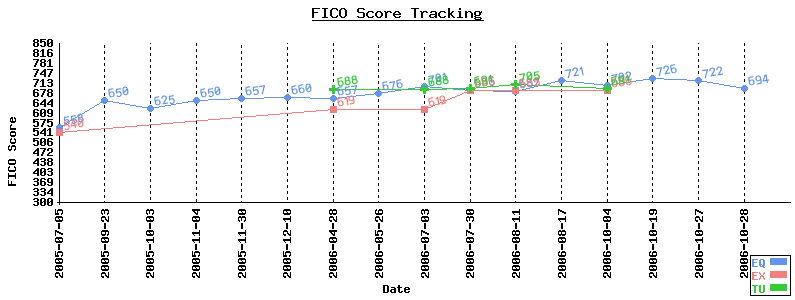
Some people show a chart of how each of the credit tracking firms is summarizing their credit.

credit_score_3.png

Some of them are using this service that provides them with a score card.

credit_score2.jpg

Others are using the same progress bar scheme seen on weight loss and event (wedding, pregnancy, etc.) forums.
credit_score1.jpg

Why can’t I feed my real time IQ into my IM status; or what my current credit card debt is?

Objection Handling

At the bank this morning they patiently explained their inability to do a particular thing what wanted doing because of “security.”  I had a flash back to an analogous experience at a bank in the early 1970s. Thought at that time the explanation was “our insurance company won’t let us do that.”  Both then and now I suspect the real reason was “our software sucks.”

Both excuses, insurance-company-rules and security-rules, resolve the question by introducing an immovable object into the discussion.  Using security is better than the insurance company because it implies that the immovable object serves our both the bank and my interests.

There is a whole craft of objection handling.

Caching troubles

I’m stumped; so this is a shout out to the lazy web.

For the some of the sites that I publish I load shift the bandwidth for serving images to another machine. I do this by having those site do a temporary redirect to images.redzephyr.net which serves the image from a cache. If it is not in it’s cache it pulls the image from the original server.

This scheme was working fine until image server was upgraded and moved it to a new IP address.

Since that change my the cache directory on the image server seems to slowly fill with images from which the first N bytes have been dropped. If I clear the cache the problem goes away for a while; but reemerges slowly but surely.

Meanwhile this is polluting the browser side caches of my users and I need a scheme to clear their caches. I have a lame scheme to do that (changing all the redirected URLs).

If anybody recognize what stupid thing I’ve overlooked?

ps. How to “Bypass your browser’s cache“.

DAIC DAIC give me your answer please

DAIC, which sounds like Daisy, is one of those BSchool/Psychology-Today frameworks I picked up at some point in my work life. It’s mnemonic for four roles that employee’s might play in the process of reaching a decision:

  • Driver
  • Approver
  • Informed
  • Consultant

Since entrepreneurs ran the organization inside of which I learned this particular framework they most loved the role of Driver; but in different organizations you tend more affection for one or another role. I have, for example, worked in organizations where the consulting and informed roles were dominate. Some groups do a fine job without one or another role. Some groups manage to get into a dysfunctional modality where two roles are in opposition and the others are ignored.

This model is pretty good, as these thing go. It gets better if you start to dig into the complexity of performing any one of these roles. That’s easier to think about if you add in a fifth entity; i.e. the decision being made.  Make it concrete: a proposal, a mailing list, a meeting, a plan, etc.  The players then rendezvous around that. That is pretty standard advice in the negotiation literature; e.g. that multiparty negotiations can only work if you rendezvous around a single text.

Once that rendezvous point, that single-text, is introduced then you can begin to see some very constructive things about how the role of each of the four kinds above should play out.

  • Driver: keep the text moving, enable others to succeed at their role.
  • Approver: own/disown, sign, accept, embrace, reject, comprehend, send back the text.
  • Informed: comprehend, monitor, and as necessary demand access to the text
  • Consultant: add value, critique, collaborate, network

Any of these parties can cause the process to fail by intent, neglect, or (more typcially) by misunderstanding their role. Any of these players can become quite powerful by if they play their role with skill.  Any one of these can be the dominate one in shaping the resulting decision.

By way of example; those in the informed role often presume they lack power to shape the outcome and think they have only the power to obstruct; and certainly that is one of the powers inherent in that role.  But you can do a lot of shaping by asking the right questions and assuring that your actually informed – that process can cause huge course corrections.

open voice networks

Martian speaks wisely about why open voice networks aren’t a technology problem but a social entrepenural one.  At the same time he is also talking about a minor aspect of why internet identity isn’t a technology problem.

These days I find myself thinking that internet identity is hard because the gap between people’s intuitions and the technology substrate is so vast.  In the real world privacy tends to be the default; in the virtual world it’s the other way around.  Saying we lack a substrate for creating privacy in the net is the worst kind of understatement; it’s a bit like saying I lack x-ray vision.

As he says we lack good understanding of what makes an open v.s. closed network.  Capitalists care about that, since closed networks have the potential to generate great wealth.  I care because there is a huge swath of tiny groups that can’t get the benefits of adding a virtual aspect to their existence.  For example the 3rd grade parents can’t put their contact list on line.  Which is killing these groups and that’s very bad for the social network’s health.

Groups, id cards & hub failure

Thought provoking: my morning mail reports that the ID card servers at the university are down and that this effects “card readers” across campus.  Reminds one that hubs are a target for assorted criminal activity.  I wonder what boundry crossings people are discovering they can’t make right now?

Meanwhile I’m told we citizens get our new regional transportation passes at the end of the month so that getting on the bus and subway will involve bringing the card into physical proximity of the toll collecting gates.  RFID I presume.  So this morning I wonder if that system has a central point of failure?

When you work on standards it’s always interesting how one constituency has concerns that another constituency has to struggle to appreciate.  That’s the real work.  In the early days of the Liberty Alliance one of these was how extremely reluctant, to the point that it had the potential to be a deal breaker, the web site builders were to add anything that might effect their reliability.  That’s a severe barrier to adoption for any identity provider.  It is very difficult for an identity provider to guarantee that the system administrator’s bonus will never be adversely effected.

If I can’t get into the pool today who will compensate me?

Big purses v.s. unbanked

Possibly last posting about the World Household Wealth Distirbution study.

First off I’m bemused by two articles in the New York Times.  One about giant purses:

“…clients old and new staggering under the weight of huge purses and griping about neck pain. “It’s an epidemic,” Ms. Ehrlich said. “We’re busier than ever before right now and big bags are the reason.”

A common side effect is that one shoulder becomes slightly higher than the other, she said. “A lot of women talk on their cellphones while they’re carrying these bags, which only intensifies the problem, because in addition to balancing too much weight on one side, they’re lifting the shoulder at the same time.”

Ms. Ehrlich recommends weekly massages for the pain. Gentle stretching and warm baths with Epsom salts can help bag abusers, too, she said. But she would never tell a client to ditch her Mulberry Elgin tote.

“It’s like telling a woman, ‘You cannot wear Manolo Blahniks,’ ” she said. “It’s just not realistic.”…”

One about giant planes.

“… private jet much like Air Force One, which is a 747. Each plane carries a list price of about $275 million. Boeing will not identify the customers, … personal use.”

Finally there is a note in the report that points out that zero is, of course, not the bottom of the household wealth distribution.  Debt allows household’s wealth to be negative.  Because most of the worlds poor are “unbanked” you need to go into the developed world to find the absolutely poorest households.  How’s that for a triggering a worry-some eye brow raising moment?  Since, the currently popular fad in this problem space is micro-finance.
