Regional Wealth

These highly skew’d distributions are extremely hard to visualize; you just can not get a feel for how vast the population of “other” is.  I give some examples of that in this previous posting, using people’s names as an example.

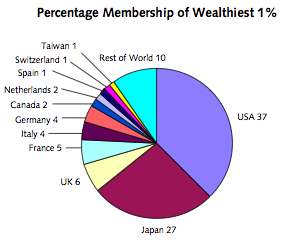
The folks that wrote the recent report on the worldwide distribution of wealth take a run at the problem in the usual way; putting the data into various buckets.  For example  they know that 40% of the total wealth of the planet is held by the richest 1% of the population.  We can make a pie chart showing were they live.  They live in the Europe, the US, and Japan.  In this visualization you can’t see the other, i.e. the vast majority of the world’s population, the other 99%; notice how China, India, Africa, etc. are all invisible on this chart.
wealthtop1percentworld.png

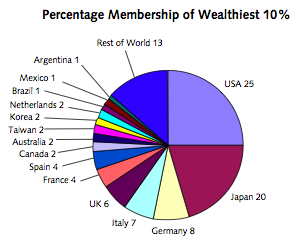
We could try to get a picture that shows these other folks by making a series of pie charts.  For example we might make ten charts each showing 10% of the world’s population.  For example this next chart shows the richest 10% of the world’s population; and where they live:
worldtopdecilepie.png

Korea, Mexico, Agentia, Brazil showed up; but still no sign of China, India, Africa, etc.    The report’s authors found a way to address the problem by making the chart below.  This chart displays a pile of similar pie charts.  The first pie chart above is the chart you get if you take convert the right edge of the chart below.

worldregionalweathshares.png

So this shows that India, Africa, and “Other Asia-Pacific” house most of the world’s poorest.

But yet the visualization problems remain.  Notice two things.  First, that 40% of the total wealth is held by a tiny tiny sliver running along that right edge.  Secondly, that these regional buckets are very misleading.  Even inside those regions only a very tiny minority of the population is wealthy.  See if you can figure out what slice shape denotes a higher or lower Gini for that region?
Productivity

screenhome-net.gifI predict the national economic statistics will show a substantial increase in worker productivity in the next quarter.

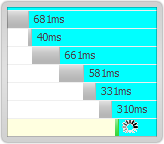
Why? The new beta version of Firebug shows clearly how long it takes for various web pages to load. I know of three web sites who’s load time has been improved by significant margins already and I expect we will see a speed up to from 5-10 across the board.

I predict data: URLs (see also) will suddenly become quite popular. Finally, we need an Apache module ASAP that automatically splices in data urls for small GIFs and css files.

World Distribution of Household Wealth

I feel duty bound to post about the recently released report on the worldwide wealth distribution put out by the “World Institute for Development Economics Research” at the United Nations University in Finland.  There is little in this report that surprises me.  Wealth is very skewed.  For example: “the study estimates that the global wealth Gini for adults is 89%.  The same degree of inequality would be obtained if one person in a group of ten takes 99% of the total pie and the other nine share the remaining 1%.”

The skew varies widely from country to country.  If there is some central authority in charge, let’s call him Zippy, Zippy might decide to reward some people with more wealth than others.  Zippy might pick any of an assortment of basis for his rewards: talent, birth, luck, effort, beauty, behavior, height, power, etc.  The Gini index is a metric of how big much Zippy decides to reward.  If he hands out no rewards then the Gini index is zero and the wealth is perfectly evenly spread out; if the index is one then he picks on person and given them all the money.
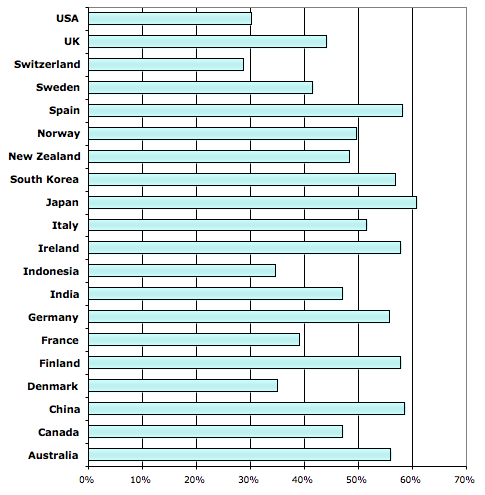
The chart below, derived from table 9 in the report, shows an alternate way to look at what Zippy has done in various countries.  It shows how much wealth the bottom 90% captured.
wealthshare90.png
Zippy likes the rich.  He really likes them in the US and Switzerland.  He’s a bit nicer to everybody else in some other countries, for example in Japan, China, and Spain.

Upsell Joy

RazrI bought a new cell phone with a year’s contract. It’s a cute phone. We like it.
The phone goes for about $200 on eBay, and after all the rebates are said and done I’ll have spend minus $50 dollars. The service is $480/year. So one way to look at is they paid me $250 to lock in $480 in revenue; e.g. to clear $230. That’s of course not quite right because Amazon, who sold me the phone, got a kickback, they certainly paid a few bucks for the phone and then of course there is a bit of cost to complete the phone calls.
It’s a perfectly nice phone, but it has a very slippery keyboard.

But now that I have this phone it is a study in modern telecom up-selling. The user interface is a rats nest of buttons and menus; and many of these offer you the chance to spend more money. There are at least three dozen places in the UI where you can spend a few more dollars. Here’s a short list of just a few of the stupid ways they try to get me to spend another few bucks:

  • Sign up for crippled web service (i.e. WAP). $6/month
  • Send an SMS.
  • Send a photo.
  • Call information for a phone #.
  • Get a weather report.
  • Get a sport’s score.
  • Horiscope

Just what you’d expect in an abusive locked in relationship, it’s obnoxious. It is far too easy it is for an unsuspecting phone user to randomly poke buttons and spend money. Twice already I’ve thought: “Damn, if I’d poked the button one over I’d have spent money.” I think the slippery keyboard design was intentional.

Ruling the Commons

I read this marvelous book, Privatopia, about Common Interest Developments, or CIDs, some time back. CIDs go by various names, condo associations, gated communities, etc. They are a form of government that lie in the vast gray zone between real government and purely private ownership; i.e. where the club goods hang out. One of the stories he tells is how there are a handful of constituencies at the table: developers, community managers, owners, service providers (lawyers, landscapers, agents), local governments, etc. That as time has passed the community managers have come to dominate the governance of the communities. They are little kings, and what they care most about is keeping a lid on things. I was reminded of that story when reading this newspaper article about:

DENVER, Colorado (AP) — A homeowners’ association in southwestern Colorado has threatened to fine a resident $25 a day until she removes a Christmas wreath with a peace sign that some say is an anti-Iraq war protest or a symbol of Satan…

…Bob Kearns, president of the Loma Linda Homeowners Association

… Kearns ordered the committee to require Jensen to remove the wreath, but members refused after concluding that it was merely a seasonal symbol that didn’t say anything.

Kearns fired all five committee members.

Kearns has since backed down, but the point stands… little kings.

Oh look! The author of that book has a blog.

Trait Transference

Consider this statement: “Alice says that Bob is lazy.” Is it better to summarize this as: “…Bob is lazy” or “Alice … is lazy”? The 2nd is very often better. Speakers mentions traits which reveal their own traits. What you say reveals your internal dialog.

So it’s with great amusement that I stumbled upon this paper. Trait Transference: Communicators take on the Qualities They Describe in Others. This paper makes a very similar argument, but the other way around. It argues that the dialog about others lays down the patterns that become the behaviors you yourself take on.

Who knows? Hard to run that controlled experiment! It’s a chicken and egg problem.

In either case, say nice things about other people – it will make you, or possible indicate you already are, a nicer person.

Meanwhile let me just say that you are very sexy!

Self Interested Politics

While it is a fascinating political science question exactly how the Democratic Congress should deploy their resources over the comming months, here is an idea that’s close to my own trade.

One of the first things I’d like to see would be hearings on the Hill about Japan and Korea and Finland and who knows what other countries being 10 times as fast in broadband as the U.S., with far more uptake. Who? How fast? How did they do it? What of that can the U.S. apply? What advantages does the U.S. have that those countries don’t?

Great idea John!

update:

If you’re looking for the future of telecom, don’t search within the US telecom industry. It’s not hidden here anywhere. I’ve looked. –via Martin

Yield Curve

Through history there has been many ideas about of how to value the future. I particularly love one of these ideas that the interest paid on borrowed money is the compensation you pay the lender for his pain in forgoing the pleasures that money could have purchased him.

In any case modern financial market have numerous schemes to allow you to price a bushel of corn or money at some point in the future. If you borrow money, for example, you pay interest. Interestingly if you borrow money for a year v.s. ten years you don’t pay the same interest rate. Sometimes you pay more sometimes you pay less. If we plot these various interest rates we get what’s known as the yield curve.

There is a very cool applet showing the yield curve for the last few decades in this magazine article.

The shape of the yield curve is a market signal about what people think the economy is going to do next. Short term rates go up when there is lots of demand for cash, i.e. their are lots options for investing your cash that will bear fruit quickly; i.e. the economy is hot. If at the same time the market collectively senses that economy is going to cool down, i.e. there aren’t good long term investments to be made, then the near term cost of money should be higher than the long term cost. That’s the case right now.

Presumably this means that investors have their attention focused on short range opportunities v.s. long range ones. When they look at longer range investment opportunities the see uncertainty and so they put their time into activities that can be wrapped up in a short, presumably more predictable, time frame.

The yield curve is the market signal that tells us what the investor class is thinking about the future; with the consumer spending and confidence tells us what they are thinking. The market signals says that we live in an uncertain world. Who knew?!?

No-knead Bread

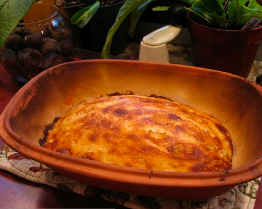
The New York Times has brought all the food blogs into sync with an article posted last Wednesday for a no-knead bread. It’s been fun reading various news groups, mailing lists, forums, and blogs as they take the recipe out for a spin. It’s a fun technique.

I think the most amusing posting though was the one pointing out that the New York Times wrote a very similar technique, giving credit to the same baker and bakery back in 2004.

Jim Lahey, who owns Sullivan Street Bakery in Manhattan, recommends placing an enamel-covered cast-iron pot and lid in the oven at 500 degees for an hour (creating plenty of ambient heat), then lowering the dough into the pot on a parchment sling and covering it. — Proper Tools for a Perfect Loaf by Kay Rentschler, New York Time 25 May 2004

Though in that version the bread is dropped into the iron pot on a sheet of parchment. Which strikes me as a better approach; since the dough is so wet it’s almost impossible to keep it from soaking into the towel you rest it on for the second rise.