Digital Footprints

The Pew center has printed up a 50 page report on their survey results regarding online privacy and how people perceive and act upon the issue.

It’s always fun to see the category names that get manufactured for these kinds of reports.  They have four:

  • Concerned and Careful
  • Worried by the Wayside
  • Confident Creatives
  • Unfazed and Inactive

I wonder what the flows between these categories look like.  If member of the category Unfazed and Inactive starts a blog does he then become a member of Concerned and Careful?
I’ll need to read it more carefully, skimming it I don’t see anything too surprising.  Which actually surprised me.  To a degree it’s hard to know what to make of the data.  Things are changing so fast.  Surely opinions about this fast moving landscape aren’t particularly solid.  In fact I’d say that most people opinions about online privacy are surprisingly random, including many folks who are quite deeply involved in the net.

These days I think the nature of public opinion about online privacy is up for grabs.

Executive:Manager:Worker

Here’s another trio.

  • Executive = Declarations: bring forth, generate something new, lead.
  • Manager = Requests: please do x by time y with condition of satisfaction.
  • Worker = Promises: deliver competent performance in a domain, over and over.

I lifted that from here, but it smells like management faddism.

Chasing links we get this little table:

Executive – Manager – Worker
Lead – Lobby – Legislate
Future – Present – Past
Declaration – Request – Promise

whatever.

Legitimacy

3cards.pngNew category, groups of three.

For example. Weber’s three basic legitimation’s of domination:

  1. The authority of the ‘eternal yesterday’.
  2. The authority of the extraordinary and personal gift of grace, aka charisma.
  3. The domination by virtue of ‘legality,’ e.g. rule based and professionalism.

I should have started this category years ago, say when I wrote about my affection for having three models.

Too hot, too cold, just right?

I like threes and I’m currently quite interested in how we manage (pilot?) our attention. How we make our choices. how we decide what to do.  So I liked the intro to Kahneman and Lovallo’s 1993 paper on how “decision makers” go about their work. The paper is introducing a behavioral model for that, but the introduction briskly suggests two others to get things going.  So I get my threesome.
First, the rational man model presumes we reach into at our basket of risky alternatives, gambles, and carefully withdraw the one with the maximum expected utility. This process involves a lot of quantitative statistical talent coupled with stellar data sampling. It’s has a kind of chess club tone to it.

Amusingly few professional decision makers sign up to that model.  Rather, they talk of their skill, prudence, focus, and self control.  That’s all a process involving a lot craft knowledge.  It has a kind of top flight athlete tone to it.

Model #3, that Kahneman and Lovallo put forward, is cognitive. In crude form it argues that we pull our decisions out of a thicket of cognitive failures.  They broadly sort those into two camps. We shun a range of decisions because we are too timid, while on the other hand grabbing those about which we are excessively bold. This treats the decider’s free will in a more nuanced, more respectful of his animal nature.

So there you have it, three models of how we make our decisions:

  1. Selecting choices to maximize expected outcome.
  2. Deciding based on determined skill.
  3. Course selection via a lousy rudder that’s simultaneous too bold and too timid.

availability entrepreneurs

images.jpgIn popular usage the entrepreneur is a scrappy individual who creates by his sweat and passion a new business and since sweat is moral his wealth is admirable. Usually one must be suspicion that his wealth is due to one of the other four less moral ways. But, that isn’t actually a good definition. The entrepreneur is actually the agent of creative destruction. He builds new institutions. Since in many cases those displace existing institutions this work is often adversarial. He’s a change agent. For good or bad since act of change is ethically neutral. Further the entrepreneur is usually assumed to be a leader; a coordinator at the hub of the new institution which is emerging. I think that’s probably far too limiting; I don’t see any reason why we shouldn’t grant the attribution to many many more individuals involved in the emerging institution. Personally I have no trouble treating most of the members of the group that manages to establish a new institutional form the title. For example the engineer or marketing people who craft their portions of these new institutions are doing difficult entrepreneurial work as well.

The problem of how to manage (build, displace) institutions is important. Entrepreneurs are key players in that. I’d rather not see the title tainted with the presumption that the change agent’s primary, and possibly only ethically plausible, motivation is his exit strategy through a liquidity event. That would be silly, but it’s also a common misunderstanding. More functionally, ignoring all these other variations is a handicap, it blinds you to their methods.

I yearning to see the word entrepreneur given a broader and more nuanced meaning so we can apply to a wider range of institutions and professions. I raised my eyebrows when I saw this phrase: “availability entrepreneur.” It’s used in this bit of climate change advocacy. The advocate is pushing to continue the status quo – of inaction – but that’s not the topic at hand.

I guess you might guess that an availability entrepreneur strives to create new ways of managing the supply chain. I know a few of those. Or maybe they would be people working to create better pricing models for that impulse borrowing shelf at the public library. But no. You can see the roots of that usage by looking up the phrase in one of or another of the scanned book collections. The availability entrepreneur is a sales and marketing actor his goal is to convince you to join the institution being built. He tells stories that increase the chance his institution building goals are achieved.

It is a possible Cass R. Sunstein introduced the term. In a book published in 2000 he wrote: “‘Availability entrepreneurs’ will thus focus attention on a specific event in order to ensure that this event will be salient and available to many members of the public.” Availability is a psych term, it’s a sophisticated name for the children’s game: “Don’t think about elephants!” It names the tendency we all have to solve problems using what is at hand; e.g. Got a hammer? Well, problems come to look more nail like. ‘Availability’ is a fact of life, it is usually treated as a source of cognitive failure in the literature. Practical people manage it. For example when building a team one of the questions you keep asking is what skills should I be adding or subtracting – which is all about about availability (as well as flexibility and budget).

So this is cool; these entrepreneurs aren’t good guys. The preceding sentences in Sunstein’s work illustrate that: “Interested actors in the private and public sectors can be expected to exploit the availability heuristic for their own purposes these actors are amateur behaviorists, operating strategically to promote their selfish or nonselfish goals.” They are suspicious characters, how non-standard is that! You can poke around in his book, which is fun.

At this point I find myself recalling the term I took away from Tilly’s work on collective violence, e.g. “violence entrepeneur“.

Somebody was poking me recently to opine on the question of displacing Facebook with something less owned, less evil, more open, more community-ish … well something like that. I was surprised that my first thought was how you would need to focus on breaking off groups from the existing network. That one of the tools you’d use to do that would be too weaken their ties to the Facebook network by – to use the framing above – raising the salience in their minds it’s risks. That you could then begin to break them these groups with the help of a bit of further polarization, and obviously some carrots.

That kind of awareness of risks inherent in the existing network is all we got out of the anti-trust case against Microsoft. Developers became more aware of the risks associated with participation in that network. Managing that perception is a part of why Google used too make a point of their “do no evil” motto. I have heard Google people say publically that motto may have been a mistake, and I think Facebook has been more transparent about it’s risks in a way that helps to immunize it – to a degree – from the accusation that you can’t trust them. It’s curious how few people who participate in Facebook seem to be resigned about how the network owner will abuse their trust. That’s a pattern that’s not uncomon with the customers of monopolies.

I think I’ve become more conscious of how the entrepeneur working to create an alternate institution is always forced to devote significant resources to making the risks of the existing network more apparent and in turn diving into the midst of the community and polarizing it so they can weaken and break of portions. These same methods seem to be needed if your don’t intend to create a fresh institution but only hope to create change in the existing one.

I can’t resist taking a swipe at that piece in the New York Times. Boy have we come a long way. A few years ago the advocates of inaction on climate change would accuse their opponents of being a hysterical herd of unreasoning who’s pseudo-science was little more than a lie. Today the best they can do is to suggest that a modicum of accessibility entrepreneurship maybe unfolding in the media. And yet it remains the same rhetorical tactic, and in this presentation it is curiously rich with projection.

looking at you

mirrorglasses.jpg“A picture showing a pair of eyes attached to a cafeteria collection box significantly raises the donated amount compared to a flower symbol…” Teehee. Presumably the eyes trigger a reframing; the contributors situate their choice in a different context. A more social one? That effect what ever it actually is might be a portion of what people are reaching for with all those damn TV cameras. “Totem poles put up in villages in North America several hundred years ago standing vigilant at attention, with ever-watchful eyes.” It’s got associations with the managerial tendency to over value close-monitoring (“the cleaning wrasse fish grooms its client fish in the friendliest way when other clients watch, but without an audience it prefers to bite off pieces of its client’s skin”) and the rationalizations used to justify the cost savings inherent in cubical office layouts. It reminds me of the way that a smiley face on the check increases tipping. Important because apparently almost anything on the check increases tipping, including a credit card logo.
Let’s be simple minded and say that people have only two modes of behavior, the one they adopt when watched v.s. the one they adopt in private. How would we determine which of these is more authentic. Maybe this pair creates something that’s more functional than either one alone would be. That mimic’s my presumption that the constraints of group membership generate value that overwhelms their costs on personal autonomy.

There is something here about the difference between gossip and spying. Gossip is about passing private information about a 3rd party outside their oversight. Spying is the collecting of that data. What offends (or frightens) about gossip is the fear that your story will be told poorly. What offends (or frightens) about spying is that you do have two modes and you certainly would have adopted your social and public one if you’d known others were watching; we would have presented those of our many persona that was appropriate to the group in effect.

The mirrored sunglasses are rude; they are spy gear. At the same time they make the wearer appear aloof. They signal that he is not a social participant. That marks him as an outsider.

Popovers

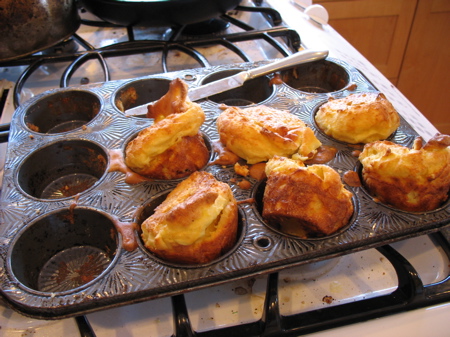
Back in college one of my schemes for impressing the women was to make popovers and more recently I have received (indirectly) a request for instructions. So.

1228popovers.jpg

My mother made this recipe for Yorkshire pudding; and in that variation you eat them with roast beef covered in gravy.

They are mind boggling simple. In a hot oven, 400F degrees say (convection is good too), you heat the muffin tin.

For six you mix: 1 cup milk, 1 cup flour, and 2 eggs. So, of course for 12 you double that; or you can also make 12 smaller ones.

Once the oven and tin comes to tempurature you cut table spoons of butter into quarters and place one bit into each tin to melt. Then pour in the thin batter and cook for 30 minutes.

Some recommendations that I follow but don’t actually put much faith in. When they come out, poke a hole  in the top of each one with a knife so they can crisp up a bit. Have all the ingredients warm before you start, i put the cold eggs into a bowl of warm water and microwave the milk a bit. Don’t obsess about how well mixed the batter is. Let the batter sit for a bit before you use it, but not more than an hour.

Taming Gorrillas

My thoughts keep turning to this effort by the publishers to update the robot exclusion protocol, i.e. ACAP. The current situation with the robot exclusion protocol certainly doesn’t look stable. We are going to get a revision, or substitute to that protocol. But who has the market power, the legitimacy, the technical and legal chops to create one? It just makes your brain hurt!

I think you could say … the current protocol is works. But why? A combination of factors? A gentleman’s agreement (that doesn’t sound stable). A concern that failing to conform would blacken your spider’s reputation. Why wouldn’t search engines wouldn’t associate with such spiders? That the protocol appears to work is surprising. These are very weak drivers.

It’s a great edge case in the world of protocols. It isn’t technically or legally enforced. It is impossible to enforce it technically; and any attempt to enforce it legally would rapidly bring a lot of issues out from under the rug.

It is a case study in the general problem: how to tame a pure public good. In this case information. So the usual circus of issues come to play. “Pee in the pool.” “Information wants to be free.” Copyright. Trade secrets. Privacy. Good manners. I guess it’s possible to imagine a perfect descendant of the robot exclusion protocol what would all me to mark a communication with some metadata that states exactly what purposes I license it for going forward.

Marking pages with permission metadata is exactly what the robot exclusion protocol is doing. Off to one side it says “sure index this” v.s. “no peeking!”. In that way it is almost identical to a copyright license, plus the convention that spiders tend to know where to look for it.

I suspect that something like ACAP is inevitable. I suspect it’s inevitable that the tie to copyright licensing will be strengthened. Spiders can look forward to some regulatory arm twisting.

With the big wealthy content owners on one side and the big wealthy search engines on the other it’s going to be fighting gorillas. That can’t be avoided. A shame really, given the ties to the privacy problem. Since it is tempting consider using copyright law as a lever in licensing limited use of one’s personal data.

Update: Andy Oram offers an interesting perspective.

Income Trends, by State

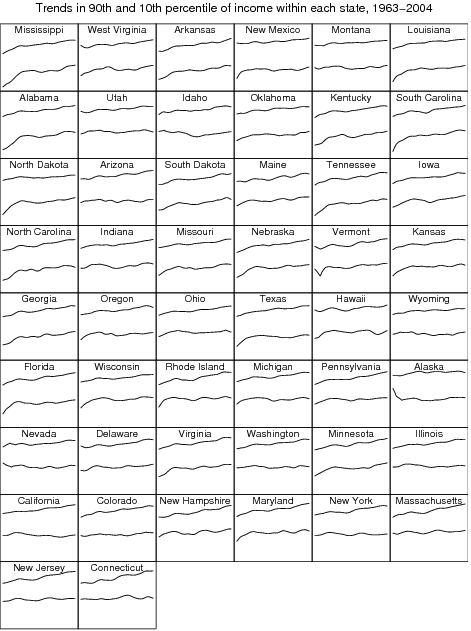
This chart is so cool, that I can’t resist in-lining it directly; I hope it’s creator doesn’t mine. The states are sorted poor to wealthy, vertical scale is log of constant dollars. The upper lines are the median income of the top 10% while the lower lines are the bottom 10%. Horizontally shows 40 years. If the lines grow closer together, as they do in some of the poor states, income inequality is declining. Contrast that to some of the wealthier states. Note that there are a number of reasons arising from the highly skew’d distributions involved that make this chart a poor lens for viewing the data. For example, most of the population lives in just the few largest states (51% in the top 9) and most of the income is actually captured the top 1%.
income_trends_by_state.png

Click thru to the original posting for some additional charts that play with this data set.