 Tim Oren sees a “studio model” emerging for Facebook Applications. Interesting thought.
Studio Model
Leave a reply
Tim Oren sees a “studio model” emerging for Facebook Applications. Interesting thought.
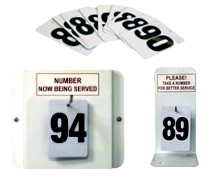 Waiting the other day my thoughts turned again to coordination problems, since I was thinking about how the store needed one of those take a number, now serving schemes. I don’t think I’ve seen a scheme like that in a software system, wonder why? Wouldn’t be too hard, in the abstract, to add one to HTTP. It would be a slight variation on the temporary redirect. The server’s redirect would include the number, along with a time to delay before the retry.
Today I was tinkering with a Freebsd installation. It includes a tool that fetches system updates. The instructions advise me to invoke that tool in a mode that forces it to do a random delay before it actually fires off. This is to avoid having the entire installed base of systems hit their upgrade server at the top of the hour. It’s brittle since it depends on the users to use the right mode. A scheme like the one above would avoid that risk, and it would could be used to help the server tune the load so it can run flat out when the bursts of users show up.
It is almost possible to do this without changing the existing HTTP spec. For example you set up a Rube Goldberg device with three servers. One to hand out numbers, one to queue up users, and finally one that actually provides service. Say you want to sell concert tickets on a first come first serve basis. As buyers arrive at your server you redirect them, providing a number, to a second server. This server has only one purpose in live and that’s to make them wait. A HTTP server configured to do that for a huge number of users is a bit odd to set up but it’s not particularly difficult. This waiting server finally redirects them to the actual selling server at the appropriate time. The nice thing about this approach is that it removes the incentive for buyers to attempt to poll as fast as possible.
Curious, I’ve mentioned take a number systems before (includes more amusing picture).
End to end encryption should be the default, but it’s not. So, I find it interesting to look for the drivers that might change that. What will create strong enough demand that it will become unacceptable to ever allow any data to move thru public networks in the clear?
Fear of identity theft is one such driver. A significant portion of the public lives in fear that their identity is at risk because we regularly hear reports of data that has gone missing in transit. Public fear raises the temperature; but it is a very diffuse driver.
Recently the US congress has been rushing to pass a bill that might create another driver. Unlike the fear of the general public this bill should scare all of us who move bits around. Who are these intermediaries? Well of course it’s the telecommunication companies and the internet service providers. But, it also all of us who kindly let random visitors use our internet connections. So if you ever let a visitor to your house use your Wifi you are at risk. The stick in the bill is a huge fine; 150 thousand dollars for the first offense, and 300 thousand dollars for the second offense.
The kindest way to describe this bill is that if you witness a crime and then you fail to report it you maybe fined. For example say you glance at your logs and you see some suspicious behavior. The bill requires that you report that suspicious behavior. It’s slightly more specific, having a focus on child porn, but it’s also extremely weak on exactly what amounts to suspicious.
My point is not to point out what a obnoxious law this is, but rather to point out how this creates demand for better encryption. I want a toggle I can throw on my wireless access points that says “Pass no data in the clear.” Since with such a toggle I can then assert there is zero chance I even had the opportunity to observe the crime.
I think that’s neat. A driver for a better safer default that targets the intermediaries. Since I think they are the folks likely to be able to change the default I think this law offers up an interesting class of moves in the game we are playing. It leads me to a more general question. What can we do to create incentives for intermediaries to drive the defaults toward safer settings?
The first sentence reads:
It has long been known that dyslexics are drawn to running their own businesses, …
This is bull. Speaking as a practicing dyslexic it should say that dyslexics are driven into running their own business. The rising idiocy which is the meritocracy movement drives out of the main stream talent with any learning disability that runs counter to their fetish for testing.
That’s my opinion. I have experience; and I have considered numerous hypothesis over the decades. Many of which I’ve discarded and some I still nurture. I certainly don’t have data from well run experiments. This article, in the New York Times, pretends it’s reporting a legitimate conclusion. But yeah, the article stands upon the result of one question in one survey of small business owners. Here’s that result:
35 percent – identified themselves as dyslexic
And it’s off to the races … the author, and possibly the researchers doing the survey, decided to adopt the Pangloss position. Sweet of them. They then called around and collected quotes from various successful dyslexics. Who, understandably, got with the program. It is certainly in our best interest to pump up the impression that we bring some secret talent to the party, and no doubt we do. But, it ain’t got nothing to do with some magnetic attraction to running a business.
I did take some delight in reading between the lines. The various “dyslexics speak” pull quotes are a study in one of the talents dyslexics have; that most anything they say has layers of hidden meanings. I enjoyed the subtle undercurrent of bemusement at the invitation to play into this farce. The best is this quote the article ends with; I’m quoting this a bit out of context but this is from the last quote in the article:
Actually, it’s baloney. But that’s what our marketing people came up with.
Exactly.
This is a delightful sentence:
I have a T-Mobile cell phone, which uses GSM technology; it works all over the world – and in parts of New Jersey. – Paul Krugman
It’s delightful, of course, because New Jersey is the home of Bell Labs. Paul’s posting is a short musing on the current state of play in the standards battle about cellular phone. He’s sense is that European standards practice appears to have bested the Americian ones at this point. Maybe so, I tend to agree.
There are lots of aspects to this story. For example an interesting one is how American standards practices appear to give us the upper hand the computer industries standards battles. While it is my impression that the European approachs have given them the upper hand in industries that are evolving more slowly. Another aspect of this is an American affection for that oxymoron: multiple standards. That tends to blind us to the winner take all nature of these things – these are standards battles and wars, not competition in the commodity market sense.
T-Mobile positioning in the US market is as a second or third tier player. The different vendors in the US have core markets which overlap less than one might expect. T-Mobile’s focus is on down market urban customers. Their network’s coverage is great in cities, and pretty lousy in the suburbs, and it’s useless in the country side. You become quite aware of that if you use t-mobile’s cheapest offering, prepaid, as I do. If you take the path of least resistance (monthly subscription/lock-in, loss leader phone, 2 year contract, screw you occasionally on overcharges) then you get access to the emerging AT&T GSM network; which has more coverage. Though still it’s useless in rural locations.
GSM was designed with a higher population densities in mind. In Europe those higher density venues aren’t as down market as they are in the US.
The virtual antique typewriter museum is a delight. This example was built at the very end of the 19th century.

Notice that it has cylindrical type ball. This same vendor also made an electric version. That one had a lock. I wonder what the salesman would say about that lock and key; kind of bad actor, waste, or impulse that lock and key where intended to address.
The teletypes like those I used when interacting with a timesharing system back in the 1960s has a cylindrical type head. They could also read and write a punch tape. You’d use that to prepare data before making your phone call. I used to carry a carefully folded punch tape in my wallet to initialized my sessions.
I like to call my cell phone pda “my box of daemons”. Maybe I should call my laptop “my secretary”. While neither have a lock and key; they have lots of passwords instead.
I have a great affection for agents, middlemen, deal makers. They sit at the hubs, build the bridges, keep the traffic flowing. I get a cranky when people who have never made a deal, built a bridge, or created a new solid connection betwen two diverse things start whinning about agency problems.
So my ears perked up at this bit over at Talking Point’s Memo. This appears in a quote from, we are told a very shrewd Republican. He’s reacting to the other evening’s Republican presidential debate.
Mitt Romney, just to try to figure out what he is thinking as he goes through this process. I don’t really know, but here’s a guess: to Romney, getting elected President is a lot like putting together a business deal. The details of getting the deal done matter, because the deal doesn’t happen without them, but the main thing is getting the deal done. I think Romney has personal beliefs, but not political principles; he wouldn’t do anything in this campaign that would hurt his family or someone he cared about, but he’ll change positions the way most people change socks. Whatever it takes to get the deal done.
Getting deals done is real work. It has it’s own ethical framework. I like to say that middleman’s problem is that he has to love both sides. Which can be hard because the sides don’t love each other; if they did you wouldn’t need to build the bridge. That makes the middleman appear two faced, since each side finds it deeply suspicious if they find out he likes the other side.
As an aside. My saying “love both sides” isn’t actually right. The middleman has to adopt some attitude about both sides, maybe not even the same one. He can hate them both for example. He can be delighted by one, and have high respect for the other. There are lots of choices.
I think that insight about Romney is reasonably correct. The presumption that he will do anything to get the deal done. I don’t know about that. I suspect it maybe right, some deal makers anchor their ethical house on the foundation of maximizing deal flow.
That said I think Romney also has a streak of boarding school brat. Poor adult role models combined with a arrogant attitude about the kids off campus. A tendency to think the uniform makes the man. I firmly believe his attitude about the voters is he doesn’t particularly like them. They just keep getting in the way of closing the deal.
Good politicians, i.e. the ones you should support, like the voters. One at a time, in groups, and all together.
 Good map showing where the world’s oil is. Hope that clears up some of the confusion.
It is worthwhile to compare that to this cartogram showing the crude oil exporters.
 As if he were reminding himself of a fish that got away the speaker spread his hands wide apart to suggest how much discovery remained before it would be practical. He held them closer for a second technology. Turning them from the horizontal to the vertical he spoke of the engineering work. He was answering question about what was needed before commercialization, spanning a big imaginary box of risk.
He was wrapping up his talk. I had come to hear the next talk about deep water windmills for electric power generation. The day’s topic was energy, the track was renewable energy, and the talk about windmills at sea was pure engineering. Hardly a wiff of discovery is required. I got the impression the only hard part might, and even this wasn’t clear, making the turbines robust over a 20 year life span when they must stand one or two hurricanes each year. The speaker appeared convinced that he can deploy these for a cost commenserate with current natural gas fired electric power plants. That’s delightful news.
I like that one would measure the amount of discovery v.s. the amount of engineering in a scheme. Wet fish and hand spans seem like a good framework.
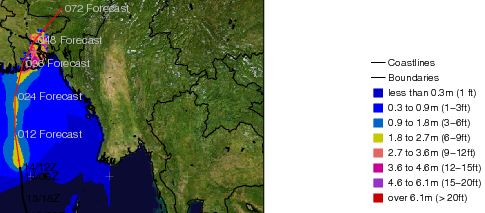
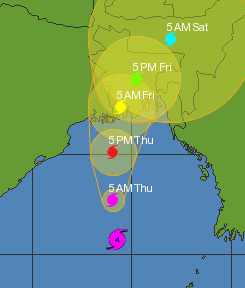 This is horrible. Tropical Cyclone Sidr is forecast to hit the low lying and extremely densely populated regions of Bangladesh. The track shown at right will bring the worst, right side, of the storm over the area. The storm is currently a category 4, and is forecast to weaken a bit before striking.
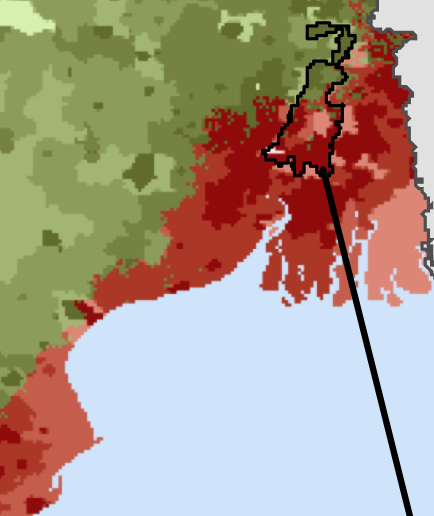
This is an amazingly densely populated region. The next map shows the low lying areas in reds, and those over 10 meters above sea level in green. The deepest colored areas have over a thousand people per square kilometer. Dhaka, the urban center here, holds 12 million people.
This next chart shows the forecasted storm surge, i.e. the water pushed in front of the storm. It’s small but the only comfort to be had is the storm surge isn’t 10 meters, but only 4-5.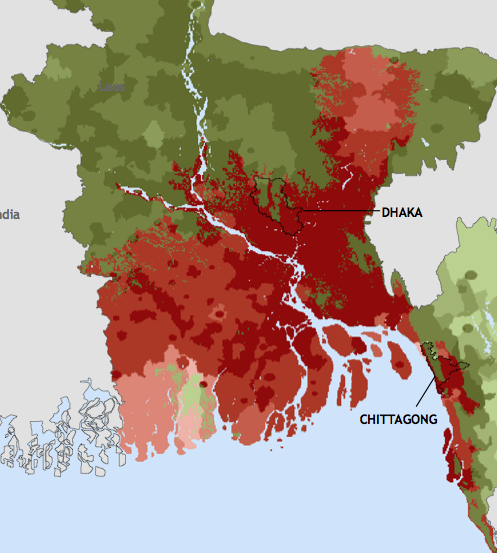
This is extremely similar to the cyclone in 1970 that killed a half a million people, lead to a civil war, and the founding of Bangladesh (formerly part of Pakistan).
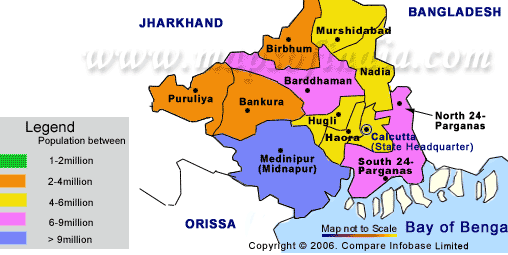
Finally this next map shows the population of West Bengal, the area of India that borders Bangladesh. This area includes Kolkata, the planet’s eight largest urban area (14 Million people). The next map is like the the one above, but for West Bengal, with the outlined area showing Kolkata.