Category Archives: politics

Concentration of Wealth

This just makes me sick. The report linked to below followed the money back to figure out who was funding the campaign to repeal the estate tax.

…the families identified in this report and their companies’ political action committees have, since 1999, made at least $27.7 million in contributions to candidates and federally focused political committees, largely to unregulated Section 527 committees.

Collectively, these super-wealthy families have a net worth of at least $185.5 billion. They include 23 billionaires, each of whom is listed in the Forbes 400. They stand to save $71.6 billion if their repeal campaign succeeds.

Nice return on investment.

Health Care Coverage for Uninsured Americans ($34 to $69 billion).

More here (pdf).

Meanwhile in California:

The top 3 percent of the returns, those with incomes exceeding $200,000, paid about 60 percent of all state taxes. “What happens to the top 1 percent is of great interest to the Department of Finance,”

As we can see the feeling is mutual.

Focusing Diffuse Rage

I found this posting just fascinating. Recall that displacement is an economist’s word for that moment when you wake up and discover that your job, community, culture, etc. have been displaced by some alternative; typically through no fault of your own.  Some examples. The hurricane floods your neighborhood; Home Depot sucks the life out of your family’s hardware store. The landlord decides to displace tenant farmers off lands they have occupied for generations.  That was this original example, he was make way for more profitable sheep.

The victims of displacement react with rage.  “The rage of the small property holder – the peasant, the artisan, the stall-keeper – against his inexorable ruin by the competition of bigger capital is given a face … to hate: a physical particularity that stands in thought for the abstractions of ‘finance’ and ‘the market’ and ‘the banks’.”

This rage can be a powerful tool for shaping group solidarity.  What the posting illuminates is how the rage often lacks a focus.  If your neighborhood has been flooded by the hurricane you can quickly to organize the citizens into a posse, but you can’t get a rope around Mother Nature’s neck.  Potent rage versus a diffuse unnamed other makes for a, ah, interesting situation.

Clever social activists will work to assure the group’s rage is dissipated.  They directing the rage toward an available target.  Consider some pairs:

Tragic suicide at the high school?  Focus the rage to invigorate the after school activities?

Traditional society finds it is being displaced by more modern and economically vibrant societies.  Focus the rage on first world nations and their citizens?
‘The Jew’ has often become the focus of this rage, as the quote above goes on to say. Rage seeks a concrete focus. Displacement rage often grows and festers until it finds a focus.  Political actors know this. The rage is an opportunity to solve problems.  But the rage is also dangerous, since it might turn on them.  You can’t hang Mother Nature, but you can hang the Mayor.

Bush et. al. refocused the rage against terrorism (a very diffuse threat) onto Iraq.  They were acting as perfectly rational political actors.  They believed was a constructive goal.  But they also saw the risk the rage would focus on something they cared for, say Saudi Arabia.

The posting goes on to suggest that the displacement rage of the Left has yet to find it’s focus. Personally I think Republicans are a fine focus. Republicans are the new Jew.

Newton’s immovable installed base

Here’s a fine example of the tensions between an irresistible force v.s. an immovable object.

At some point in my childhood my father, presumably in an attempt to keep me from wasting a summer in idle pleasures, got me an unpaid job working with a locksmith. I really enjoyed it, though I never did get the hang of picking locks. One thing I loved about the job was all the paraphernalia. One of the principle artifacts in every lock smiths tool kit is a box of pins. These pins are tiny bits of brass all of various lengths. They were color coded so you could put them back in the case.

These pins are packed into the lock so that when the right key is slide in they align just right and the lock will turn. Sweet little springs push the pins back into place when the key is removed. Each spring sits in a hole and the hole has two pins whose length sum up to fill its column just right. A lock with a master key will have three pins in one or more of the columns.

Locks of varing sophistication modify this design by having the columns oriented in various patterns. The typical lock just has the pin-columns in a straight line. If you look at your key ring you’ll probably find at least one key who’s bumpy bits are set up in some tricky way. Complex topology makes it harder to pick the lock; or at least that was the idea.

The design patterns for key-and-pin locks form a the plaform for a huge installed base of locks and keys. So it’s a great standards story and like all standards used for security things get messy when a security flaw is revealed. The usual exemplar of that is Microsoft Windows, which was never really designed to be secure and now sustains the vast cyber-crime industry (said to be larger than the drug trade).

You can’t ‘just fix’ a system like this because the installed base is very slow to move. As Bill Gates is rumored to have said back in the 1990s, “My biggest competitors is old versions of Windows operating system.” Users don’t upgrade quickly.

Over the last year or two knowledge of a huge security flaw in the key-and-pin lock design pattern has been revealed. There is a fun video (with subtitles) from a Dutch TV show you can watch (WMV) and a paper about it (pdf).

It’s easy to understand though. The common name for the technique is bump key. You make a key that bumps the pins. Well, actually, it taps the pins sharply. The sharp tap is then transmitted thru the stack of pins until it reaches the top most pin. That pin then floats up and way from the rest of the stack. At the moment the gap appears you turn the lock. All you need is a good bump key, a sharp tap, and to time the turn to the right moment.

You have seen this dynamics in one of those executive desk top toys (these are known as Newton’s cradle) where a group of balls hang in a line and you drop one ball one end and ball on the other end floats up.

Designing around this problem is, I presume not too hard. For example, since only the top most pin will float up when tapped you need to assure it’s movement won’t open the lock. That’s not too hard since you can arrange to have the top pin above point where the lock turns. In some cases you might even be able to repin an existing lock to prevent the problem. In other cases you probably have to redesign the locks.

There are techniques for moving a large installed base. Firms, like Microsoft, that depend on upgrade revenue are very practiced at these. Moving an installed base can be very profitable. Rekeying the entire planet, changing every lock in every door, replacing the keys on everybody’s key ring – wow! The lock industry ought to be very excited about this. I bet there is quite a backlog of key-and-pin patents piling up at the patent office right now.

Of course, the profits to be made from migrating the installed base are not the first thing most people think of when they hear this story. But then, most people don’t tend to think of Microsoft’s security problems as an upgrade driver either.

Magic Helpers

Speaking of magic helpers, when I was a boy my father used to joke from time to time that a problem we were working on required a sky hook. A sky hook was an imaginary device that would float in the air above you and allow you to hang stuff from it.

I was reminded of that by Seymour Hersh’s article about air power’s role in Iraq, given that the people we might hand ground responsibilities over to haven’t any.

At one point the article falls into that defense contractor catalog motif of casting the weaponry into the role filled by magic helpers in fairytales.

These bombs home in on targets that must be “painted,” or illuminated, by laser beams directed by ground units. … “The guy with the laser is the targeteer. Not the pilot. Often you get a ‘hot-read’ “-from a military unit on the ground-“and you drop your bombs with no communication with the guys on the ground. You don’t want to break radio silence. The people on the ground are calling in targets that the pilots can’t verify.”

It’s a sky hook that breaths fire. I particularly like the detail that these are said to loiter in the skies above.

But the sentence that really caught my eye was this one. Hersh was frustrated in his attempts to figure out exactly how much fire has rained down the skyies over Iraq. The best he could do was a press release from a the fall of 2004, a year ago.

"Since the beginning of the war, the press release said, the 3rd Marine Aircraft Wing alone had dropped more than five hundred thousand tons of ordnance."

That’s 500,000+ tons, or 1,000,000,000 pounds of explosives. I presume that a pound of explosives refers to some standard explosive; presumably TNT. Iraq is 168,754 square miles; so that’s 5,925 pounds of explosives every square mile. And most of it is just empty desert!

We need more fairy tales where the magic helper turns out to be the wrong one.

Who’s the Pitcher

The Fitzgerald press conference was just marvelous, the kind of political theater that you’d pay to see on the stage. Just amazing. (transcript).

I found the most revealing bit to be this analogy:

Let me try something.

If you saw a baseball game and you saw a pitcher wind up and throw a fastball and hit a batter right smack in the head, and it really, really hurt them, you’d want to know why the pitcher did that. And you’d wonder whether or not the person just reared back and decided, I’ve got bad blood with this batter. He hit two home runs off me. I’m just going to hit him in the head as hard as I can.

You also might wonder whether or not the pitcher just let go of the ball or his foot slipped, and he had no idea to throw the ball anywhere near the batter’s head. And there’s lots of shades of gray in between.

You might learn that you wanted to hit the batter in the back and it hit him in the head because he moved. You might want to throw it under his chin, but it ended up hitting him on the head.

And what you’d want to do is have as much information as you could. You’d want to know: What happened in the dugout? Was this guy complaining about the person he threw at? Did he talk to anyone else? What was he thinking? How does he react? All those things you’d want to know.

And then you’d make a decision as to whether this person should be banned from baseball, whether they should be suspended, whether you should do nothing at all and just say, Hey, the person threw a bad pitch. Get over it.

In this case, it’s a lot more serious than baseball. And the damage wasn’t to one person. It wasn’t just Valerie Wilson. It was done to all of us.

And as you sit back, you want to learn: Why was this information going out? Why were people taking this information about Valerie Wilson and giving it to reporters? Why did Mr. Libby say what he did? Why did he tell Judith Miller three times? Why did he tell the press secretary on Monday? Why did he tell Mr. Cooper? And was this something where he intended to cause whatever damage was caused?

Or did they intend to do something else and where are the shades of gray?

And what we have when someone charges obstruction of justice, the umpire gets sand thrown in his eyes. He’s trying to figure what happened and somebody blocked their view.

Meanwhile in other news. Washington Post shows some balls: Vice President for Torture, and the Secretary for the Environment channel’s Orwell arguing we should open the Arctic Refugee to drilling because administration’s friends would then have someplace to spend the 10 billion in profits they captured last quarter.

Rosa Parks


So many threads in this story.

LBJ wanted to be president, so he allied with the northern democrats that were pro-civil rights. The South switched over to the Republicans. The rest is history.

When they buried Dr. King my mother stood next to the cleaning lady watching the television, both weeping.

The student reading the news on the college station which woke me this morning said Rosa Parks refused to give up her seat to a black man.

The map at right shows the black population density from the 1990 census data for Boston and suround. American cities look like that today because of racial covenants in the mid-century and then latter because because mortgage lenders, lead by the federal mortgage lending rules, treated race mixing as an indicator of increased risk. That made drove mortgage lending out of cities into sharply segregated suburbs. In Detroit, where Rosa Parks died, a desperate developer solved this problem by constructing a high wall around his property – entirely so he could get a mortgages for his buyers.

Australia

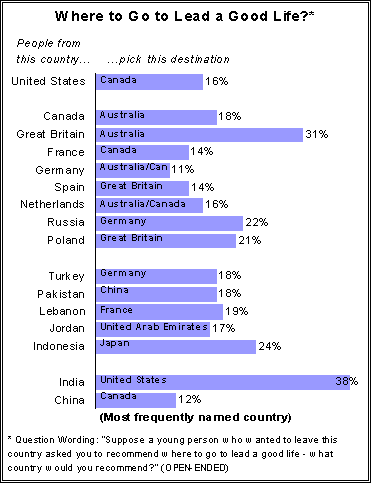
The Pew Global Attitudes project asked “Suppose a young person who wanted to leave this country asked you to recommend where to go to lead a good life – what country would you rcommend?”

Everybody is going to end up in Australia! But a lot of people will pass thru Canada on their way there.

Idle Hands

Recently I assembled a bridge in between my interest in business models and my interest in the wealth distribution. Business models span some space of actors, coordinating their actions, driving actions with motivations of all kinds. If we rope in other institutions (church, state, professions for example) we need to reframe these as institutional model.

The sum of these models creates the distribution of wealth. That’s the bridge, but the consequence is how this ties to ethics. In the search for interesting business models the holy grail is the business model that once added to the societal sum increases equity rather than decreases it.

Ethics permeates the work of those actors who labor to shape institutions: Entrepreneurs who labor to make new institutions that respond to observed institutional failures, critics who attempt to illuminate institutional failure, guerrillas who labor to undermine institutions they perceive as sufficiently failed as to be deeply illegitimate, professionals who strive to keep institutions vibrant, efficient, and away from the many dead-ends that lead to failure.

How an institutional model effects the income distribution is largely independent of how much activity in enables and coordinates. How much eBay, Microsoft, Google, all create large amounts of economic activity. How they effect the income distribution is another matter.

On my more cranky days I suspect that most internet business models are not on the side of the angels here.

In broad strokes the standard internet business model works by realizing that the internet gives the entrepreneur access to a vast pool of labor. The successful model discovers a means to engage those idle hands. Given them something to do. This works best when their motivation is intrinsic while the motive force for the business is more fungible.

None of this should be taken as dismissing either the magnitude of the effort the entrepreneur goes thru to construct the new institution or the magnitude of the social and economic value generated when one of these institutions come into existence. This is not an argument that Google, eBay, Microsoft, etc did not raise the economic boat overall. It is an argument that they certainly appear to have contributed to the shocking disparity between rich and poor.

Short of deciding to forgo the economic and social benefits of these network businesses we are left with a search problem. Can we find designs that get the benefits without the corrosive social consequences? How your institutional shaping actions effect the skew is part of the metric that guides that search. How much is, of course, up to you.

Weather v.s. Law Enforcement

Art Botterell wrote an interesting email to Dave Farber’s venerable Interesting People mailing list giving a bit of his impression of how FEMA has evolved over the years. It’s very interesting from a number of perspectives. They apparently learned a lot from the experience around Hurricane Andrew, learnings that went missing in recent years.

One thing he mentions in passing I found particularly thought provoking. “And then came 9/11. FEMA was subsumed into a law-enforcement dominated Department of Homeland Security” That’s a fascinating dialectic; between the problem of how respond to an emergency v.s. the job of law enforcement. In law enforcement there is a bad guy; so much of your energy is directed to, as Pat Robertson says, taking him out. In emergency management geology, weather, and the bad guys that get away are your problem. One is all about individual actors, while the other is all about probabilities, scenarios, and rapid response after the fact. I suspect that people have a natural tendency toward one or the other world view.

A skills of law enforcement seem pretty clearly bogus for tempering the risks of hurricanes and earthquakes. What really caught my attention though was that I suspect that they are far less effective for tempering the risks of terrorism than one might think at first blush.

Take for example the risk of terrorist acts against critical distributed systems; like pipelines, highways, power grids. The pool of bad actors is everybody on the planet with a grudge and the target has a immense perimeter. The chance of the vile deed is a statistical modeling problem; like weather forecasting. There are only a few ways to temper the risk. Three examples: find ways to reduce the energy of hate being pumped into the system. Find ways to configure the systems so they are less fragile; for example by finding choke points in these networks and distributing them. And finally being ready react quickly to limit the damage when it happens. I’m sure that law enforcement experts use these techniques; but they aren’t at the core of their craft.

I’m not a great fan of one dialectic to rule them all; but this is certainly an interesting one to throw in the pot. I think of the terrorism problem as more like the weather while I think a lot of people I disagree with tend to think it’s a law enforcement problem.

One risk of getting all excited about a single dialectic is that you tend to project it casually onto lots of other problems. But you it’s clear that what you see in New Orleans is very different if you see it as the breakdown of public order or the a vast messy coordination problem gone horribly wrong. What you do over the coming months is very different depending on your mind set. Law enforcement or emergency management?