“Gulf Coast Needs Immediate, Retroactive Relief from Death Tax, Says AFBI; Small Industry in Region Must Rebuild, Provide Job” — press release
Looters
Leave a reply
“Gulf Coast Needs Immediate, Retroactive Relief from Death Tax, Says AFBI; Small Industry in Region Must Rebuild, Provide Job” — press release
Good Posting about the kinds of issues that people ought to be giving some attention to, now.
Here’s a contest. Name the actions the administration could take which serve their agenda but have little if any relevance to actual problems that need to be addressed. For example I just listened on the radio and the administration is relaxing environmental protections (you know so we can increase the fuel supply) and suspending labor work rules (you know so we can respond more vigorously).
Or maybe FEMA could direct donations to Pat Robertson’s (you know the guy the close personal friend of Charles Taylor who likes to suggest taking out foreign leaders and supreme court justices) operation blessing. Here just for example are at least 30 legitimate places to to donate.
Or yeah, it’s five days after it the national hurricane center forecast this catastrophe, time to get back to work on repealing the estate tax. If only we could find a rich corpse!
But wait, how about we eliminate the minimum wage.
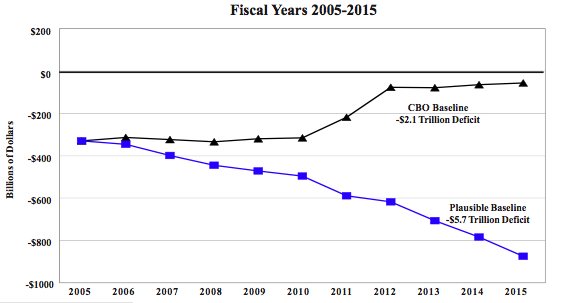
That chart should say: $57K per household; or around $500 a month.
The chart is based on four predictions about the future:
You might be curious about how the Congressional Budget Office is manipulated into making assuptions about those that are so very different. For example why the war is entirely off their books.
Each of these has it’s constituency so you can see how the political battles are going to play out. For example there is $1.7 trillion in the Social Security Trust Fund. For example, at $100 dollars a barrel the Iraq oil reserves are worth $30 trillion.
Or you could come at from the other side and wonder who’s going to lend us that money. Currently Asia governments are said to hold $2.3 trillion of our paper.
The President and Bill Gates are throwing some love to the anti-science anti-secular crowd. The president signals that he thinks teaching anti-evolution poppycock in the schools is just fine. Meanwhile Bill gives 9+ Million dollars to the creationist PR mill’s front office, i.e. the Discovery Institute
Massachusetts, where I live, has a Republican governor who has been attempting to make progress on the healthcare debacle. The other day an article appeared in the paper with the latest chapter in this ongoing attempt. The word “freeloading” appeared in the article; to suggest that the current refinement’s goal is to remove options for freeloading on the system.
Freeloading is a problem in all collective action systems. It’s one of the reasons that classical minded economists run screaming from the analysis of public goods – you know, like public schools, public roads, public health, environmental regulation, etc. etc. More mature economists get a gleam in their eye and roll up their sleeves, of course.
One way to pull the rug out from under any collective activity is to highlight how some people are, or might, be getting
a better deal than others. For example you announce that families with more children are freeloading on the public schools, or that my acquaintance who got encephalitis is freeloading on the health care system. Of course that was probably caused by cut backs on the public health expense of keeping the mosquito population under control.
My first thought when people mention freeloading as a problem around healthcare is Wal*Mart. World’s largest corporation which manages to avoid much of the responsibility for healthcare that comes with being an employer. Employer responsibility for health care was one of the bargains struck by American society during the 20th century; it arose out of union negotiations. Over the last 30 years corporations have discovered that as unions weaken and their political power has increased they can opt-out of that bargain. The society has yet to reach a new consensus about how to bear this responsibility.
Of course there are lots of other candidates for the the role of healthcare freeloader; or to use more exaggerated speech – parasites. A lot of money has been spent to cast malpractice lawyers into this role, though the data would seem to suggest it’s the malpractice insurance providers who benefit from that subplot.
My impression is that since we have a total breakdown in the consensus about where the responsibility for healthcare resides we have fallen into a messy trap where all the players spend vast amounts of resources attempting to shift responsibility to somebody else. The business community created that mess. All now compete to see if they can shift costs someplace else.
The governor’s plan is to force individuals to buy health insurance, much as we force everybody to buy car insurance in this state. So today’s casting for the role of freeloader is individuals. That’s a very popular move on the right, shift risk onto the weakest player in the social game.
But looking more closely it’s interesting to note that the governor is, at the same time, trying to force employers to provide health insurance. To make them pick up the responsibility they dropped over the last few decades. Of course the details of that make all the difference.
One last detail, states are not allowed to work on problems like this without the permission of the Bush administration. To institute any change in the regulatory framework the state has to be granted a waver. Only one state has managed to get a waver that allowed them force firms to bear some of the responsibility, i.e. Hawaii.
David Chess reports that he has been listening to Supreme Court Justice Scalia. David suggests that rather than the “originalist” label that Scalia likes it is more accurate to call him a “temporal denotationalist.” Which is to say that the constitution denotes exactly what it denoted at the instant it was signed. He quotes this bit by Scalia:
I’m saying the Eighth Amendment means what was cruel and unusual and unconstitutional in 1791 remains that today. The death penalty wasn’t, and hence it isn’t, despite the fact that I sat with three colleagues that thought it had become unconstitutional. Executing someone under eighteen was not unconstitutional in 1791, so it is not unconstitutional today. Now, it may be very stupid. It may be a very bad idea, just as notching ears, which was a punishment in 1791, is a very bad idea.
Temporal denotation strikes me as being very stupid and a bad idea.
David then suggests we should pass the 28th amendment:
XXVIII. Cruel and unusual punishments shall not be inflicted.
While to the untrained eye this would be a no-op it’s revolutionary to the eye of the “temporal denotationlist” since it resets the clock!
This could make for great political theater force the various state legislatures to vote to reratify the constitution! Welcome them into the 21 century. Look at the benefits: the industrial revolution, modern medicine, the electron, the novel, science, … golly!
Thru direct mail and radio advertising (on my local NPR station) a church here in town has been campaigning to make me curious about them. I’m a very secular fellow. But I happens to know a lot about abusive cults and so my first question was is this one of those large abusive cult churchs that spring up from time to time. Like, for example, the Boston Church of Christ.
The Internet can be a big help with questions like that. The large older abusive churchs are easy to identify because some of their survivors will post descriptions on the net. Vineyard probably isn’t one of those. But it sure has attracted a lot of analysis and commentary from folks who are interested in mapping out various church theological positions and those who are working to understand the evolution of American Protestantism. Much of that is pretty stern stuff.
For example “Vineyard emphasizes public healing, glossolalia (speaking in tongues), demon depossession, and prophecy.” and the following passage from here.
One obstacle the Vineyard Movement has recently faced deals with the disfellowship of the Toronto Airport Vineyard Church (also known as Toronto Blessing ). Over 300,000 people have visited the Toronto branch to experience for themselves the outbreak of “holy laughter.” Holy laughter is the manifestation of the Holy Spirit through hysterical, uncontrollable laughter. John Wimber and the Association of Vineyard Churches recognize holy laughter as an important part of their ministry. However, when the Toronto Vineyard started incorporating animal noises as part of the holy laughter experience, Wimber decided that they had gone too far. In 1994, the Toronto Airport Vineyard Church was kicked out of the Vineyard Movement. It was a difficult decision for Wimber to make considering the popularity of this charismatic event and due to the fact that the Vineyard Movement was in such a relatively early stage of development.
Wimber, along with C. Peter Wagner, was one of the founders to what is sometimes called the third wave. These three waves are Pentacostals (1902), the Charasmatics (1960s), and what is sometimes now called the New Aposstolic Reformation(1990s). These guys had a product to sell, a course on how to make your church grow faster. The key advise was to include more “Signs and Wonders” e.g. the glossolalia, demon depossession, and such. Wimber’s innovation was to add a lot of music. He had at one time been a keyboardest for the Rightous brothers.
So one thread here is the charasmatic or evangelical church growth movement. For example the Alpha program who’s signage you see hanging outside lots of churches is a direct decendent of the work of these two guys. The ads on NPR and the direct mailings reflect the increasing sophistication of modern marketing techniques in use by church growth experts such as these.
It isn’t clear to me exactly how much Wagner is still tied into the Vineyard moement. I wish I knew because I find him to be a scary character. He’s very, ah, pragmatic:
“… we ought to see clearly that the end DOES justify the means. What else possible could justify the means? If the method I am using accomplishes the goal I am aiming at, it is for that reason a good method. If, on the other hand, my method is not accomplishing the goal, how can I be justified in continuing to use it?” (C. Peter Wagner, “Your Church Can Grow – Seven Vital Signs Of A Healthy Church”, 1976, pg. 137. – emphasis in original)
He’s really concerned about demons:
Peter Wagner in a symposium on power evangelism at Fuller Seminary affirmed: “Satan delegates high-ranking members of the hierarchy of evil spirits to control nations, regions, cities, tribes, people groups, neighborhoods and other significant social networks of human beings throughout the world. Their major assignment is to prevent God from being glorified in their territory, which they do through directing the activity of lower-ranking demons.” (John D. Robb, “Strategic Praying for Frontier Missions,” Perspectives on the World Christian Movement, Study Guide, 1997 Edition, Pasadena: William Carey Library,1997), p.1-8.)
You might think this is kind of odd and marginal until you recall
General Jerry Boykin, deputy undersecretary of defense for intelligence and the following story:
Of a strange, dark mark on a photograph he took of Mogadishu, Somalia, during the Black Hawk Down operation of which he was a part: “Ladies and gentleman, this is your enemy. It is the principalities of darkness. It is a demonic presence in that city that God revealed to me as the enemy.”
Life was simpler when I didn’t have to understand these currents in American culture. I prefered a simpler secular view of the world.
Very nice posting over over at Washington Monthly on income inequality trends under the two parties. The %20/80 cut point he uses isn’t a very good metric, I think it under estimates the severity of the skew since much of the wealth captured is up in the 1%, 5% region; but it will do.
The other day I said to somebody that “it’s a political process” and he replied “you mean he has a hidden agenda.”
I think the word politics names the process by which many parties with widely divergent world views attempt to find common ground so they can get something done. That search is the key. So when I say “political process” I mean that the parties are still searching; but that they are still in the same room trying.
Lots of people hate that room for quite a laundry list of reasons. First off it appears that nothing gets done in there. Attempting to find common cause is what gets done in there. It’s risky hard work. There is huge risk that you spend resources and fail to find common cause. There is risk that spend resources, find what you think is common cause, and then latter you discover it wasn’t strong enough to stand the buffetting of future work. Always there is the risk that the guy in the room won’t be able to deliver his constituency. All that raise the risk that the game your playing is a short term rather than a long term one; which only makes the possiblity of defections higher.
If people all see the world in the same way then you wouldn’t have a problem you wouldn’t need to go into a room and try to find some common cause. In such rooms the puzzle is to figure out what the other guy can see that you can’t. In retrospect I find it amusing to realise that the difficulty of that work makes it always appear that the other guy is hiding something. It is rare that people know what they know. It’s even more rare that they know what you need to know.
