Author Archives: bhyde

Two Kinds of Clubs

I’m slowly rereading Olson’s “The Logic of Collective Action: Public Goods and the Theory of Groups”.  I find it pretty frustrating, but that’s another story.

In the section I was reading last night he gets to musing that there are two flavors of clubs: inclusive v.s. exclusive.  Both create club goods.  The default tendency of an inclusive club is to welcome new members, while members of exclusive clubs tend to prefer that the membership shrink.  For example a lobbying group seeking lower taxes on industry will be inclusive, the more the merrier; meanwhile a members of an industry will tend to prefer that the number of competitors shrink.  Thus, for example, the members of an industry standards body with associated patent pool may prefer to trend toward a smaller and smaller membership.  In another example a professional society who’s function includes granting professional status to it’s members will might tend toward exclusive; e.g. a profession with a 1o0 members can charge more for it’s services than one with a 10 thousand members.

I sense foreshadowing in Olson’s plot development.  Since any hint of  selfish motivation always excites economists  I’ve little doubt he will soon explain how an exclusive club is more sustainable.

The name of this blog is about this topic.  A club of enthusiasts will not casually ascribe membership in their club to others, in fact doing so would offend them.  The enthusiasm acts as a binding force for the group, and dragging in those who lack it is likely to weaken that.  Members of the local model rocket club may engage in outreach, striving to juice up other people’s enthusiasm for the hobby, but it would be quite odd for them to randomly pick people and anoint them as members.

Clubs labor to create club and public goods.  That is their primary goal, but other goals get piled on sometimes intentionally sometimes by happenstance.  An example of that is how members of some clubs often garner status.  To start the goal is to create the good, in support of that the club fiddles with the process that maintains the pool of members.  As an unintended side effect membership becomes selective, and hence elite, and hence confers status.  This status creation wasn’t the goal of the club, and in fact it’s a distraction from the goal.  Good members are engaged with the primary goal, creating the goods; further they are peeved at the way the status becomes a distraction from that.  Meanwhile, outsiders who are much less concerned about creating the good tend to see only the status.  How perverse is that!

Most clubs are actually a hybrid, of course, you want members who contribute to the goal but at the same time you want to extend a broad and enthusiastic welcome to any and all; since how else can you hope to search out the enthusiastic members.

No doubt there are scenarios where the agenda of a club is entirely captured by the status generation.  As an outsider it would be hard to know for sure; for example I know practically nothing about Mensa, which was the first club that came to mind as existing entirely to create status for it’s members, but for all I know if I was inside that club I’d know that it exists to provide a delightful pool of fraternal activities for it’s members.  The insider/outsider problem is fascinating.  For example I certainly feel that people who own Rolex watches are just buying status, but then you discover that lots of those are sold to people who own multiples and have special watch humidors for their collections.  It’s confusing.

Inclusive/Exclusive is not the only dialectics that can be used to sort clubs.  It’s probably worth starting a list.

  • Primary goal: create club goods v.s. create public goods.
  • Focus is inward facing (i.e. on some project (think barn raising)) v.s. focus is outward facing (for example on some threat)
  • Membership – is naturally inclusive v.s. exclusive; e.g. the existing members would naturally prefer more or less members going forward.
  • The club tends has high/low capacity to exclude others from access to it’s club goods.
  • Clubs that create a broad range of goods v.s. clubs that fix upon a single good
  • Clubs who’s principal good’s quality depends upon the quality of the members contributions such that the best contribution sets the quality v.s. those where the worst contribution sets the quality.

These are not entirely orthogonal, are they?

Hiding the cursor++

Back in the day I used to write code for graphic user interfaces.  If you write code like that you develop a eye for details that hopefully are invisible to other folks.  For example I happen to know that when you typing the mouse cursor is hidden and then later when you move the mouse the cursor reappears.  If the mouse cursor doesn’t disappear when I’m typing it causes a bit of cognitive dissonance.

Since I did that kind of work starting in college and then very intensely for the years after the Macintosh was released I’ve had the fun of watching as people tried every possible variation of how they might make a UI work.  I think that search space is pretty well mined out.  Stuff is rediscovered all the time.  Rarely somebody stumbles on a new idea.  Most of the time the computers get faster so things become possible that were just too slugish to do before.

In recent years as I’ve become interested in how we manage our attention I’ve become increasingly interested in UI schemes that help with that problem.  I’m a huge fan of Readablity, a bookmarklet that attempts to glean out only the text you want to read from your web page.  And I like the hack for the Mac Spirited Away that automatically hides applications that have fallen into the background on the desktop for some period.  I desperately wish I could find a similar hack that would replace, on demand, the entire screen with the content area (and only the content) of the topmost window.

Those are all examples of hide the clutter when I’m doing something, and they are directly analogous to the hide the cursor when I’m typing.  There is a dirth of good schemes for automatically hiding when I’m reading.

Anyhow the new scheme that Google recently deployed of hiding the clutter on their homepage until you move the mouse pointer is, amusingly, a direct extension of the hide the standard mouse pointer when typing (and he is typing right?).  My silly brain screamed out “bug!” when I first saw this; complete with a diagnosis that the code for mouse pointer hiding was hiding too much stuff.  The same part of my brain then tried to puzzle out how code got the clutter into the top most overlay which includes the mouse cursor.

Who knows?  Maybe it will become standard practice to hide other clutter, in addition to the mouse pointer, upon typing.

Income Inequality

Some nice illustration of income inequality pulled together at Visualizing Economics.  For example this shows a fine grain map of US income inequality.  Oh I’d love to see a video of that over time!

us_income_inequal_5_15_2006

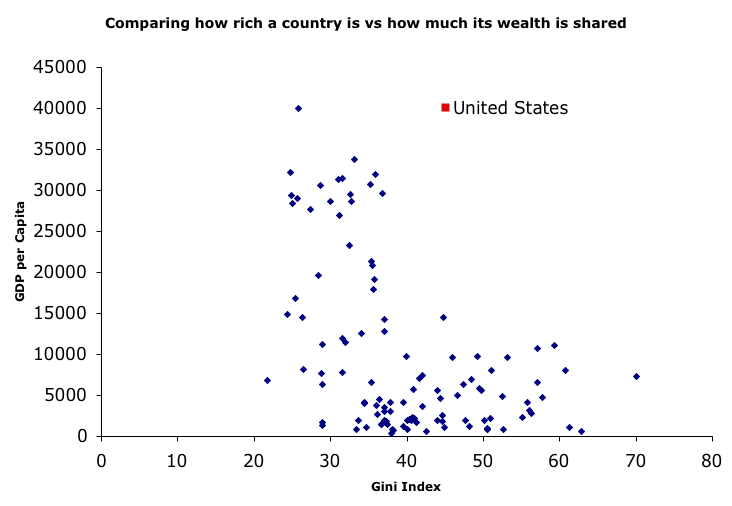
Or this scatter plot nations showing the height of inequality v.s. their per-capital GDP.  The US, an outlier, is highlighted.

GDPCapitaVSGini

Lots of thought provoking stuff over there, for example this fine grain map what real estate is productive.  I wish this was GDP/capital.

sachs-gdpdensity

The original sources can be found in the postings I pulled these from; though sadly many of the links are broken.

Craft of Software Management

Nice list

  • Continuous deployment.
  • Tell a good change from a bad change quickly
  • Revert a bad change quickly
  • Work in small batches (at IMVU, large batch = 3 days worth of work)
  • Break large projects down into small batches
  • Have a cluster immune system
  • Run tests locally. Everyone gets a complete sandbox
  • Continuous integration server – tests to ensure all features that worked before still works
  • Incremental deploy – reject changes that move metrics out of bounds
  • Alerting and predictive monitoring – wake somebody up if metric goes out of bounds. Use historical trends to predict  acceptable bounds.
  • Conduct rapid split tests: A/B testing is key to validating hypotheses
  • Follow the AAAs of metrics: actionable, accessible and auditable

But for heaven sakes!  Nothing on this list is particularly insightful or new.  All these things were true in 1980.  Have we learned nothing?  Is the schooling around software development so weak that these are news to people?  This list ignores the much more fundamental question of when those rules get broken.  Hint: about half your time will be spent in that state.  But what’s key is knowing when that is a good witch v.s. a bad witch.  The only customer/user input or feed back loop in that list is A/B testing.  That is particularly bogus!

Feeling cranking.  The old joke for the 1970s about the software industry:  “I am blessed to have stood on the toes of giants!”

Anonymous Phone

It is frustrating that there is no chance I’ll ever know the real story here.  This article says that they, you know they, are disabling 25 million cell phones in India.  These are generally cheap phones and what they have in common is they lack a unique id number, what’s known as the IMEI.  Twenty five million phones is a lot of phones, and since these phones are presumably owned by the poorest segment of the population I suspect it is a significant taking of their total wealth.  But that’s only one frame I’d like to understand this story in.  For example the story says that 30% of the phones sold in India fall into this category, which means that this is a horrific blow to most of the cell phone retailers.

I entirely dismiss the nominal rational given – i.e. that this is a security move.  If the phone companies can do billing they can do security.  I suspect this is about billing, and not security.  But it might be about operational issues, since I assume that these phones all have an IMEI just not a unique one.  I bet there is a fun geeky story about how the phone industry has been dealing with that.

I suspect that the makers of pricier brand name phones are terrified by the rising tied of off-brand cheap phones.  I wonder if this could be an attempt on their part to bankrupt, or at least raise the barriers to entry, of the smaller producers and their distribution networks.

It’s interesting how anonymous phones have strong synergistic with cheap phones.  In the US if you use cash to buy prepaid phone and it’s minutes you can get a phone that has no ties to your identity.  That falls apart the moment you start leaving a trail of phone records to your social network, but still.  In at least one country in Europe, I’m told, I’d have to provide my passport when I bought a prepaid SIM.  Such regulations create a broad tax on the entire population with assorted consequences.  The nominal rational is always to spin up a story about criminal activity involving a cell phone.  Personally I think we should register our alarm clocks too.

I find the more subtle consequences of requiring non-anonymous phones more interesting.  The way it shapes the industry.  The unit cost of phones and network access are falling so far and fast that the cost of this kind of that kind regulatory requirement becomes a significant portion of the total cost.  At which point the industry’s attention become increasingly focused on these aspects.

There is one more aspect to all this.  As the industry and it’s regulators puzzle out how to manage the phone identity problem they are also puzzling out the extent to which the phone can play a role in the overall identity problem.  This is a reasonably critical point of control around the question of how we license anonymity going forward.

Enabling Change

I was working with someone a while back who was in the midst of advocating for an alternative approach inside his organization.  He was frustrated.  He was deeply convinced of the benefits of his new approach and frustrated by his colleagues passivity.  My first thought was to recall a few of my lists, for example this one.

But later I got to thinking – I do have the list he was looking for.

  • enable small wins
  • provide field trips where the problem can be observed in the wild
  • increase contact with actual users, preferable ones with high emotional trigger; i.e. fame, sympathetic, impedence matched, etc.
  • don’t ever attack or dismiss their core competency, e.g. do not propose your new approach in contrast to existing practice
  • invite them to join you solving your sales problem, e.g. create an imaginary client and discuss your challenges selling to that client
  • lots of short stories of others using the approach helps – it creates social proof, demonstrates value, invites a monkey see monkey do pattern
  • create clear low cost affordances for action
  • stand ready to encourage anybody who exercises those options
  • plan out how this blends into existing their time management
  • plan out how this blends into existing sources of encouragement
  • plan to provide air cover, money, staff, and to resort their objectives
  • map out existing social networks and know that it’s the network not the individuals you need to transition

You can use that list to for an initiative (both to help or hinder), and you can use it to shift culture.  Two take two examples of culture – if your organizations tends to pile on lots of objectives or very a narrow repertoire  for giving encouragement you can be sure that new ideas are being squeezed out and adaptability suffers.  Of course adaptability it not an unalloyed good.

Self Binding Service

Arising from my interest in impulse control, hyperbolic discounting, and will power I have been nursing an interest in how people enforce their personal rules.  Say you wish to promise to go to bed at 10pm, or not to drink before 5pm, or to save 10% of your income, or call your mom once a week what tools exist to help you keep those promises.  The literature highlights the amusing point that you can’t write contracts with your self as the counter party and then expect to have recourse to the courts when you break those contracts.

If you keep your eyes open you will notice assorted tools for self binding.  To do lists, reminder services, and date books are simple examples.  There are software applications that will lock out your internet access.  There are savings plans that include a penalty for early withdrawal.  In Arizona you can sign onto a list that requires the casino to deny you access.

Some of the promise keeping aids involve enlisting a third party.  There is a horrible scheme that addicts fall into where they enlist a friend and license him to punish them in some awful manner if they break their promise.  For example they might write a letter which will ruin their professional life if revealed and then give it to the third party.  Once you introduce the third party there is all kinds of risk for abuse.  The third party might extract a promise from a victim during an irrational moment by coercion.  A light weight example of that is how the salesman at the health club pressures customers into signing up for a subscription.  And then, there are chastity belts.

Some of these promise or binding technologies are designed to remove the temptation entirely.  For example: living in the dry town, never buying the liquor, and avoiding the pub.  And those come in degrees – for example moving the ice cream to the back of the freezer.

I’ve been stewing on what might be the lightest weight service a third party could offer to help individuals with this class of problems.  And I have a theory.  It’s based on the time-lock example used for bank vaults.  In that case the bank want’s to remove any possibility of opening the vault for some period of time – usually while the bank is closed.  While obviously the bank’s intent is to keep criminals from stealing their money they actually promise not to open the vault under any circumstances.  They are self binding.  They could of locked the vault with a one time password and given it to a trusted officer of the bank.  They don’t trust themselves.  Apparently the only thing they trust is the people who built the vault.  It’s interesting that if you look at pictures of these time locks they are usually in transparent cases so anybody can visually inspect the mechanism.  They are over engineered and simple which encourages that inspection.

Say you wanted to lock up a present for christmas day.  You put it in a safe, put it under the tree, and christmas morning you hand the key to the recipient.  But what if you want to wrap up a present for yourself and you don’t trust yourself not to open it too soon.  Now what?  You could ask the help of a friend, but that’s got other complications.  Can you solve this problem without a third party?  You could if you could buy a time-lock.  I’d love to know of a vendor.  I’ve not found one.  I find that bizarre; surely there are lots of people who’d like to lock things overnight etc.

Anyhow, I’ve built one for you.  It’s based on a bit-o-crypto.  You lock up things up by encrypting them, and later when the timer runs out you can decrypt them.  Frustratingly this does involve a third party, my little service.  You get the means to encrypt by going to the service, and later once the timer has run out, you go back to get the means to decrypt.  This depends on public/private keys.  You use the public key to encrypt and the private key to decrypt.

For example say you want to make it much harder to play that damn addictive video game until next tuesday.  You go grab the public key for next tuesday and lock away the damn game by encrypting it.  Next tuesday, or sometime after, you go grab the private key and decrypt the stupid game.

Of course this requires that you trust me to keep the service running and not loose the keys it gin’d up.  I wouldn’t recommend trusting me, yet.  For example I really haven’t tested it much :).

Here’s the service http://hang-on.appspot.com/.  I’d love to hear suggestions for things to do with this, or ways to improve it.

Motivation Effects in tradeoffs of Economy of Scale and Reliablity

Here’s something I hadn’t quite noticed before about the trade offs between reliability and efficiency.    This was triggered by the hearsay that yesterday’s troubles in the US air traffic control system are the fault of a single router.    I don’t actually believe that rumor.  That makes it sound like they design the system so it could not fail gracefully; more likely this was a breakdown in the hard part – implementing and maintaining the architecture for graceful failure.  So I was thinking about why that happens.    Which lead to noticing something I’d not noticed before.

If you want to make a system more efficient or cheaper a common trick of the trade is to roll up parts.  For example if you have five elementary schools in town it will be cheaper to roll them up into a single school.    That’s called economy of scale.    What your eliminating when you merge those schools are the redundant bits; i.e. maybe you don’t need two school Principals, two school nurses, two language labs, one great PTA president instead of one great and one who’s just ok, etc. etc.  If the redundant bits are a large portion of the overall cost then roll up is highly leveraged.

One of my utility companies charges me a base fee plus a fee for usage.  That base fee creates an incentive for me to merge my account with my neighbors.  The base fee is about $240 a year, so could each safe a $120 a year.  The benefit from rolling up accounts like that falls off fast.    That $120 a year is the economic motivation to roll up the account.  But notice that the motivation weakens as the coop grows.  If five of my neighbors get it together to roll up their accounts into a single account we’d save $960 a year – but individually we’d only save $192; or an addition $72 each.    The economic motivation for reducing the redundancy weakens quickly.

I’d noticed that before, and is other reason why the motivation weakens, i.e. the increasing coordination costs of the larger organization.  I’ve presumed that in different spheres of activity there are distinct sweet spots; but that’s not the topic today.  The topic for today is how this plays off against the problem of system reliability.

What I hadn’t noticed is how the motivations for economies of scale are at their most powerful just at the moment when they will do the maximum damage to your redundant system design.    For example if your running the FAA flight control network you balance costs against reliability; wearing those two hats is exhausting – not to mention confusing.    Those are very different kinds of expert skill.  So if Mr. Reliability is out sick and Mr. Efficiency is looking for his most highly leveraged move to reduce cost by merging duplicate system – well – that list will sort to the top duplications where 2 systems are reduced to one system.  And there goes your last bit-o-redundancy for that subsystem.    A complex real system has numerous subsystems and you need only loose it in one portion to put the entire system at risk.

I love a good bug

This is such a great bug.

There’s a rounding-error bug in the camera driver’s autofocus routine (which uses a timestamp) that causes autofocus to behave poorly on a 24.5-day cycle. That is, it’ll work for 24.5 days, then have poor performance for 24.5 days, then work again.

The 17th is the start of a new “works correctly” cycle, so the devices will be fine for a while. A permanent fix is in the works.

So their good for the Thanksgiving holidays, but if they don’t get a move on it’s going to ruin Christmas and New Years!