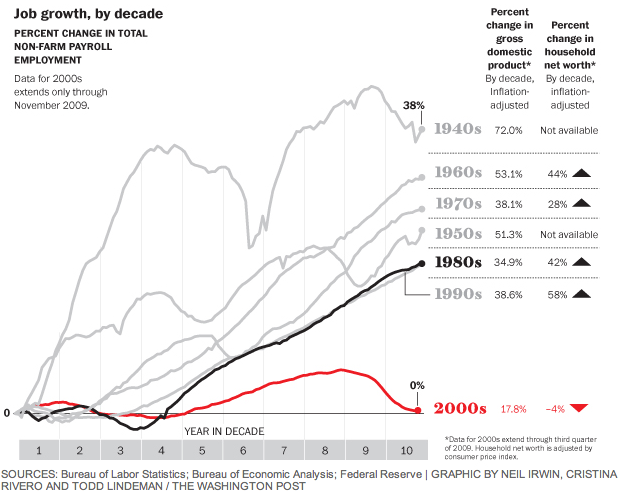
Oh man that is ugly, and as the column on the right shows household net worth is even worse.
Oh man that is ugly, and as the column on the right shows household net worth is even worse.
People are writing blog posts about plans, goals, resolutions and such. I am reminded that like a plan that manifests some eccentricity by this guy who resolved a year ago to spend a year without getting into a car. Nice. After the revolution all media outlets will be required to report on some happy local who has just succeeded in keeping an exceptionally interesting resolution. Give us all hope we can pull it off. Help to model this fine behavior.
If you see more examples, please pass them along.
A public service announcement: You’ll get 40% more done by keeping your plans secret! So if your writing up resolutions and goals, have at it; but consider tearing up the list and don’t show anybody!
 Lordie! I’m Glad that’s over, what a truly awful year it has been; for me personally at least. The decade was good though. I learned and puzzled out a lot. Stuff I very much wanted to learn. Started a lot of things, most failed but that’s to be expected.
For my country: the decade – oh my – what a train wreak! Decades of increasing polarization have born ugly fruit. The last year has been a huge improvement on that front. One can hope we have turned a corner, but so so far to go.
One can always hope that this is true: ‘adults learn best if presented with what he calls a “disorienting dilemma,” or something that “helps you critically reflect on the assumptions you’ve acquired.”‘
Better going forward, that’s the plan.
This email I just got informs me that I’m queued up to get twelve cents cashback. I think this maybe a sign that my power shopping habits are a bit out of hand. The vendor, the intermediary, and I will bear far more than twelve cents each to see this through.
Two of my rules of thumb about discounting come to mind. Negotiation is expensive and it adds friction to the transactions; but at the same time negotiation allows the seller to scour out more money from the customer. The “deeper relationship” lets the seller learn more about the buyer’s “willingness to pay”. It’s all about cost benefit.
Rule #1: The higher the transaction value the greater the chance of a full fledged well staffed negotiation. That explains why a salesman is part of the process of buying a car, a high end stereo system, an expensive camera, or an Oracle database license. It suggests that one should always negotiate with the hospital, the dentist, the mortgage company, the university. Of course the seller in all these situations would prefer a customer who doesn’t negotate; and in many cases the customer prefers that too.
Rule #2: There is lots of room for technology to shift the curve, so negotiation becomes cost effective for the seller at a lower price point. Coupons, cash back, sales, etc. etc. are all examples of that. In an interesting example of globalization shifting the cost curve for sellers, I was recently shopping for health insurance and found myself talking to a very competent negotiator who was transparently on the other side of the planet.
So all commerce has some negotiation tax included in the price. I wish I had better intuitions for how that tax varies across products. For example, Universities seem unique. They have struggled valiantly and largely sucessfully to reduce the tax. So they are a counter example to rule #1.
I don’t even have a rule of thumb for what the average tax is, 35%?
Rule #1 might lead you to suspect that low priced goods tend to bear a smaller negotiation tax, but then rule #2 suggests otherwise. A stream of low priced goods can pay for the overhead of a marketing/sales department that builds out a slew of coupons etc. etc. Some businesses, VistaPrint comes to mind, seem to be 80% negotiation tax.
You might hypothesize that commodities (cheese, coffee, meat) would have minimal negotiation costs. But for those of those I can save about 30% if I buy in bulk each time they go by on sale; 50%+ if I play with coupons.
Meanwhile I think it would be fun to create an iPhone app that lets the passengers on a plane reveal anonymously what they paid.
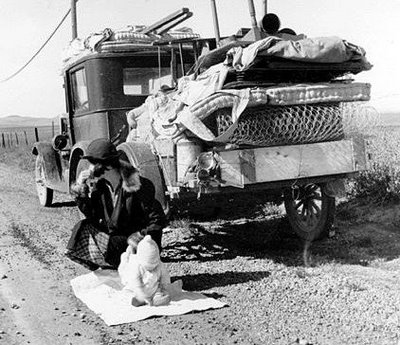 Here’s a thought provoking story about on-demand labor, Amazon has a fufillment warehouse in some low population rural area. Of course once a year they need more labor, what to do?
Workers from Tulsa were adding a 4-hour round-trip commute to an already grueling 10-to-12 hour shift, Cherie is quick to add. “They’d get there exhausted.”
Enter the workcampers, people making a go at living in their RVs full time-many of whom might be otherwise overqualified. “I think Amazon was skeptical at first,” says Cherie. “But after the first trial year they were very, very impressed. Workcampers came in enthusiastic about working, since most are professionals. We’ve owned businesses or been managers.” White collar workers, trying their hand at the gypsy life. Even better, the workcampers were able to stay locally.
I gather that across the nation the unemployment rate tends to even out. More because people leave areas with high unemployment rather than because the areas in question spin up jobs for the available labor. How quickly can that happen? Faster, I guess, if we all owned RV’s instead of houses. When I was comunting to Mountain View as part of my job I would often arise before dawn. At that hour you could see that lot of people live in RVs around Silicon Valley.
 I was skimming this long long post about the demographics and institutional affiliations of the community of climate skeptics, and deep in the body is this fascinating bit.
UPDATE (December 19, 2009): Peter Staats, in the comments, suggested that belief in anthropogenic global warming is entrenched among scientists and will disappear as the older generation dies (citing Planck, whose point is also made in Thomas Kuhn’s Structure of Scientific Revolutions). I responded that I thought he has it backwards–that AGW has become more and more supported, and the holdouts tend to be older, as some of the data about the anti-AGW organizations above already suggested. So I tested our respective hypotheses against Jim Prall’s data, for IPCC WG1 scientists vs. the signatories of the AGW-skeptical documents. I looked at the average year of the last academic degree awarded, first for those with citation counts for their fourth-most-cited paper >= 200, then, since that was such a small sample for the climate skeptics, for citation counts >= 100, and then for all the 623 IPCC WG1 scientists vs. the 469 signatories of AGW-skeptical documents. Here are the results:
Citation counts of 4th-most-cited >= 200:
IPCC WG1: N=83, 12 w/o year, N=71, average year of last degree = 1981
Skeptics: N=13, 4 w/o year, N=9, average year of last degree = 1965Citations counts of 4th-most-cited >=100:
IPCC WG1: N=201, 51 w/o year, N=150, average year of last degree = 1983
Skeptics: N=38, 15 w/o year, N=23, average year of last degree = 1968All IPCC WG1 vs. AGW-skeptical document signers:
IPCC WG1: N=623, 208 w/o year, N=415, average year of last degree = 1989
Skeptics: N=469, 346 w/o year, N=123, average year of last degree = 1973
In short, the skeptics are 15 years older than their opponents.
My mind is settled on this whole climate issue. But, it would be fun to have a list of other conflicts with a strong generational component. For example, I think I’ve written about how I think Microsoft is caught on the old side of the swing back to data center computing and it’s associate control of the customer and distribution channels. I suspect there is one in the Business schools around platform based business architectures.
In a somewhat related bit, I’m subscribed to various pages at wikipedia. Apparently there is some kind of lower life form that draws satisfaction from swooping into pages and adding “citation needed” after the first period, and so naturally there are mechanisms that chase after this to remove them. This silly activity happened on one page I was watching the first sentence read “Given two similar rewards humans show a preference for one that arrives sooner rather than later.”
And so, I was delighted to stumble upon a possible citation for that. Via Crooked Timber, quoting Richard Tol and his co-authors:
Estimates of utility discount rates for individuals are almost always positive – an estimate of 1.5% is considered plausible for the UK for instance (HMTreasury, 2003) – for the simple reason that humans prefer good things to come earlier rather than later. Given the inevitability of death for individuals, a preference for benefits to accrue earlier rather than later is entirely sensible.
John Quiggin adds:
We can sharpen this up a bit by observing that the average annual mortality probability for adults is around 1.5 per cent, suggesting that this factor alone is sufficient to explain positive time preference.
That whole post is thought provoking but what has been stewing in my head since reading it is how immortals might manifest a very different discount rate than we mortals do. The planet, society, nations, and many corporations act as if they are immortal. This leads to a pervasive mismatch in the discount rate between an group and it’s members. That’s the tension of the prisoner’s dilemma, the gang would prefer that the game continue.
I love charts like this.

This chart implies that if you want to know what it costs to make something all you need to know is how much it weighs and how many are produced. Note also that this is my favorite grid: log-log. So, you get quite a large factor in the variance around that line. And then, you don’t often see that curve on log-log graphs. The chart is taken from Dan Nocera’s Pop!Tech talk on “Personal Energy” which makes an interesting arguement about the shape of the industry we will need to solve the energy crisis; i.e. a few very big producers should produce the capital equipment which is then run locally by billions of households; i.e. down in the lower right of that chart. He’s the guy who’s lab at MIT found a new catalyst that they claim is a game changer when it comes to splitting water to get hydrogen.
A quick search didn’t turn up the original source, presumably by Schmidt and Slocum, of that chart. Anybody happens to have a pointer, or better yet the paper?
Giving donations is fraught with frictions of all kinds. For example my wife and I once gave some money to a nonprofit only to suffer a year of verysolicitations for more money.
I think this is just amazingly and delightful. Giving Anonymously is a small nonprofit in Washington state that facilitates giving money to others anonymously. They clear about $75 thousand dollars a month at this point. This lets you avoid the social frictions of donations. It avoids any suggestion that your dontation is a form of status seeking. It avoids any suggestion that the donation is just another market transaction.
So what could you use this for?
I really like #2. If you are trying to fund some club’s operations it is brilliant. It is very likely your club’s community of members has some very very wealthy people in it. But they have little desire for that fact to be known. By offering all your members the opportunity to make anonymous donations you create a way for the rich members to help without insisting that they break cover.
For gifts of less then $500 they charge nothing, though you can give a bit to help them along. That’s pretty amazing when you block out what their credit card charges, mailing costs, check processing fees, etc. are so say nothing of the labor. Well actually, they are apparently entirely run by volunteer labor. It must be strange working there! Apparently they listen to every phoned in thank you message before forwarding them back to donors. Listening to a few on their site makes it clear that would be emotional work!
To give money you’ll need:
There must be a term of art for the scenario where a corporate sponsor uses a charitable activity in such a noxious manner that the charity becomes entirely a vile facade for marketing. It can obviously be quite quantitative. If the firm spends N units of cash on marketing their affiliation with the charity for every one unit they actually donate to the charity the entire exercise is a fraud. But we need a label for this bogosity. “Pink tides of hope,” or something. Then a list. It’s so offensive.
Two fun examples of business models that reside adjacent to the waste stream.
First a fun posting about getting free food for your pigs by talking to the guy at the cold storage warehouse who has to puzzle out how to dispose of damaged good. (HT – Rebecca). He’s obviously having fun playing the game, but I don’t think he’s won until he get’s them to pay him to cart it away. I gather some cheese makers pay pig farmers to take the waste whey off their hands. Since they can’t dump it in the river anymore.
Second buried in the tail end of this article at the New York Times we discover that this guy is actually running a small business in stooping trade. He pays people for bags of discarded betting slips, then he pays other people to sort, flatten, and stack ‘m, and finally he stands around for hours a day feeding them into the scanner. I tend to doubt his employees are getting health insurance; since apparently he’s grossing only around $45K/year.
There is a story in my family about the uncle who lived in the attic when he wasn’t filthy rich. One of the ways he got rich was buying train cars of too wet grain, mixing it with dry grain and selling it. I guess trash based business models are in the genes. Maybe I should start a new category.
There must be an amusing book about this kind of stuff.