The Devil’s Long Tail

In this day and age you really can’t hope to achieve scale with deep relationships, you need broad light relationships that create vast probablistic oportunities for sucess. I’m glad to see that Neil Gaiman and Terry Pratchett know this:

Fourteenth-century minds, the lot of them. Spending years picking away at one soul. Admittedly it was craftsmanship, but you had to think differently these days. Not big, but wide. With five billion people in the world you couldn’t pick the buggers off one by one anymore; you had to spread your effort. But demons like Ligur and Hastur wouldn’t understand. They’d never have thought up Welsh-language television, for example. Or value-added tax. Or Manchester.

He’d been particularly proud of Manchester.

Housing Prices

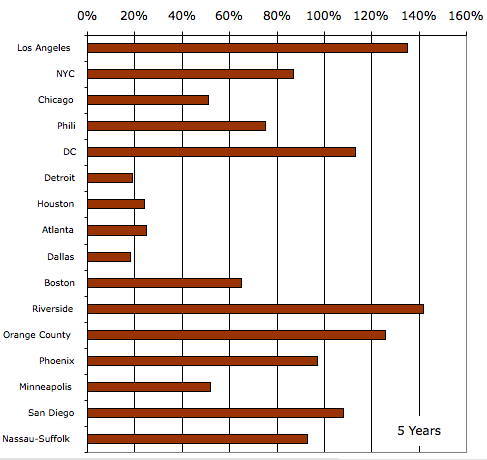
The chart below shows the five year rise a housing price index for the top handful of metro regions.

Presumably some of the varation from one region to another is grounded in fundamentals while some is irrational exuberance.

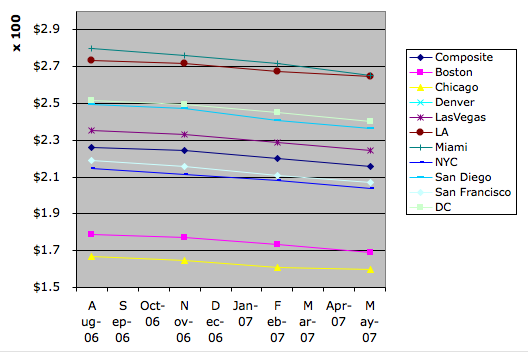
Meanwhile one of the future’s markets has a thinly traded product you can buy. In a perfectly functional market that would be your best estimate of what the future holds. This chart shows the price as of yesterday for a contract on a somewhat different housing index for various dates in the future. You can see that they are all falling, but also that there is little variation from one region to another; at least nothing to compare to the variation in historical price rises.

This was all triggered by reading a story this morning of a seller in Washington who entered the market asking 1.1 million and sold after an auction for half that.

Top of the Heap

Today’s Dilbert amused me.

One of the standard problems in all system design is what to call the root of your class hierarchy. I worked for a company once that started with the name “object,” and then in a later version they wanted something yet more general so the inserted “entity” above object. Later yet they inserted “item” above entity.

Middlemen

This pretty well sums it up:

In days past, these professional courtesies were almost necessary in building a strong agent/client relationship. Those days are long gone. At one time, it was a loving and trusting relationship built on mutual respect. But as with most modern relationships, the agent/client, once sacred bond, has been destroyed by the Internet.

I like to say that the intermediary must love both sides; that gets harder to sustain in a hurricane of disintermediation. Craig’s list and eBay don’t sport much relationship. Amazon’s model of your buying habits is the best you’re likely to get along those lines.

Personal Note from Richard Stallman

June 1984:

The Lisp Machine is a product of the efforts of many people too numerous to list here and of the former unique unbureaucratic, free-wheeling and cooperative environment of the M.I.T. Artificial Intelligence Laboratory. I believe that the commercialization of computer software has harmed the spirit which enabled such systems to be developed. Now I am attempting to build a software-sharing movement to revive that spirit from near oblivion.

Since January 1984 I have been working primarily on the development of GNU, a complete Unix-compatible software system for standard hardware architectures, to be shared freely with everyone just like EMACS. This will enable people to use computers and be good neighbors legally (a good neighbor allows his neighbors to copy any generally useful software he has a copy of). This project has inspired a growing movement of enthusiastic supporters. Just recently the first free portable C compiler compiled itself. If you would like to contribute to GNU, write to me at the address above. Restrain social decay–help get programmers sharing again

From the preface of the Lisp Machine Manual.

Slicing and Dicing the Senate

Below are two syncronized animated charts. The file containing them is large, a half a Meg (sorry about that).

Each point on the charts represents one US Senator; they don’t move. The idea of this technique, “Optimal Classification Estimates”, is to reduce each legislator to two numbers and them pin them onto that graph. It’s extremely reductionist, but it works. The lines slicing thru the chart illustrate how voting proceeds on various bills. A line running from top to bottom reveals that a bill was decided largely on economic issues; while a line running left to right is a bill that was decided on social issues. The democrats on the left are economically liberal, i.e. they tend to look out for the weaker and more numerous economic actors. The Republicans on the right are economically conservative; look after the economically large, but few.

The chart on the right shows how well the model works. The hand full of points shown are Senators who votes didn’t fit the model.

I grab’d that chart from here.

The model is extremely accurate; around 95% these days. Amazingly you don’t actually need two axis; you will get 90% accuracy with a single axis that runs almost top to bottom, but slices slightly at an angle. You can see the entire Senate sorted into that ordering here. For example Joe Liberman isn’t the most conservative democratic Senator, there are a handful who are more to the right than he is.

I’ve writen about this model before; and I keep coming back to it because it totally changed the way I think about politics. It’s all economic; all the noise about social issues never actually flows thru into the legislative agenda.

If you download the chart and stick it into the right program (Quicktime player works for me) you can single step thru the votes. You can then go look up particular votes. That facinating because the topic of a bill may appear to be along one dimension but the vote shows clearly that it was entirely decided by another dimension. For example, the votes around now failed plan to create a guest worker program are a good example of social and economic conservative issues playing off against each other.

Unlinkablity

I see that the New York Times found a reporter with sufficent wit to actually track down one of the users who’s searchs are revealed in the AOL search data. It’s a pretty good article.

Meanwhile Ben Laurie is curious about creating an anonymous package delivery system by mimicing the ideas found in Tor. It’s an amusing idea Anonymous Package System, or APS; I’m sure that Fedex is scared! If two of you out there want to give this a try you can forward a package thru me; send me a pgp email and I’ll send you back a token to include in the package (think of it as postage) to provide you “bought” the one unit of forwarding. I’ll can then take pictures of the various artifacts for and do blog posting to report on how it works out.

Today, rather than anonymous physical package delivery, I find my self yearning for Tor like functionality that I can target at particular URLs; because today I’m much more interested in hiding my search data from Google than I was a week ago.

Decay, Rust, Terror

Actual gorrilla mask worn by global guerrillas!Why do I keep expecting John Robb to point out that rust is yet another example that validates his global guerrillas model of where the world is headed? What distructive force is further out on the long tail of bad actors? The ultimate in fire power rust coordinates it’s actions thru a swarm based attack. Does not metal’s primary loyality for oxygen illustrate the inevitability of states losing their monopoly on power? Surely corrosion’s vile attack on the Prudhoe Bay pipeline is yet another sign: our economic system is just a long line of fat sitting ducks? And, yet again we see our over muscular military totally unprepared to deal with the real threats we now face in this post super-power globalized economy!

This just in: rust now teaming with sludge!