Category Archives: politics

Politics 101

Another addition to my set of little frameworks for explaining things. I’ve lost the back pointer to where I learned this.


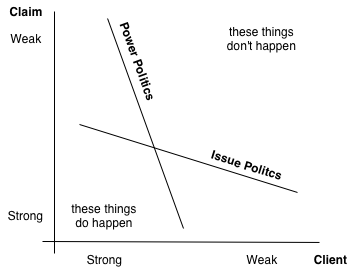
This is tool for thinking about budget items when the budgeting is embedded in a political context. And when isn’t it? The budget items can each be scored by two measures. First, how strong the claim of that item is; i.e. how pure, noble, and necessary it is. For example the maintenance of the public health system that inspects the food supply has a strong claim to funding. Second, how politically strong the parties who will advocate for a given item are. For example it’s rare that the executive suite’s benefit package goes unfunded.

Presumably an ethical practitioner of the political craft strives to draw a line thru his budgets that is more horizontal wile a practitioner who believes in giving power it’s due strives toward a vertical line. Of course reasonable people can dispute the how to score the claims – such dispute are, of course, why you need politics.

Example: Say your required to propose a budget within some cap; but you want to do more. What to do? Leave strong/strong items out of the budget. For example: funding the war in Iraq is strong/strong. It will get funded. That’s why the war’s been funded almost entirely with supplemental funding bills. These tricks make it subtle to read budget projections.

Update:The annual release of the president’s budget triggers … a more original source for this model. David Stockman, who knew? Homework; draw three curves in the space shown: a) a imaginary existing budget, b) a goal budget and c) best budget to propose to shift toward your goal budget. Extra credit pretend your really evil.

The fruits of economic growth

In today’s New York Times Paul Krugman points out that if you run the numbers the plan to privatize Social Security has contains a Catch 22. For it to work you need to have extremely healthy stock returns for 70 years. He’s an economist, he assumes strong economic growth would drive that. He then points out that if we’re having strong economic growth payroll tax revenue will rise too. Opps, wait, how embarrassing. Wouldn’t rising payroll taxes eliminate the “crisis.” Indeed they would.

But is this truly a Catch 22? It assumes that capital and labor will split the fruits of economic growth? That’s an old fashion idea; strong economic growth need not lead to rising payroll taxes. Consistently over the last 25 years the split between capital and labor has shifted sharply toward capital. Shifts in the tax system, shifts in the wealth/income distribution have worked to assure that. That’s what Republicans do. That’s their goal and they have been succeeding. There is no Catch 22 here, just another symptom of a consistent plan. Capital gains is most moral.

Political Correctness

I’ve never quite gotten the hang of this “political correctness” meme. I’ve not been able to distinguish “polite” from “politically correct.”

Larry Summers, president of Harvard’s, gotten with the program though. Noting that women aren’t found in assorted roles, like in the ruling class at Harvard, he opines that maybe they lack some innate skills. Which reminds me of the the just so story that women are fundamentally more child like because, well, it makes them better able to relate to the children their raising. So much for the powerful in the halls of academia.

Bill Thomas head of ways and means for the US Congress has gotten with the program. He floats the idea that mabye should segregate the old birds into a special class when it comes retirement benefits. So much for those with political power.

And while this one doesn’t rise to the level of the first two Paul Krugman likens a large number of American voters to a naive girlish bride swept off her feet by a mendacious older man. So even the powerful in the fourth estate don’t quite get it any more.

So that’s it! I’ve been confused. I thought “politically correct” was a substitute for “polite” but nope, it’s a mnemonic for stupid, evidence free instal-theories, stereotype and naive metaphors used to reenforce oppression by those in positions of extreme power and their apologists. The point is that powerful people need to be much more careful about speaking outside their areas of expertise; and since there is zero credible evidence for most of the fanciful theories about this or that class being somehow better or worse they should be particularly careful in when it comes to playing with that fire.

Larry Summers’ “apologized,” not for the stupid groundless unfounded statement but for the “any adverse impact.” That’s outrageous. First it indicates that he’s not admitted that he’s clueless in this domain. Expertise in economics, his field, is not expertise in all the social sciences. That’s such a basic part of academic good practice that it make you wonder. Secondly Larry Summers is not just some random academic. Larry Summers is a professionally power broker. He knows how to use the power of his position, his voice, his authority and his reputation. That apology reads like the artillery captain apologize for “any adverse impact.” He knew exactly what he was doing. It was not correct, it was wrong.

Frustrating condensation

Two stories about the slope of the power-law curve; both drawn from a delightfully rich book about the suburbs that I’m reading.

First, steam engines.

Steam engine trains were slow to attain speed and then they were slow to decelerate. Cities in the Eastern United States developed railroad suburbs at one point in the 19th century. Developers would buy up land on the periphery, build a railroad line and then sell the fantasy of suburban living to the well to do. The nature of steam engines meant that the stations on these lines were pretty far apart; often 2-4 miles apart. Residents around each village would walk to the station so the developments appeared as beads along the line with gaps between that remained undeveloped.

Second, city size.

The largest city in the United States is … Anchorage Alaska!

The presumption in the 18th and 19th century was that the destiny of a successfully village was to become a city. That villages were seeds that grew into mighty cities. The states arranged their laws to enable this presumably natural evolution. As a village grew it would fill out some forms, petition the state, and mature to the next level of status. Each status brought with it more governance powers.

At the same time growing cities would absorb their peripheries. A thriving city would annex the periphery to provide additional space as the city expanded. The platform of services provided by the city (sewage, water, paved streets, police, education, economics…) provided an attractive force. A crisis in the service infrastructure of the peripheral communities might accelerate the condensation; riots on the periphery, water supply problems, etc. Sometimes the developers and their transportation overlays drove the process. They wanted the promise of city services in their brochure, so they would push for annexation.

Starting with Brookline in Boston this all changed. As the cities expanded they began to reach the railroad suburbs. The railroad suburbs were run by a very wealthy class. Since the wealthy needed support services and there was little alternative transportation the working class lived adjacent to their employers. For these communities the spreading urban periphery looked pretty threatening. They weren’t being offered union with the thriving downtown; they were being offered union with the rough unfinished edges.

So when the time came in the natural order of things for the city to annex these well off parts of the periphery these well connected communities declined. Brookline was the first. In many parts of the country that turned out to be reasonably easy to do. All they had to do was petition the state to move up a notch or two on the evolutionary ladder toward becoming a city.

The result was east coast cities were soon encircled by a choker of small incorporated villages. The cities stopped growing.

Historically annexation is the single largest means of increasing a city’s population. Cities in parts of the country that didn’t suffer this pattern have kept growing and thus a city like Houston has grown a lot while older cities like Boston haven’t. For reasons that I’m totally unaware of Anchorage is really vast, in land area.

I see this thru the lens of the power-law distribution. First that the technology of the steam engine frustrated condensation. Secondly that a happenstance of governance coupled with the legacy of the railroad suburbs frustrated the condensation of the cities.

The trade off made in these condensation stories is always between the efficiency of a unified standard versus the diversity of a mess of different standards. There is an interesting tail to tell about how these cities who’s growth was frustrated sought out means to work around the inefficiencies it created. Regional authorities began to emerge; for example regional water, school, trash, police districts. These are substitutes for city governance. In some cases the state became the locus for provisioning the platform of necessary services.
They never come on time

This article by Richard Bernstein A Continent Watching Anxiously Over the Melting Pot that appears in the New York Times is just awful.

It fails to provide any demographic data. For example it doesn’t mention the problem of an aging population or the low birth rate. It fails to mention any transportation and regulatory changes than make population mixing so much easier. For example it doesn’t mention the effect of the European Union of cross national migration within the union. It fails to mention any of the forces – war, famine, etc. – that drive populations to flee their homelands.

Finally it casts a entirely false picture of America as a paradise of multiculturalism. That is so bogus! I live in Massachusetts, I gather we are a liberal kind place. We recently passed a law by popular referendum and over the objections of all experts to outlaw public school funding of curriculum in the student’s native language.

A friend of mine and I have a game we play that involves attempting to enumerate the well known cliches about ‘them’; i.e. those people who live in next valley, the other department, the next town, etc. For example their women are aggressive, but exotic and passionate. Their women are oppressed and submissive; but it’s an act. You won’t believe what they do to their children. Eat their young! Let them run wild! They do, of course, live for the moment – they don’t know how to defer short term pleasure for a long term benefit; like we do. You’d be surprised at what they wear. Clueless! Oh man. It’s a weak culture, yes, but that leads to a brutish power that you must both respect and fear. Rhythm, they do have rhythm. …

This article is a useless cartoon even than that.

What a waste of news print, bring on the fishes.

Capture the Commons


Moments such as when Archduke Franz Ferdinand or John F. Kennedy got shot are oft considered so significant a fork in the road that people expend pages imagining alternate histories. I can’t help thinking that today we are at just such a moment. Consider this quote from the New York Times article that appeared as part of the PR campaign around Google’s plan to scan the collections of some of the major libraries.

“Within two decades, most of the world’s knowledge will be digitized and available, one hopes for free reading on the Internet, just as there is free reading in libraries today,” said Michael A. Keller, Stanford University’s head librarian.

Can you see what’s horribly wrong with that sentence?

The steward of one of the worlds richest repositories of human knowledge says “one hopes for free.” In effect he’s saying that no, the deal does not assure that.

I would love to be convinced that these librarians didn’t do what I think they did, but it looks to me like they just sold their collections to Google for cheap. It appears that they taken the public good that they, their predecessors, their donors, and their institutions, all of mankind have labored to create and assemble over the millennium and handed it over into private ownership.

I’m sure that the folks at Google are the nicest people, but that knowledge is mankind’s, and it shouldn’t be a matter of “hope” that it be available for free. If there is one lesson that open source has taught us it’s that it is surprisingly easy to capture a public good by the adding of the smallest bits of technology.

If my fears are well founded then this is a very black day in mankind’s history.

You elected them.

How do you shift yet more income from the lower ends to the upper ends of the wealth distribution.

Well you could eliminate the sales tax deduction.

The Bush administration’s plan to overhaul the federal tax code includes eliminating the state sales tax deduction…

There are the old classics:

… shield interest, dividends and capitals gains from taxation, expand tax breaks for business investment …

But how’s this for a real block buster?

…scrapping the business tax deduction for employer-provided health insurance, …

That should bump a few million people off the health insurance roles.

Nation building is so much easier if you lower your baseline.

You can not think about this!

As an advocate for the power-law distribution one frustration is how difficult it is to visualize. You can use examples like Mark Twain’s delightful description of evolution: “Man has been here 32,000 years. That it took a hundred million years to prepare the world for him is proof that that is what it was done for. I suppose it is. I dunno. If the Eiffel tower were now representing the world’s age, the skin of paint on the pinnacle-knob at its summit would represent man’s share of that age; & anybody would perceive that that skin was what the tower was built for. I reckon they would. I dunno.” I.e. those at the top of the power-law wealth distribution it makes no sense to bend over and pick up a thousand dollar bill.

We generally assume that things are distributed uniformly. The rain, for example, falls reasonably uniformly overy my back yard. These systems with power-law distributions aren’t like that. They are more like some freak storm passing by and dropping all it’s rain into a bucket in my yard.

One of the classic examples of a power-law distribution is the size of cities and towns. Stop and think what that means. It means that every time you look at a geographic map of which displays some human activity your being horribly mislead. Because humans are spread out evenly like the rain in my backyard. Instead they are all concentrated in a handful of buckets. In New York, Paris, Hong Kong, etc. etc. large regions of the city have from a quarter to a million people per square mile. It is as hard to think about that as it is to think about men who’s income is so high they ought not reach down and pick up a thousand dollars.

It’s no help trying to address this problem by telling outlandish stories like the ones above. The listener’s mind just locks up and switches over into denial. For example, if I say that social networks are power-law distributed what should you immediately think? You should expect to find people who’s place in the social network is like the lower east side of Manhatten; who are like the skim of paint on top of the Eiffel tower. Can you think about that?

If people can not think about these distributions what is one to do? If people can not get into their head any reasonable model of rich the rich are, or how dense real cities are, or how long evolution takes how can we expect to work thru the consequences of these facts?

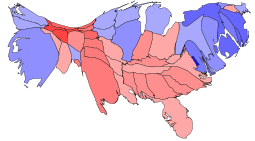
Visualization of data is one possiblity. One possible technique is the cartograph. For example here’s a nice short article by the Mark Newman that tries to give a more accurate visualization of the last election.

A drawing like that is just barely accessible. Notice that how you can see San Fransisco bay on that map. Notice the scale of Long Island.


That map was drawn using technique outlined in this paper. That paper includes some wonderful examples of how hard this kind of visualization is. For example here are two maps of the 2000 election. The more distorted, and hence somewhat more accurate, map reflects a more accurate model of were the population lives. New York, New Jersy, Massachusetts, and Pennsilvania all become distorted to show where they have urban centers. But even maps like this can’t quite capture how dense the population really is in places like Manhattan.


That paper also has a very nice example of how important it is to get this right. In this example we look at cancer cases. In the first drawing we can see that if your looking to find somebody with cancer you’d best go to NYC. But that is an entirely different from saying that NYC is a place where your likely to get cancer. In the second drawing the incidence of cancer looks almost entirely independent of population density; just the slightest sign that Love Canal near Buffalo and the poor districts of upper manhatten and the south Bronx might be problem areas.

But again second map certainly doesn’t look at all like New York State. In fact it’s proably a good rule of thumb that when visualizing data about human society if the drawing bears any resemblance to something in the physical world your probably about to be mislead.

This is the problem. How can we get people to think constructively about systems that are inherently hard to think about?

out sourcing sympathy

Phil Greenspun wrote a satirical posting on why it’s ok not to care about other people troubles. His self amused argument is that in the Modern world such work can be left to specialists.

Modern, aka Urban, life is all about residing in numerous communities. If you buy into my two part model of communities (That they stand on three legs and generally have a limited liablity for their extent.) Then Phil’s strawman can be reframed as one’s duty to other members of a community is limited to that which is within the liablity scope of that particular community.

Phil’s posting is amusing because of it’s exagerated nature. Few communities are very formality about their limited liablity contract. In fact it may well be a sign of a scam in progress when a community becomes exacting about it.

Why exactly am I expected to be sympathetic to a coworker who’s not feeling well? Is that work part of the community social contract of the workplace? Possibly not, more likely it’s part of the social contract of some larger community we both inhabit.

Sometime ago a friend of mine suffered a horrible event. It laid waste to a major aspect of their life. Discussing it, a long after the fact one aspect of the story struck me. People in other spheres of this person’s life had no idea.

It was just like the sailor with two wives, two families, in two ports recieving word of the distruction of his other home. People would have idea what to make of his mood. If he told them their first reaction would be “Gee! I never knew you had another life.” In part their reaction included an element of “Oh, I thought your loyalities lay elsewhere.”

Modern life’s advantage is that it provides a diversified portfolio. Diversifited portofolios only work well if your willing to dump parts of the portfolio.