Category Archives: politics

secession

I think it’s time to give serious consideration to secession. The polarization is too deep. The other side too clear that they are morally superior. Yes the divorce will be hard. But if you think dividing of the community property and debts is difficult now just imagine what it’s going to be like after we make the deficit permanent.

I have spent most of my life understanding the mindset of many sides in debates, but no longer can comprehend the mindset of the other side. They are beyond me. I do not wish to be associated with these people. I want out.

Those of us in the secular, industrial, innovate, educated blue states need to decide. Do we wish to go for this ride? We pay for the red states. Do we really wish to fund their anti-secular, anti-diversity, anti-little-guy agenda? Do we want the wealth distribution of Arkansas to become the national standard?

Some political actors work by polarization. Terrorists for example. The forces of polarization have done their work in this country and they aren’t done yet. I say let them go.

Internets!

Last time around the right wing treated us all to a concerted campaign to pretend that Al Gore had falsely claimed to have invented the Internet.

I presume it was nostalgia for those good old days that lead President Bush to invent the whole new and improved internets. As usual the Whitehouse made a valiant effort to prove there the existence of many Internet (or is it Interneti); even leaking top secret information to make their case.

But wait! There’s more! INTERNETS VETERANS FOR TRUTH.

BCCI

It is an amazement to me that we can be approaching the election and people can fail to know who John Kerry is. I doubt there is much I can do to compensate for that but I might as well try.

Let’s just take an example that’s very relevant to the mess in the Middle East.

BCCI was a bank run out of one of Arab gulf states. The quotes below are from the Senate investigation’s final report on BCCI.

These oil rich gulf states are an organizational pain the neck. When the wealth of a nation flows thru a few very easily controlled bottlenecks it’s almost impossible to avoid extremely severe distributions of wealth. So you get dictators. A handful of men with nothing that can counter act their power; particularly nothing at home. It breeds the worst kinds of societies. Oppression, slavery, prostitution, terrorism, powerful wealthy bad-actors. The typical mess you get when the distribution of wealth becomes so severe that nothing prevents abuse of the little guys while at the top the competition becomes vicious.

And it’s a mess that tends to spread. Because the money and power buys friends and the vicious local culture when exported can find the liberal democratic culture easy prey. BCCI was a perfect example of this kind of spreading cancer.

BCCI’s criminality included fraud by BCCI and BCCI customers involving billions of dollars; money laundering in Europe, Africa, Asia, and the Americas; BCCI’s bribery of officials in most of those locations; support of terrorism, arms trafficking, and the sale of nuclear technologies; management of prostitution; the commission and facilitation of income tax evasion, smuggling, and illegal immigration; illicit purchases of banks and real estate; and a panoply of financial crimes limited only by the imagination of its officers and customers.

Nice people huh?

While BCCI was an ugly mess. But of course such things aren’t hard to find. Here are a few examples: Enron, WorldCom, the California energy debacle, the 80s Savings and Loan mess, the War in Vietnam, the fouled up process of going into Iraq, the apparent institutional breakdown in the days leading up to 9/11, Love Canal, Abu Ghraib, Somilia, Reconstruction after our Civil War.

These are society’s equivalent of natural disasters. They are like a Hurricane sweeping across the Florida pan handle, or the 6 story waves that recently hit the populated coast line of Japan. But these aren’t, entirely, acts of nature and on our good days we learn from these. We toughen up the building codes, we set the buildings back from the shoreline. We remove for the scene those folks who were failed to do the building inspections. We fine the builders that cut corners. We punish those that bribed or took the bribes.

Societies learn. Sometimes one of these comes along and we discover a failure modality that we haven’t seen before – the Asian currency crisis in the 90s was one of these. With luck we figure it out and then lay in regulatory mechanisms – building codes – to temper the risk it will happen again.

Social disasters like these sometimes have bad actors at their core. These actors who labor to overcome society’s defenses.

In 1977, BCCI developed a plan to infiltrate the U.S. market through secretly purchasing U.S. banks while opening branch offices of BCCI throughout the U.S., and eventually merging the institutions. BCCI had
significant difficulties implementing this strategy due to regulatory barriers in the United States designed to insure accountability. Despite these barriers, which delayed BCCI’s entry, BCCI was ultimately successful in acquiring four banks, operating in seven states and the District of Colombia, with no jurisdiction successfully preventing BCCI from infiltrating it.

When these social disasters happen it is very rare for them to go entirely unnoticed. For example the CIA knew what BCCI was up to.

By early 1985, the CIA knew more about BCCI’s goals and intentions concerning the U.S. banking system than anyone else in government, and provided that information to the U.S. Treasury and the Office of the Comptroller of the Currency, neither of whom had the responsibility for regulating the First American Bank that BCCI had taken over. The CIA failed to provide the critical information it had
gathered to the correct users of the information — the Federal Reserve and the Justice Department.

After the CIA knew that BCCI was as an institution a fundamentally corrupt criminal enterprise, it continued to use both BCCI and First American, BCCI’s secretly held U.S. subsidiary, for CIA operations.

It is also a very common pattern that as these disasters unfold the coordination problems between societies institutions (rivalry for example) frustrate pulling together an appropriate response. For example the various parts of the justice department didn’t seem to be able work together on BCCI.

Justice Department personnel in Washington, Miami and Tampa obstructed and impeded attempts by New York District Attorney Robert Morgenthau to obtain critical information concerning BCCI in 1989, 1990, and 1991, and in one case, a federal prosecutor lied to Morgenthau’s office concerning the existence of such material. Important failures of cooperation continued to take place until William P. Barr became Attorney General in late October, 1991.

Cooperation by the Justice Department with the Federal Reserve was very limited until after BCCI’s global closure on July 5, 1991.

We almost always get to watch the good guys getting confused about what their job is. Acting to assure their local benefit rather than doing their job.

Some public statements by the Justice Department concerning its handling of matters pertaining to BCCI were more cleverly crafted than true.

One way the bad guys manage to pull off something like BCCI is to buy their way into the elite fabric of the societies they are undermining. Much the way the Enron’s Ken Lay was Bush’s largest donor last time around, or the local TV broadcast stations use are so friendly with those who regulate them, or the local savings and loan banks were so friendly with their regulators in the 80s.

BCCI’s systematically relied on relationships with, and as necessary, payments to, prominent political figures in most of the 73 countries in which BCCI operated. BCCI records and testimony from former BCCI officials together document BCCI’s systematic securing of Central Bank deposits of Third World countries; its provision of favors to political figures; and its reliance on those figures to provide BCCI itself with favors in times of need.

The result was that BCCI had relationships that ranged from the
questionable, to the improper, to the fully corrupt with officials
from countries all over the world, including Argentina, Bangladesh,
Botswana, Brazil, Cameroon, China, Colombia, the Congo, Ghana,
Guatemala, the Ivory Coast, India, Jamaica, Kuwait, Lebanon,
Mauritius, Morocco, Nigeria, Pakistan, Panama, Peru, Saudi Arabia,
Senegal, Sri Lanka, Sudan, Suriname, Tunisia, the United Arab
Emirates, the United States, Zambia, and Zimbabwe.

While that kind of relationship building is well worth it as the cancer spreads it has a much more serious consequence.

When the disaster finally becomes obvious every one of those partners in crime becomes an ally for a cover up. These are powerful people.

To stand up to that power takes guts.

Who led the Senate investigation on BCCI? John Kerry.

Could there be any experience that makes a man better suited to understanding what is really unfolding in the Middle East?

Do you want a president with that experience?
Comic Genius

Benziono NapaloniI think I’ll try out the Brad DeLong technique and bring your attention to something by quoting the entire article. Let’s see if I get this right.
In the royal court of the shrill the Third Assistant to the Second Vice Jester innovates new modalities of shrill giggling.

It’s debatable

Now, I had never seen George Bush speak for any length of time before watching the three presidential debates.

I had no idea.

The man is a comic genius.

The sheer breadth of his repertoire, the winks, the allusions, the outright mimics of so many comedy greats, it’s astounding, exhilarating, it’s

Oh, where to begin?

It’s the ongoing homage to the old Mack Sennett zanies: Too Many Highballs, The loud mouth, The bluffer, A close shave, Hubby’s latest alibi, Daddy boy, The beloved bozo, Remember when? the list just goes on and on.

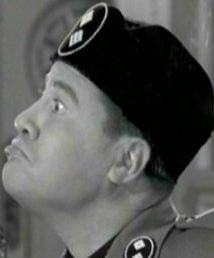
He’s nailed, I mean nail-ed, the Emmett Kelly frown, Harry Langdon’s blank stare, Sam Kinison’s delivery, Judy Holliday’s incredulity, Jack Benny’s shrug, Harold Lloyd’s eye shifts, Jack Oakie’s Benzino Napaloni pout, Don Knott’s indignation, Bill and Ted’s memory lapses, Shirley Temple’s lemon-squeezed determination, Lucy’s look when caught by Desi and that thing, that thing he does when he gets all riled up by something Kerry said and, when given the chance to respond, just freezes.

Man, that’s good television.

As a leitmotif, I sensed a grand homage to Gilda Radner’s Miss Emily Litella character in all those instances where he was asked a question, and responded with a fully off-topic descent into nonsense.

Actually, Mitch McConnell had a minimum wage plan that I supported that would have increased the minimum wage. But let me talk about what’s really important for the worker you’re referring to

And, let’s be frank, who but the most avant-garde comedian would maintain a lump of white spittle on the right-hand corner of their mouth for the entire first half of a “serious debate” if they had no ulterior vision in mind?

(A coincidence that Derrida had just died, and a new era of perception had dawned? I think not. The man knows his audience.)

Gosh, there are so many to choose from, but I really think the defining moment came in the second debate, when discussing the issue of Supreme Court appointments:

That’s not what the Constitution says. The Constitution of the United States says we’re all-you know, it doesn’t say that. It doesn’t speak to the equality of America.

That, my friends, is comedy gold.

Is he wired?

Well, let me just ask you this: would you expect Letterman or Leno to perform their monologues without cue cards?

Let’s be honest, now.

Make less, make more!

Many years ago my father advised me to avoid antenna design – “Too much black magic.” I took that advice; but I seem to have fallen into a similar trap, i.e. pricing.

Consider this pricing problem. You sell a product which two classes of people. One class, 10 people, would be willing to pay 100$ a unit. A second class with 90 people in it are willing to pay 10$ a unit. So if the vendor charges 100$ he will make $1,000; if he charges 10$ then he will also make a $1,000. If the the first class is willing pay a bit more or the second class is willing play a bit less then the vendor will profit if he makes only 10 units.

That story is a bit bloodless so let’s put some adjectives on these classes. The first class is desperate if they are willing to pay so much. We might say the first class is very loyal to the vendor’s product and nothing else will do. We might say the first class is locked in.

Early in the Bush administration a handful of electricity vendors in California realized they were in exactly this situation. They could make money if they sold less electricity. So they shut down some generating plants. They called it maintenance and complained about excess regulation. The first class of buyers, unable to switch, locked in, and addicted to electricity then drove up the price to amazing heights. At the time experts knew exactly what what was going on but the regulatory organization had been entirely cooped by the industry and so nothing was done. Amusingly the Bush folks talked about how we needed more supply which was true, and suggested we should open up new oil fields which was irrelevant.

There is a picture in my local paper of a long line in front of a pharmacy down the street from me. Long lines are a symptom of a group of folks in the first. They were queued up to get flu shots. The supply of flu shots has fallen sharply. The price is up. Clearly this market is just like the one in the model above. There is a core of desperate buyers willing to pay a lot; as demonstrated by their willingness to wait in extremely long lines. I’m suspicious that it’s also an example of the kind of story shown above.

What’s fascinating about some of these scenarios is how the trigger of the mode switch could come from anywhere. For example an investor in firm A might strive to get firm B shutdown; say by reporting safety violations to a regulator. Then when the firm B gets shutdown and the large class of low price buyers go looking for an explanation the regulator gets blamed.

The California electricity debacle shown how deeply the pro-business Republicans have undermined the regulatory systems in this country and sadly it makes me terribly suspicious about the current flu vaccine situation.


Meanwhile the Bush administration thinks scientific fact is a special interest group, and certainly not part of their base.

Undecided

Some times a postings just take my breadth away. … Let’s leave it at that.

Well no.

This is another posting about the logic people use for justifying their not engaging with American politics. It is written in response to this posting.

The value of a platform of public goods is that you don’t have to negotiate everything. As you drive down the street you don’t need to negotiate how to pass the oncoming driver. Why? Because the social contract has a subparagraph about that. When you go to the hardware store and buy a length of rope you don’t need to bring your own measuring sticks because society has internalized a set of weights and measures. Should the exceptional cases arise and bad or deeply confused people abuse the social contract then, we can hope, society’s institutions will correct the problem.

Living inside a strong social contract gives the actors access to a deep pool of public goods. The economists would call that a club. Inside the club boundary so much seems to be free.

It is not free!

Each of us inside the social contract pay something toward it’s maintenance. We pay with our taxes. We give our attention to the maintenance of civility in the public square. We occasionally contribute to the commons. We give some our attention to good governance of the public institutions. We donate our conformance to societies norms. These contributions, in a healthy society, are amply rewarded.

While it is not free, but you may freeload. There are two standard justifications for freeloading.

One of these is the rational man justification. The ethics of the so called rational man dictate that everything is a negotiation. Always capture the discount. Always minimize your cost. Drive a bit over the speed limit. Cut the corner on the road. Never hold the door for a stranger. Capturing 5% here, 20% there; it is a pretty good return on the investment. Don’t vote; it’s not cost effective. Don’t engage in the political process it might dirty your ethics. The rational man lives inside the club and then declines to pay the dues. He is a parasite. He considers those who labor maintains the public goods to be irrational, possibly delusional, and at worse dishonest. He projects his nature onto them and assumes that their motives are similarly parasitic.

The parasite has a few additional decorative elements he usually deploys to decorate his self justification. He likes to argue that his taking is synonymous with thrift. Thrift creates economic value. He likes to argue that he was coerced into club membership and so it isn’t fair to hold him to it’s norms; the short form of that is ‘I don’t recall signing a social contract.” He likes to deploy the word freedom to mask his abuse of the social contract.

There is another justification. Attention management. Nobody can devote attention to all the clubs of public goods we draw upon; that is just impossible! The list of public goods we draw upon is infinite: the public library, the public street, the public park, the ecology, the peace and quit, the public school, the rules of the road, the language, etc. etc. etc. One will have to freeload on most of these.

So people focus. They pick their club(s) and they do what they can. This justification does not make you a parasite, it makes you humble. You are grateful to those who do maintain the public goods you use; you respect their work and you are grateful.

So back to the topic at hand. American politics. Some of the pool of undecided-voters or non-voters presumably fall into each of these camps.

Some are just parasites – they freeload on the public goods created by strong good governance. They reveal their allegiance to the rational-man/parasite world view when they project evil motives on those who do participate. Getting these people back into the political process is a bit of mixed bag; since if they assume that the political process exists to serve the rational man’s continuous striving to capture the best possible deal for his self interest they are very likely to participate in a way who’s emphasis is taking from the pool of public goods rather than creating a yet more vibrant pool.

Some undecided or non-voters presumably fall into the second rational. Their attention is elsewhere.

So what brings them back. One thing that brings them back is their sense of responsibility. Some come back because it’s a ritual like church on Sunday or parent’s night at the school.

Some come back because the word goes out from those they trust: ‘We need you now!”

This is a common pattern around public/club goods. On the good days a few caring souls can keep the boat afloat, but then a bad day comes and the call goes out. Funding for the public library is about to be cut. The traffic light at the corner of 12th and main has gotten really lousy. Somebody is trying to take private your open source project. The call goes out. People come out of the woodwork. People who care enough to come forward when they are needed.

For those who labor at the center of a public good’s maintenance it is always a little hard to understand why more people don’t step forward to help. Since there is always plenty to do, always the threat of a crisis. One is always making the call for help, to some degree.

But, for those of us involved with American politics it is particularly hard to imagine how anybody could still be undecided at this point.

The call has gone out. The voices are horse from pleading. The other side calls this shrill. American, that shining city on a hill, the hope of the planet, has fallen into the hands of the parasites. They are writing themselves checks and putting their idiot sons in the mayor’s office. It’s not clear if we can stand another four years of this.

The time has come for all good men to come to the aid of their party. Come out of your walled gardens. Duty calls.

sorites paradox

Horse chestnut in prickly shell
Mother nature flings horse chestnuts down from the trees to konk you on head. “Winter is coming!” So too society has arranged warnings of that an election is coming. Society is throwing about all the old chestnuts.

Sorties paradox is back for a visit. You remember old sorties don’t you? A grain of sand is not a heap. I add a grain. Still not a heap. So! Argh! It’s hopeless I’ll never get a heap. Heaps don’t exist. They are impossible. Might as well give up on the heap thing. Move along. Nothing to see here.

The election version of this silly chestnut substitutes votes for gains of sand, and heaps for political power.

The story goes like this. The chance your vote will effect the outcome of the election is very small. So it’s value to you must be small. So be sure to make the cost/benefit analysis before you bother to go vote.

The problem with arguments like these, so popular with the self ascribed rational man, is that in the rush to get a sweet little model we had to kill the patient.

Voting is not a game you win. Voting is one of the rituals performed to denote your membership in the body politic. That body is already heap and to think usefully about it’s function you must focus on the body, not on single cell. The argument is like saying “You don’t need that skin cell over there do you? … So see you don’t need skin.”

Chestnuts like this are deployed to a purpose. In this case the purpose is not to amuse or be cute. The purpose is to suppress turn out. High turn out is good for one side and bad for the other. It serves the same purpose as Republican resistance to simplified voter registration, or deploying a heavy police presence at polling places in black neighborhoods on election day.

It’s purpose is to shape the body politic. Like much of the rhetoric of the right it’s disingenuous. The Right isn’t anti ‘big government” it’s just against a big, diverse, body politic. A small uniform loyal body is easier to coordinate. Everything you have been so carefully taught about how politics is evil, and government is bad – it’s purpose is to convince you to volunteer to exit the body politic. Collective action is not evil. Hard? Yes. Evil? No.

That guy? The one arguing that heaps don’t exist. He’s defending his heap.

Language

From a the school’s parent newsletter…

“The No Child Left Behind (NCLB) Act mandates that principals supply military recruiters with a mailing list of all high school students in order that the military can send information to students’ homes about opportunities for careers in the armed forces. …”

Reminding me of this phrase: “Language falls dead in the hands of the powerful.”

Social Miracles

This is a very nice appeal by Duncan Watts to not forget that central control and hierarchy is not the best way of solving organization problems. His desire it to temper the drive toward a centralized solution to the problem of “intelligence failure.” I’m glad he wrote it because if there’s one thing that’s rarely intelligence it’s a centralized hierarchy.

He tells some classic stories of organizations that engaged in such transcendent problem solving that the results seemed miraculous. They were. This is the kind of problem solving that only a healthy organization with a deep pool of social capital can pull off.

Much the same kind of recovery happened in lower Manhattan in the days after Sept. 11, 2001. With much of the World Trade Center in rubble and several other nearby buildings closed indefinitely, nearly 100,000 workers had no place to go on Sept. 12. In addition to the unprecedented human tragedy of lost friends and colleagues, dozens of firms had to cope with the sudden disappearance of their offices along with much of their hardware, data, and in some cases, critical members of their leadership teams. Yet somehow they survived. Even more dramatically, almost all of them were back in business within a week-an achievement that even their own risk management executives viewed with amazement.

Once again, the secret to their success was not so much that any individual had anticipated the need to build up emergency problem-solving capacities or was able to design and implement these capacities in response to the particular disaster that struck. Rather, the collective ability of firms and individuals alike to react quickly and flexibly was a result of unintentional capabilities, based on informal and often accidental networks that they had developed over years of socializing together and collaborating on unrelated and routine-even trivial-problems. When talking about their recovery efforts, manager after manager referred, often with puzzlement and no small sense of wonder, to the importance of informal relationships and the personal knowledge and understanding that these relationships had engendered

Perhaps the most striking example of informal knowledge helping to solve what would appear to be a purely technical problem occurred in a particular company that lost all its personnel associated with maintaining its data storage systems. The data itself had been preserved in remote backup servers but could not be retrieved because not one person who knew the passwords had survived. The solution to this potentially devastating (and completely unforeseeable) combination of circumstances was astonishing, not because it required any technical wizardry or imposing leadership, but because it did not. To access the database, a group of the remaining employees gathered together, and in what must have been an unbearably wrenching session, recalled everything they knew about their colleagues: the names of their children; where they went on holidays; what foods they liked; even their personal idiosyncrasies. And they managed to guess the passwords. The knowledge of seemingly trivial factoids about a co-worker, gleaned from company picnics or around the water cooler, is not the sort of data one can feed into a risk-management algorithm, or even collate into a database-in fact, it is so banal that no one would have thought to record it, even if they could. Yet it turned out to be the most critical component in that firm’s stunning return to trading only three days after the towers fell.

Thank’s to Karim for the pointer.