Monthly Archives: January 2010

Arbitrary Handedness

I have a soft spot for totally arbitrary  standards  that achieve a security consequence.  Here are three examples (driving, light bulbs, and handshakes).  So I hear today that some thieves have taken to stealing a pair of shoes by grabbing the left shoe from the display in one store, and the right shoe from another store.  Clearly the shoe industry just needs to standardize on displaying one, or the other.

More on walk aways

Some time back I mentioned a great essay on the huge difference in ethical norms between normal people and business people using the mortgage industry as an example.  In effect home owners and thier friends see it as dishonorable to walk away from an underwater debt, while commercial actors see it as dishonorable not too.  The commercial actor would probably call it incompetent or weakminded to keep paying an underwater debt you can walk away from.  Last weekend Roger Lowenstein, in the  NY Times magazine, had  an article arguing that home owners should change their norms.

If your want to think about this question the first essay is much more interesting than the short article in the Times.  But, Lowenstein did one thing that got me thinking.  He enumerates a few examples of large banks walking away from large mortgages that they hold, mostly on commercial properties.  For example a mortgage on five buildings in San Francisco.  Which got me wondering about orders of magnitude.

It’s hard to be find good data but it looks like those mortgages were worth about 2 Billion dollars. Just cause it makes the arithmetic easy let’s assume that a house mortgage is  typically  two hundred thousand dollars.  So that walk away is the equivalent of ten thousand home owners walking away from theirs.

I don’t know what you can do with that number though.  The commercial mortgage market’s troubles are lagging the homeowner market.  There were about 2 Million foreclosures last year; and maybe 11 Million households that are underwater.  But I haven’t seen numbers for how many commercial mortgages are underwater.  Nor have I seen estimates for what the  probabilities  are that mortgage holders of various kinds will walk when they are underwater.

There is an  argument  that many household mortgage holders do not have the cash at hand to fund walking away.  To walk they need to switch to renting, and that typically requires first and last months rent and possibly a security deposit.  Walking away may save them a lot of money in a 2-3 year time frame, but they can’t pay the startup cost to stop the bleeding.  Sounds like a  opportunity  for some clever banker, probably somebody in the check cashing biz.

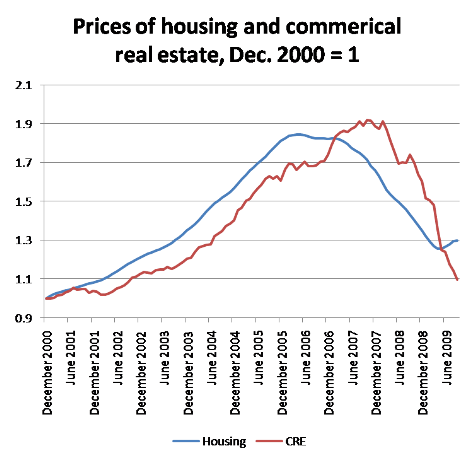
One thing this chart,

via Krugman, got me thinking is that though the commercial real estate market peaked later their norms mean that they will walk away faster, while the housing markets norms mean the walk aways are going to play out much more slowly.  Does that mean we will get a double whammy, both happening at the same time?

I’ve been thinking a lot about norms, because of this  fascinating  paper: Norm of Self-Interest (recommended many times by Andrew Gelman).  It points out that once it becomes conventional wisdom that people act in a self interested manner people become increasingly likely to conform to that expectation.  I’ve started noticing how often the when faced with a “why do you…?” attack people take shelter in the safe haven of  a self-interest  explanation.  I too recommend it.

Assumption of Generality

I gather that the term ‘Assumption of Generality’ is used in behavioral psychology to highlight the presumption that if our experiments observe a pattern of behavior in one species we are likely to observe that pattern in other species.

For example here is a typcial behaviorist experimental setup.  You put a pigeon in a cage with a button.  If the pigeon pokes the button she get’s a reward.  Then for the next 30 seconds the poking the button doesn’t do anything, but after that another poke gets the pigeon another reward.  In a sense this setup allows us to see if the pigeon has a pocket watch.  A sophisticated pigeon might learn to poke the button exactly every thirty seconds.  What actually happens is the pigeon learns not to poke the button immediately, but as time passes it give it another try, and as the 30 second mark approaches the pigeon starts hitting it more or for frequently.  The rate the pigeon hits the button is said to be scallop shaped; since frequency of pecking rises as the deadline approaches.

If we accept an assumption of generality then we would expect different species placed into a similar experiment to act in a similar manner.  Or to put it another way that they all have similar time keeping skill and  heuristics.  And indeed we do, almost.

Now for years and years I have been a huge fan of practical  behaviorism.    There are plenty of great and useful books on how to use it in everyday life to make things work better and avoid stupid feedback loops with the people around you.  You can find some pretty amazing videos of what people have trained various animals to do.  It’s clear from those that assuming generality has merit.  I had limited success once training a fish, but other people have had amazing success.

But wait a second!  Why had I never heard about the contrarian data about the Assumption of Generality.  Apparently, at least as far as that experiment above, we know that humans, and a few animals, don’t behave in the manner of pigeons.  If you put a human in that experiment they  behave in one of three ways.  You do see the scallop pattern.  You also see to two time other time keeping heuristics.  One is a kind of  rhythmic  pattern, where the animal just hits the button every few seconds.  The second scheme the animal first adopts a mode where he doesn’t hit the button at all, and then switches to a mode where he hits it a lot.

That second scheme is as if the animal takes a walk, knowing that it will be a while before the button works again the animal finds an activity that will provide a reasonable substitute for setting a timer.  This allows him to apply his mind to another activity during the interval.  The rhythmic behavior is similar, he finds something he can use as a metronome and then he can treat the button pushing as a background task.  In both cases the animal has a assembled a more symbolic, or digital time keeping heuristic.

In any case it seems to me  bizarre  that having read over decades discussions of behaviorism and it’s application to problems in various venues that not once did I happen upon the concept of  “Assumption of Generality” and that at least in some scenarios it’s known not to hold.

Stepping back, it’s way common for people to assume that what ever works the systems they are familiar with comprehend drives the other guy’s system.

Bad Behavior

I can’t believe I haven’t put this list in my collection of frameworks.

These are the eight ways to untrain a bad behavior, from Karen Pryor’s Don’t Shoot the Dog.

  1. Shoot the dog
  2. Punishment
  3. Negative reenforcement
  4. Extinction
  5. Train an incompatible behavior
  6. Put the behavior on cue
  7. Shape the absence
  8. Change the motivation

Number 6 is my favorite.  For example if you want to get somebody to stop reading, pay them to read; and then later, stop paying them.  It really works.

Nexus One Part 2

Just sat thru the live feed from the Nexus One press conference.  Reading only slightly between the lines it sounds like they announced just what I wanted to hear, a new distribution channel.  More phones to come, and more carriers as well.  In particular during the Q&A it was pretty explicit that blowing up the current costs associated with the store & agent based selling model is part of the scheme.  It will be interesting to see were the value pricing, discounting, etc. goes next.  And there remains a real tipping point when the plans finally stop including a subsidy for the phone’s cost.  I was a bit surprised that T-Mobile (and Sprint, and Verizon) wasn’t at the event – that really signals something but I’m not entirely sure what.  Finally this event had the production quality of middle school play.  I find that weird.

UpdateAnother version of this story.

Cloud Wiring

In this morning’s batch of bargain shopping news feeds appears this already  exhausted  offer.  For nine dollars Target was selling a gadget from GE that looks like a light switch; you toggle it’s toggle and it then sends a radio signal to a module across the room to turn on a lamp.  Since  I live in a house that was build before electricity it would be very useful, but once a gadget like that costs less then ten bucks it’s unclear to me why anybody would pull wiring even if you were building a house from scratch.  Building codes possibly?

No doubt that widget has just horrible engineering.  Terrible security for example.  Sloppy RF design which no doubt ruins your WIFI whenever you touch the toggle.  I’m assuming that widget is based on a bawky old industrial standard.

It’s an interesting puzzle when we will finally make the transition.  Today the vast majority of the controls that sit around the house have a wire behind them rather than a radio.  Someday the majority will have a radio behind them.  And just as interesting is how the market will shake out.  One thing that frustrates the transition is how fast the technology moves.  If we standardized on anything the tech would move on before we got it deployed.

Maybe these control signals will move thru the cellular network?  Push the doorbell and an SMS message gets sent to it’s cellular service provider who then routes the message back to your household’s high fi who’s speakers then  discretely  make the announcement that somebody is at the door.  A similar, but different, story for the household thermostat.  In that case the house would have a dozen tiny  temperature  sensing faceless cell phones scattered about the house, move them if you like, who’s only purpose is to pass  occasionally  information about the  temperature  in their environment.

All this could be done instead over bluetooth or wifi or yet-to-be-named.  And, I guess, these days the marginal cost of the widget/phone supporting lots of different schemes for connecting to the net.  But, cell phones are amazingly cheap.    I have a suspicion that the cost advantages of the cellular system’s widget production and the associated tangle of players is going to pull things down that path.

This is, of course, another part of the puzzle around Android et. al. and the puzzle of where in the stack things are more or less commoditized, and the eternal flame of who will own what in the network operating system.

Nexus One

pastedGraphicRumor is that Google will offer for sale to the general public a phone based on the Android platform, real soon now.  Here is what I hope they do.  I hope they announce a slew of phones, not just one.  That they offer a shop where you can pick any of N Android phones.  In my opinion it would be a mistake to anoint one Android phone as more or less worthy than the other offerings.  Further I think that if they want to break the tie between the phone and the cellular service they need to break the up the distribution channel in some manner.  There are plenty of tiny electronics manufacturing firms all over asia who can build these things, but they can’t distribute them.  No doubt Google wants to fix that.

I think they ought to announce a premier phone that sets a bar for these firms to aspire to, while also putting a bit of a fright into the other smart phone platforms.  I expect that phone to have some Google branding juice.  But what does that signify?  Does it signal that Google is now a cell phone maker (in the eyes of consumers)?  I hope not, I hope it only signals that the Google added value is inside (i.e. the proprietary applications).  When Sony or LG makes an Android phone based phone they will want to put that have that bit of tatoo on their phones and then it certainly won’t mean “phone from Google.”

All this assumes that Google’s overarching goal is to make cellular internet access more of a commodity than it is now.  That goal, to commoditize one of their key complements, is far far more important than having a profitable phone business.  For that to happen you have to disrupt the distribution channel that currently keeps phones, cellular service, and long term contracts in a death grip.  Building an alternate distribution channel is key.

Oh and, I’m wondering if the Apple product that is the topic of many rumors will be, ah, pliable.

The Tale of the Traitorous Story

cat-traitorSometime ago I posted about a fun book on depression era “stamp scrip” a variant of local currency that, to hear tell, actually works. In that posting I quoted a story about the surprising amusing helpful role that a high velocity currency can play. Today I happened upon the same story again, but I was bemused that the story has been repurposed. I think it is fair to say that the original story’s purpose was to illustrate why we need more currency in circulation, while the new version appears to be arguing that you shouldn’t trust the currency system.  Apparently this story lacks much loyalty to either side in the debate.

Here are the two versions, first the older one:

Charles Zylstra, the enterprising man who first introduced Stamp Scrip to America (in a small western town) tells this story. A travelling salesman stopped at a hotel and handed the clerk a hundred dollar bill to be put in the safe, saying he would call for it in twenty-four hours. The clerk, whose name was A, owed $100 to B and clandestinely he used this bill for the liquidation of his debt, thinking that before the expiration of 24 hours he could collect $100 from his own debtor, whose name was Z. So this 100 dollar bill went to B, who, greatly surprised, used it to pay his own 100 dollar debt to one C, who (equally surprised) . . . and so on, and so on, all the way down to Z, who, with much pleasure, returned the bill to A, the clerk, who, in the morning, restored it to the salesman. And then did A, the clerk, stand petrified with horror to see the salesman light a cigar with it. “Counterfeit,” said the salesman, “a fake gift from a crazy friend, Abner; but he didn’t put it over, did he?”

Apparently they used to write in paragraphs, but the modernized version is done up in newspaper standard style; one sentence per paragraph.

It’s a slow day in a little east Texas town. The sun is beating  down, and the streets are deserted. Times are tough, everybody is in  debt, and everybody lives on credit.

On this particular day a rich tourist from back east is driving  through town. He stops at the motel and lays a $100 bill on the desk  saying he wants to inspect the rooms upstairs in order to pick one  to spend the night.

As soon as the man walks upstairs, the owner grabs the bill and runs  next door to pay his debt to the butcher.

The butcher takes the $100 and runs down the street to retire his  debt to the pig farmer.

The pig farmer takes the $100 and heads off to pay his bill at the  supplier of feed and fuel.

The guy at the Farmer’s Co-op takes the $100 and runs to pay his  debt to the local prostitute, who has also been facing hard times
and has had to offer her “services” on credit.

The hooker rushes to the hotel and pays off her room bill with the  hotel owner.

The hotel proprietor then places the $100 back on the counter so the  rich traveler will not suspect anything.

At that moment the traveler comes down the stairs, picks up the $100  bill, states that the rooms are not satisfactory, pockets the money,  and leaves town.

No one produced anything. No one earned anything. However, the whole town is now out of debt and now looks to the future with a lot more optimism.

And that, ladies and gentlemen, is how the United States of America Government is conducting business today.

It’s fun to think about all the little changes.  Things happen faster these days, for example.  I like the addition of weather. And a prostitute!  How liberated.

Eccentric goals

People are writing blog posts about plans, goals, resolutions and such.  I am reminded that like a plan that manifests some  eccentricity by this guy who resolved a year ago to spend a year without getting into a car.  Nice.  After the revolution all media outlets will be required to report on some happy local who has just succeeded in keeping an exceptionally interesting resolution.  Give us all hope we can pull it off.  Help to model this fine behavior.

If you see more examples, please pass them along.

A public service announcement: You’ll get 40% more done by keeping your plans secret! So if your writing up resolutions and goals, have at it; but consider tearing up the list and don’t show anybody!