Monthly Archives: February 2004

Left holding the bag.

I want to highly recommend Josh Marshall’s excellent article printed in the New Yorker. It’s a very sophisticated look at the issue of how the United States has managed it’s emerging power on the planet.

I found particularly facinating by one story he tells.

Josh’s story expands on one of the classic cartoons that people use to sketch how communties are kept coherent; e.g. “nothing brings people together like a common enemy.” I don’t like the quality of exagerated speach in that aphorism, but I entirely agree with it’s general form that common cause is at the heart of any community. There are many species of common cause: a body of practice, a proffession, shared turf, a public good, a shared goal, a shared experiance, contracts and other kinds of ties, etc. etc. Fear of a common enemy is just one; probably a rare one.

Josh looks at what happens when our common enemy disappears from the landscape. In a community is organized around a common enemy members will subordinate their own goals and desires. They will follow leaders. They desire the coordination efficencies of a command hierarchy. They do this not out of respect for the leader but out of fear of the enemy. It is rarely as stark as that. All the baggage get’s thrown on the cart. Everybody will decorate their justifications for riding on the bandwagon. They drag out the usual suspects: shared values, a common narrative, tradition, social ties, etc. etc.

So when the common enemy disappears it’s interesting to look at what happens. One thing happens to the members and another happens to the leaders.

Regular members first. People start dropping off the bandwagon. They start following their own muse. This alone is enough to change the topology of the community. It grows less intense, more difuse. The resources that people put into it fall. The strength of the ties grows a bit weaker. A general sense of nostalgia emerges for the good old days. But nostalgia isn’t a force sufficent to create or maintain a community.

The second thing that happens is more interesting. The heart of Josh’s point is what happens to those who are at the top of that command hierarchy.

In the presence of a common foe the leaders need only to speak softly and the subordinate members listen respectfully and attempt to execute. After the common foe departs the leaders are a little like the cartoon character who’s run off the cliff but has yet to look down.
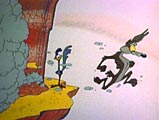
coyotefalls.jpg

So what becomes of the leaders? One possiblity is that they pack up and go home; or at least step back from the podium; or they stop speaking softly and try turning up the volume. For many leaders their idenity is deeply entangled in the community, so walking off isn’t easy.

So Josh tells two stories that fit this pattern. In the modern story on the common enemy was the Soviet Union, the leader was America, and the rest of the industrialized world the subordinate community members. In the historical story the enemy was France, the leader was England, and the community members were England’s colonies.

In that story once England triumphed over France (we called that French and Indian war) the leader announced from the podium that the colonies should help pay the bill for the war. We proceeded to: throw tea in the harbor, hop off the bandwagon, and go our own way.

I find the ‘pay for the war’ part of that story quite enlightening. It draws our attention to a third player in the story. So far we only noticed the leaders and the subordinate community members. What ‘pay for the war’ reveals is the institutional infrastructure found in any significant community. The bandwagon’s physical manifestation. As the intensity of the community declines the resources available to fund the maintainance of the bandwagon decline.

The leader is left holding the bag. That, it seems to me, increase the chance that he will deal with the situation by raising his voice. He doesn’t really have the option of stepping away from the podium, or at least not until such time as he’s found a way to scale back the bandwagon. It’s facinating how a democracy deals with a situation like this. With lucky your community members elect different leaders. Ones who lack the same affection for the good old bandwagon. Corporate boards play a similar function, again if your lucky.
Commuting as cost shifting

Wonderful posting suggesting the idea that the time people spend driving is really part of the costs associated with shopping or working. That when employers or stores shift to models that increase the time employees or shoppers spend traveling they are actually just shifting costs. He then goes on to suggest that this explains a chunk of the difference of GDP between Australia and the US.

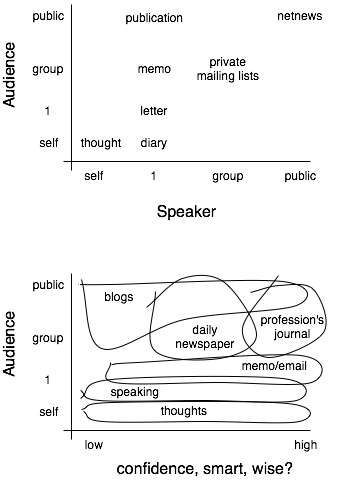
A nice example of using a blog as a way to engabe in “think in public“.

Social Networking Cartoons Chapter II

I’ve ranted before: people are missing the point of what’s going on in the explosion of the social network web sites.

But wait! There’s something else to be said. This industry, the social networking industry, has another classic pattern.

Markets tend to sort out into a population of players distributed along a power-law curve. Some industries have greater or lesser slopes on those curves. For example: while there are many independent garden centers there are fewer and fewer independent hardware stores. Michael Porter has a list of some of the reasons this happens.

How with the social networking sort out? Lists’ like Porter’s give you hints. They help forecast the future. They tell you what levers to try and pull if you want a particular outcome.

If there are strong forces that push us toward a single huge social networking sites then we are in for a bit of serious competition. If there is only going to be one then that’s a very valuable peice of real estate.

We are seeing a lot of these sites because of the low barrier to entry for creating one. If you can lower that barrier even more then you will get more.

The driver toward a single sites are always scale advantages. It is a huge pain for a person to maintain N such sites. If most of your community of contacts gathers at one site then there are strong network effects for you to settle in there and just ignore the rest of the sites.

This combination of a low barrier to entry and a strong network effect makes for a particularly high stakes game. You can get into the game cheap. The winner may carry off a huge prize.

I certainly hope we don’t end up with one site. That barriers to entry can be made even lower with open source. The network effect can be tempered by with open standards for linking these sites to each other. I certainly hope that happens; because it would be a very weird outcome to discover that almost all the clubs and organizations on the planet start pitching their tent inside one firm’s walled garden.

The forces that push industries toward one outcome or another are not invisible, they are not blind, and they are not inevitable. They are the consequence of the actions taken by the participants in those markets both individually and cooperatively.

Complaining about how autistic the social networking sites are misses the point. The key question is: what shape do you want the market to take?

Revealing$

Here is an article that I find quite amusing about the free revealing question. Putting on their rational-man everything is a market thinking cap these researchers tackled the privacy problem. They ran a little experiment to see at what price points people would be willing to reveal

For example here’s a little table showing what percentage of their respondents demanded more than $100.00 to reveal the information mentioned:

Percentage Information
48.% Salary
38.% Savings
36.% Spousal Salary
24.% Credit Rating
5.4% Weight
3.5% Age

The article has this great title: “Privacy and Deviance.” That pleasing title arises out their not too surprising discovery that if the respondent percieves the information he is being asked to reveal as being highy deviant compaired to the median he will demand a higher price; particularly if the value would imply a social negative. Overall it’s an fun bit of research. I just love that little be about revealing the spousal sallary.

Gapminder!

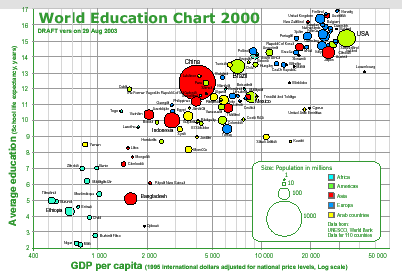
These gapminder charts are just marvelous. They are a exemplar of what we should expect from data presentation going forward. Printed data’s days are numbered.

They are also amazingly thought provoking. Just for example try out the flash based display of world income distributions. Notice how Japan’s distribution of income has become more equitable and narrow over the last twenty years. Notice how the breadth of incomes is so wide in some nations. Notice how Brazil has two peaks in it’s income distribution. Notice the same pattern emerging in the US income distirbution.

Almost all the examples are as facinating to dig into. The presentation on human development trends is particularly so. Showing as it does that the 1990s were not a particularly happy decade.

Possibly the hardest problem on the planet is how to solve the problem of third world development. As far as I can tell we really don’t know what does and doesn’t work. That’s appears to be because we don’t have very good data. What have data we have is too thin to be statistically significant. The conversation is so often confounded by various faddish adgendas. Data like that shown in these charts gives me some hope that we just might start to resolve those problems.


WorldEd.png

This link came my way via del.icio.us. It continues to please me with lots of interesting links.

Python and Lisp

Ted points out this essay intended to help Lisp dudes understand Python.

“Python supports all of Lisp’s essential features except macros, and…”

… so what’s the point? Why are people so deeply suspicious of programing languages that provide solid tools to construct the program prior to compiling it? The language designers seem to feel that programmers shouldn’t be allowed such tools. “Oh no son, you might hurt your self.” The programmers fallen for this – “Right you are boss! Oh, could you shapen this stick for me, please?”

For example here is an optional package in Common Lisp written so that it adds an amazingly powerful bit of functionality. It allows you to write programs where functions appear to generate a series of values. A suite of functions are provided to do things with these series such as generate, filter, compose them. This is very analagous to to the pipes of unix or similar constructs found in servers.

But the important point is that this package conspires to rewrite the programs written in this functional notation into more traditional programs using loops. This rewriting is made possible because Lisp provides the tools to pick up your program at compile time chew on in and put it back down again before diving into the compiler; i.e. macros.

This allows you to both to create micro-languages (or not so micro like the one above) that are problem specific. For example if you want a parser you don’t need to invent a separate program like yacc to generate parsers you can do it in the native language.

Syntax is not as important as ablity to revise the parse tree. It’s incredibly sad watching the industry slowly but surely re-discover all the features in Lisp. One at a time usually about one a year.

Battle of Standard

The Oxford English Dictionary assures me that the oldest known use of the word standard was as the name of this battle; The Battle of Standard.

In Eng. the word appears first with reference to the `Battle of the Standard’ in 1138. A contemporary writer, Richard of Hexham, relating the story of the battle, describes the `standard’ there used as a mast of a ship, with flags at the top, mounted in the middle of a machine which was brought into the field. He quotes a Latin couplet written on the occasion, which says that the standard was so called from `stand’, because `it was there that valour took its stand to conquer or die’.

The editors of the OED also spend far too much time fighting the losing battle that a standard is a triangular flag while a rectangular flag is a banner; except of course the Queen’s standard which is a rectangle.