A casual model of identity presumes that it is about self, but it’s not. Identity is about multiple actors. For example, typical usage of identity cards requires three actors, i.e. the card’s holder, issuer, and the reader. All the internet embeded identity protocols follow a similar pattern. PGP keys have the same three players. Those who sign your key fill the role of card issuer.
All of that reminds me of the seventies television detective who would carry an assortment of business cards from which he could pick the identity he wanted to adopt prior to questioning a witness. I can’t help thinking of him each time some spammer offers me yet another 50 free business cards. When I have worked for older companies they always had a business card policy, while these days you can pretty much design your own, which can lead to trouble.
At the optometrist the other day another customer was selecting glasses that would make her younger in the evenings and older when she was in front of her students. The optometrist related the story of how he has people come in seeking short term rentals of glasses, say for an interview. So there is a huge subtext of style, fashion, and the like off to one side here. Riding the subway it’s facinating to observe how carefully crafted some people’s presentation of self is.
All of which has gotten me thinking about ways that people present themselves in the internet. I can’t recall when email software first came to support automatically appending a signature file; it certainly goes back a long way. The finger/.plan file scheme, according to wikipedia, goes back at least to 1971. I seem to recall something similar on the Dartmouth basic system in the late sixties.
What triggered writing this post was noticing some interesting examples where the identity issuer role is about enabling the shaping of who you are more than authenticating who you are. That’s interesting from the point of view of the business modeling of identity systems since the issuer role is, presumably, the only really profitable role in this industry. Credit card and check printing companies do a bit of this when they let you select which cat picture to put on your card or check.
Web forums do this by allowing users to select the avatar. I’m shocked, at this point, that there doesn’t appear to a number of firms trying to capture forum avatar market. Why, for example, can’t I stick something into my account settings at the model train forum which so that my avatar there is based on my flickr photos of my train set? Or my delicious tag cloud around my train tag?
In point of fact there is a huge amount of this going on. Here are two examples.
It looks to me like Ticker Factory’s first users were hanging out in child birth forums. What ticker factory lets you do is put a simple chart into your signature showing progress toward a goal. These are very simple, here is one from a weight loss forum.
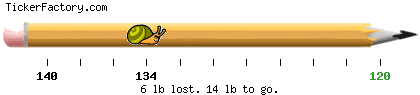
I find it notable that most of the data, the parameters, reveal not the data but information about the person’s style.
 For a while if you typed “doll” on google it would suggest that you’d might have actually meant to type “dollz“, and even today the top hit for “dolls” is not about dolls. When I first stumbled on the dollz movement I thought it was a kind of online paperdoll, which it is. but it’s actually about creating avatars and signatures. It’s discussed at wikipedia, where this provocative sentence appears.
“
.” Should of listened to her mother I guess. The dollz/avatar business appears to be huge. I wonder how much market concentration has already happened?
The first instances of cartoon dolls showed up in 1995 as avatars made for use on a visual chat client called The Palace by a Palace user named artgrrl (later known as shattered innocents)
Notice that both of these examples have a tiny bit of advertising in the resulting image. Sites like flickr and delicious accumulate quite extensive models of their users and that ought to enable them to offer services like these that are more informed about who the person is. You can inject these feedburner widgets into forums and email signatures.
I guess I don’t know where this posting is going. Maybe I should ramble on about christmas cards next.
 Presumably as the internet identity problem get’s solved services will emerge that can cough up tiny nuggets of information about those identities. Did zippy_133_a go to Harvard? Is sweet_thing_341 over 18 years of age? What percentage of wild_boy_12’s comments to blogs were flagged as spam, offensive, angry? Ebay, for example could provide a service that provides information about an identities’ feedback at there, i.e. “bought 10 items for a value 312$ with 100% positive feedback, sold 3 items for 17$ 33% positive feedback, 66% no feedback recieved.”
 Back for a moment on the left/right (aka little/big-economic entity) distinction. Consider a treaty who’s name is something along the lines of ‘Treaty to protect the rights of X.” Now, imagine the X that that is furthest to the right. ‘Treaty to protect the rights of Bill Gates?” ‘Treaty to protect the rights of the G7?’ How about: ‘
 This leads to all kinds of common but irrational behaviors. Breaking the diet, staying up to late, having a few too many beers, failing to hold our tongue, etc. etc.