Tax collecting

Bridges make great venues for collecting a tax.  They are a bottleneck. As soon as people find a route around that bottleneck then your power to collect the tax weakens.  Income taxes, for example, work only because firms have rich accounting systems that it would be hard for them to route around just to avoid the taxation.  Of course the rich can route around them.

As technology changes the bottlenecks move around; and tax collectors slowly follow along behind.  Slowly because people don’t like taxes, but inevitably because people dislike the absense of government a lot more.

So the question arises where in a highly globalized information economy are the bottlenecks where taxes might be effectively collected?  At the emerging hubs.  For example a tax on search would work.  A tax on eBay, Amazon, and Windows would work as well.  I’m surprised I didn’t see this before.  What triggered it was it appears that China sold their search franchise.  I don’t think what your seeing there is censorship; it’s about revenue, regulation, and as usual who’s cronies are in favor.  That firewall of theirs looks like a real money maker!

Micro-utility Coops

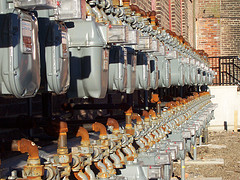
gasmeter1.jpgThere is a certain fantasy, at least among Americans, that they might go off-grid. Grow their own vegetables, keep a some live stock, heat the house with wood from from their own wood lot, a yurt, a windmill, some solar panels. Of course a the satellite TV and Internet connection would be nice. Off grid is one thing, but no TV or Internet – that’s crazy; I mean “there are more World of Warcraft players than farmers.”
The grids fascinates me; including the utility grids.

I contemplated my gas bill (google spreadsheet, the onion). Broadly the gas bill has two parts; one part is the cost of the gas and the other part is the cost of tapping into the gas distribution network. The gas distribution network is a classic two sided network; they buy from assorted suppliers and sell to assorted consumers. Here’s the formula, a function of C and T; where C is their cost to buy the natural gas, and T, the number of therms of gas I use.
Bill(T, C) = $14.72 + .34*min(0,max(T-3,47) + .053*min(0,T-50) + (1/45+C)*T

For me $300 a year, about a quarter of the bill is the cost to access the local distribution network.

I could go half off the grid, saving $150 a year if I could coordinate my purchase with a neighbor. We agree to form a gas purchasing micro-coop. One of us cancels our service and we run a pipe over to his house from the remaining service. You can buy a gas meter so the bill is split equitably.

Schemes like this are all about coordination costs. I think you could do a lot to lower those coordination costs by providing a bit of innovative technology and IT to help. For example. Consider the micro-gas coop outlined above. A vendor might offer a kit for setting this up. The kit would include a gas meter for each member which reports usage back the vendor who then bill the members. This reduces the coop’s coordination costs to signing up, setting up, and occasional maintenance of members. Reducing an on going coordination cost to mostly just a plumbing problem.

Of course there are other utilities that this makes even more sense for. Internet access and cable TV access for example. The CATV installer, some years back, told me about some guy in a small city north of here who had his entire neighborhood running off a single CATV subscription. At least at that time the rules were such that you could do that; and even today there is plenty on the CATV cable that you can view just by plugging your TV into it.

Meanwhile, flickr has a great pool of gas meter photos. Where you can see there are plenty of apartment buildings a coop housing estates were a micro-coop wouldn’t be that hard to plumb.

Banking Concentration

This is called burying the lead, in the ninth paragraph of an eleven paragraph article.

Nationwide, perhaps the most significant point in the FDIC reports was figures showing Bank of America’s total deposits account for 9.9 percent of all US deposits, including assets it is acquiring with its purchase of LaSalle Bank in Chicago, according to analysis by research group SNL Financial in Virginia. This moves the bank up against the federal limit of 10 percent, beyond which it cannot grow by acquisition.

The nominal headline of the article was that smaller banks in Massachusetts appear to be taking market share away from the larger banks.  On that topic the article appears to be mostly hearsay: “… she’s heard anecdotal evidence that frustration is driving the growth of midsize institutions. “They’re gaining on having lower fees, some higher interest accounts, and perhaps better service”.  My impression is that there is some very aggressive efforts by some area banks to drag customers in; and it appears to me this is in service of making them more attractive acquisition candidates.  For example DanversBank is both 6% interest on your checking account (with very complex rules) while at the same time it is going public.  Going public is, I think, a precursor to selling the bank off.

Presumably Bank of America will now be lobbying for loopholes so it can get yet larger.

Expensive Eccentric

Markets are the friend of the plutocracy. In the market the votes are per dollar rather than per person. Which is, in passing, one reason why “market choice” isn’t synonymous with democratic freedom. Progressive governments do assorted things to counter the pro-plutocracy tendency of markets, for example creating public goods that raise the foundation the entire economy stands upon, but that’s not what this post is about.

Tibor Scitovskyin his book “The Joyless Economy” points out that mass production can act as a countervailing force. Mass production, which can lower unit costs tremendously and that empowers the masses to draw out of the economy goods which raise their standard of living and fulfill their desires. The market aggregates their dollars and mass production leverages those dollars. These pseudo public goods are leveraged by both rich and poor.

This arguement is analogous to the change the subject argument made whenever the distribution of wealth becomes the subject of attention; e.g. that rising standards of living have raised all boats. I don’t have much patience with those arguments, but that’s not what this post is about.

Economies of scale create a well known perverse effect; they tend to make the largest producer in an industry the cost, quality, and profit leader. That’s is good for the plutocracy and bad for the health of the market. What Scitovskyin highlights is a perverse effect on the consumer side.

Scitovskyin uses an older term for the consumer, he calls them the mob. The mob is the complement of the plutocracy. The mob can only benefit from economies of scale if a coherent demand signal emerges in the market about their desires. In the absence of that signal the producers don’t know what to make. That creates a yearning for both producers and consumers to rendezvous, standardize, on achievable desires.

It is perverse that mass production creates incentives for everybody to be more conventional. Advertisers pour money into the market is their yearning to accelerated the forming of this or that consensus. It’s parsimonious to argue that when they succeed it’s their desires, rather than the mob who’s desires really being fulfilled. One is tempted at this point to call them the herd. In any case, economies of scale act encourage normative of behavior in the mob.

Markets make it expensive to be eccentric. What ever goods and services the eccentric desires are substantially less likely to be produced by the market. Of course if your rich you can bear that expense. If your poor these market forces pressure you to extinguish your abnormal desires. There is a long tradition of plutocrats fearing the mob, see French revolution. Early propagandists felt it was in their brief to help keep the mob in line. It probably says something about American education that I’d not previously noticed that the market works to normalize the mob’s behaviors.

It is amusing to note that the rich, while probably not born more or less abnormal than the rest of us, are less likely to have their rough edges worn off.

But there is another point I want to draw out here. As I’ve only just begun this book I don’t know if he goes onto make it. The economies of scale also work to extinguish some goods and services. Mass production is not a universal solution. It is not effective across all goods and services. It works well for something thing, e.g. lawn furniture, but much less well for others, e.g. live music.

So a second perversity of markets is that they work to extinguish goods and services that are resistant to scaling and this happens even if there is substantial demand for them. Thought provokingly, by the force of habit the market will label those activities as eccentric; and when members of the mob signal their demand for them they the market’s return signal will be “mind your manners.”
Bribing the Pirate

This is kind of fun.

In the October/November issue of the Academy of Management Journal, the authors note that the basic purpose of options has been to promote managerial aggressiveness in top executives, even if they sometimes led them “to undertake large-scale risky investments that tended to deliver extreme company performance.” What was not envisioned, they write, “was that the extreme performance delivered by option-loaded CEOs was more likely to be in the form of big losses than big gains.”

I’m not sure of their premise, i.e. “the basic purpose of options has been to promote managerial aggressiveness”. The purpose of options is and was to create improved alignment between the employees and the shareholders. A shareholder may want a more agressive management, i.e. higher risk and increase volatility, but only if that shareholder is well diversified so he can temper that with the rest of his portfolio. Options tend to create higher risk taking since the option holder, unlike the shareholder, doesn’t actually have capital at risk.

It’s fascinating to me how capital/shareholders may be perfectly happy to have their managers take risks that will kill the company; since limited liability shelters them from the full magnitude of the down side while they are likely to get much of the upside. So the pattern seen above maybe what the owners want.

Update: Paul Krugman makes an analogous moral hazard argument.

See also the pirate metaphor as applied to limited liablity.

Google Docs …

… now lets you embed fragments of your documents into your web pages.

That chart is x = 1..100 v.s. y = 1/(1+x). I don’t see how to tell it to make the axis log rather than linear though.

That is done with an image; but ou can also grab chunks of a spreadsheet and show them in an iframe:

Visualization

Two nice visualization examples.

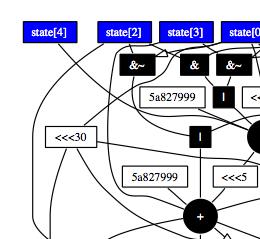
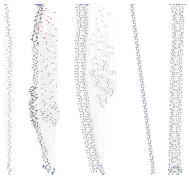
Daniel J Bernstien has a posted an extended abstract (pdf) showing some nice visualizations of assorted crypto algorithms (via Bruce Schneier). The three thumbnails below are a preview.

crypto3.png crypto1.png crypto2.png

Fun. See also.

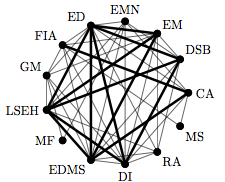
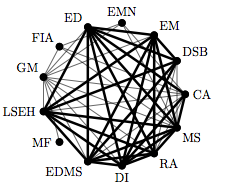
Secondly I liked this visualization of before and after pairwise correlations over time.

corr1.pngcorr2.png

I don’t think I’d previously see this visualization technique. The lines denote the degree that the nodes behave similarly. This is from a paper that attempts to puzzle out what happened in the financial markets in August 2007. One hypothesis, illustrated by that chart, is that the diverse world of fund strategies ain’t so diverse after all.  The industry’s strategies have been collapsing into a single uber-strategy.  They checked to see how correlated the returns were between pairs.  Emerging Market funds used to be only lightly correlated with Risk Arbitrage (see EM v.s. RA in the chart).  Now they are highly correlated.

This is a technique that could be run on lots of time series; for example any of the many indexes available for metropolitan areas. It could also be enhanced with color and more sophisticated graph layout techniques.

Artistic Praxis

Here’s a nice sentence template:

“This mechanism is called Z and Z is a pivotal driver of Y.  See W for an approachable introduction to the theory of Z. But be forewarned that there is a lot of artistic praxis involved as well.”

I’ve always liked the word praxis, or “practice or exercise of a technical subject”.  It also has a common usage in political theory naming the puzzling part: how to connect your grand theory of the world to practical application, or “that through which theory or philosophy is transformed into practical social activity.”

The original of sentence which I distilled that template was about financial futures.  It is a nice example of the two meanings playing off each other.  The practitioners of a craft are all about praxis, and are likely to scoff at contents of W; while readers of W are likely to find that they can’t quite make actionable the lovely theory found there in.

Daddy’s rich and momma’s good looking…

From a press release

For example, low-income households, or those at the 10th percentile of the income distribution, spend approximately $8,900 per year per child, while high-income families, or those at the 90th percentile, spend $50,000 per child.

I find that hard to believe.  Where do people in the bottom 10% find $9K/child/year?  According to this report from the BLS the top of the bottom 10% make $163/week (“Usual weekly earnings of wage and salary workers, by upper limits of … deciles …”); though I have my doubts about the correctness of just multiplying that by 52 that’s $8,476 per year.  Maybe that number includes the transfer payments for what ever actually reaches the child via food stamps and public education. For comparison that BLS report leads one to conclude that $59,228 is the 90% annual income.  These are 1999 dollars, and salaried workers.  Of course the real explosive growth in the income distribution happens after the 90% level.

Arbitration Trap

Oh my this is quite a report!  It’s about those mandatory arbitration clauses which have become so popular in various terms and conditions.  This is a perfect example of how difference between left and right is how benefits from societies institutions; small economic entities v.s. large.  Unsurprisingly the arbitration system favors the large.

The report is one outrage after another, so it is difficult to pick one thing to highlight.  For example one of the arbitration companies had a press release saying 55% of the cases are settled for the consumer, neglecting to mention that they selected only those cases filed by consumers (a few hundred); a vanishingly small slice of the cases (tens of thousands) that move through the system.  Contrast that statistic to one arbitrator they look at closely, 96% of the cases he handled were settled for the credit card company.  On a few days they mention he handled half a million dollars worth of cases a day.  Later Schwarzenegger made this guy a judge.