Warning: Goals maybe hazardous to your health

Possibly the most common prescription handed out by managers is to set goals; it’s a cheap trick for clarifying incentives.  The authors (Harvard BSchool) of this amusingly titled paper Goals Gone Wild suggest it should come with a warning label.  The paper includes a few examples of each of the deadly side effects.  These warnings are well known in the liturature on applied behaviorism.

I liked this bit of damning with faint praise from the Q&A –

Sean Silverthorne: So, are you against incentives and goals?

Max Bazerman: No, my coauthors and I are not against incentives. We believe in incentives. And each of us has found goals useful in limited domains. …

A useful paper as it is exausting running counter to conventional wisdom.

The Stock Market

Below I’ve drawn a very rough piece-wise linear summary of the Dow Jone’s average over the 20th century.

It might be better to treat the 1900-1950 period as three sections, two flat bits on either side of that roller coaster.  I think it’s reasonable to say that in seven of the ten decades the market was flat.  A sobering thought if your only spend four decades in the market in service of your retirement.

Ruby considering move to Microsoft

I am sorry to see the Sam Ruby is considering a move to Microsoft.  Like anybody of my age in this industry the strategic landscape I have lived in has always been substantially shaped by Microsoft.  They, and that means primarilly Bill Gates and his closest advisers, have played the game extremely well.  Their place in the ecosystem has given them mind boggling power.  They have played those card to their advantage with surprising skill.  Repeatedly I have watched in awe as they have crushed, absorbed, and underminded competitive threats around them.

Of course their scale means they get a very long time to puzzle out how to get that right.  I do not trust Microsoft.  No doubt there many good people there.  Vast pools of good intentions.  But the nature of the company’s role in the market and the fundimental dynamics of what is required for them to maintain that make for repeated disconnects between the goals of the individuals and the outcome that is best for the firm.

Microsoft’s core strategic requires that the commoditized everything around them.  If your a developer or partner of microsoft you upside is capped.  Open standards, and open platforms are fundamentally their greatest competitor.  Strategically they must come into those communities to assure that they remain tame.  This is often something their individual representatives in those communities do not fully appreciate.  At least until it is too late.

Sam has done a just beautiful job playing a role of that kind that coming out of IBM and into the Apache Software Foundation.  He succeeded in part because he is amazingly talented at the art demanded in that role back on the home front.  He succeeded because he was extremely clear in his own head about where he was trying to go.  He succeeded because he had a thirst to puzzle out what was new about open source that IBM didn’t know.  But importantly, what he was trying to do was fundimentally in synch with IBM’s strategic best interests.  IBM’s IP portfolio is well served by an open vibrant diverse industry.  IBM isn’t threatened by the successes of others, since it always has the option of taxing those others via it’s IP rights.  IBM other business, services, ought to love open source (of course open source is only part of puzzle of making a vibrant industry).

I wish him luck, but it makes me sad.

How to Screw the Poor

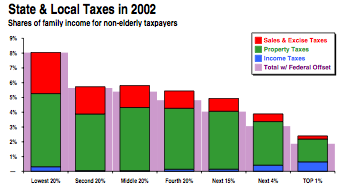
I suspect a lot of people believe that their state has a progressive tax structure.    That belief is wrong.    The well-off do not pay a larger percentage of their income and wealth than do the poor.  There are a very few exceptions, Delaware for example – at least in 2002.  Here’s what it really looks like.

Here for example is my state.

That shows how the mix of taxes effect things.  In Massachusetts it’s the sales tax that really does the damage.  The mix of taxes that implement this lovely situation for the parasitic well-off varys from state to state.  New Hampshire manages to be extremely regressive; using a different mix.

If you want to screw the poor then here some hints:

  • Avoid an income tax
  • If you have to have an income tax be sure it’s flat. (that’s what we do in Massachusetts)
  • Adopt a sales tax and some excise taxes
  • Use property taxes
  • Exclude capital gains from income
  • Use tax credits to counteract progressive taxes; say on federal taxes or certain property taxes
  • Be sure your sales/excise tax includes groceries, smokes, beer, and gas
  • Don’t index to inflation if forced into tax brackets, exemptions, or earned income payments
  • Empower local governments to raise funds using regressive means

No doubt there are much more creative schemes for assuring your tax system screws the poor.  I certainly can think of quite a few without much effort.  This posting is based entirely on the original edition of what is currently  this report, from www.itepnet.org; you can quickly find your own state here.

This is Washington state, which makes me wonder how those Microsoft and other high tech winners feel about this.

Close Monitoring

Another item for the hyperbolic discounting attention management (Ainslie) pile.

TimeSnapper (note scroll down to the free version).  This app takes a snapshot of your desktop.  Latter you can play that back as a time lapse movie. This helps you see where the time went.

I don’t use a PC so I haven’t tried TimeSnapper.  On the Mac there is a substitute: Gawker. Gawker is a tool for making time-lapse movies using your Mac’s iSight camera, but it can be used to record your desktop. I’ve enjoyed watching my days, and to my surprise I’ve enjoyed seeing what my machine does at night.

Apparently people use TimeSnapper to prove to their clients that they were actually working on the project during the hours they claimed.  Obviously this could be used for all kinds of abusive monitoring.

Which reminds me.  I gather that some years ago the US Post Office was well known for having the most horribly polarized employee/management known.  Visiting my local Post Office during an open house I was amazed to discover that they had built the place with high ceilings.  In that space they had built walkways from which the management to observe the workers.  These walkways were enclosed with tiny spy holes; to assure that workers didn’t know when they were being watched.  The staff was as amused as I was.  The observation posts hadn’t been used in years.

Update: Karim Lakhani mentions Freedom, A mac app that disables your networking for up to eight hours.

I hear the Firefox plugin – LeechBlock is popular.

Tip of the hat to John Sequeria who mentioned TimeSnapper.

Minimum Dosage

“study shows that health benefits follow from just 2 minutes of written  expression. Certainly these results do not mean that spending more time expressing  emotion is bad but they do show that the minimum dosage required may be lower than previously thought.” — Burton and King

What we really want to know: “Is 140 characters enough?”

See also: blogging happy?

Stress from the ongoing digital apocalypse

The four horsemen of the digital apocalypse  are cpu, storage, communication, and content, aka Moore’s law and his friends mean that costs are always falling, capablities are always increase, and displacement opportunities are always popping up.  These are the drivers that keep pulling the rug out from under any industry that’s built on them.  The telecom industry, the entertainment industry, the content based industries.

Muzac didn’t stand a chance, but how did it manage to last for decades?  It was originally a high tech company, repurposing the latest military electronics for consumer markets.  In that way it is a classic example of firm based on an opportunity created by Moore and his friends.  But it’s long survival comes on the other side of the equation; the difficulty of displacement – or something like that.  It appears that a lot firms bridge a gap between what falling commodity cost of these things and their customer’s inablity to move that fast.  The installed base moves in fits and spurts.  The firms struggle to manage that.  There is a tension, if they can get the gap larger they capture more revenue.  But large gap creates a tension where competors can step into.

To take an example the Telecom industry didn’t lower prices for decades.  Their network effects made routing around them very hard.  But finally the largest customers started to route around them.  Much later the industry suffered a vicious restructuring.

Which brings me to today’s question? We have numbers, i.e. communications capacity doubles ever 9 months.  So what’s the number for cloud computing and why do EC2’s price trends appear to be unconnected the price trends of their cost of goods?