Quicklisp new packages, October 2013

Xach has announced the the October 2013 quicklisp release.  Below are short summaries of the new packages.

asdf-package-system 2K -- No license specified?
  No description provided.
  git: git://common-lisp.net/projects/asdf/asdf-package-system.git

ayah-captcha 4K -- MIT
  A simple interface to the API of the play-thru captcha of areYouAHuman.com
  author: Andy Peterson
  git: https://github.com/aarvid/ayah-captcha.git
  more: https://github.com/aarvid/ayah-captcha#readme

cl-binaural 4K -- GPL
  Utilities to generate binaural sound from mono
  author: Alexander Popolitov
  git: https://github.com/mabragor/cl-binaural.git
  more: https://github.com/mabragor/cl-binaural#readme

fgraph 6K -- EUPL V1.1
  No description provided.
  author: Thomas Bartscher
  mercurial: https://bitbucket.org/thomas_bartscher/cl-fgraph
  more: https://bitbucket.org/thomas_bartscher/cl-fgraph

cl-larval 20K -- GPL
  Lisp syntax for assembler for AVR microcontrollers
  author: Alexander Popolitov
  git: https://github.com/mabragor/cl-larval.git
  more: https://github.com/mabragor/cl-larval#readme

cl-ply 10K -- LLGPL
  A library to handle PLY file format which is known as the Polygon File Format or the Stanford Triangle Format in Common Lisp.
  author: Masayuki Takagi
  git: https://github.com/takagi/cl-ply.git
  more: https://github.com/takagi/cl-ply#readme

cl-server-manager 5K -- MIT
  Manage port-based servers (e.g., Swank and Hunchentoot) through a unified interface.
  author: Wei Peng
  git: https://github.com/pw4ever/cl-server-manager.git
  more: https://github.com/pw4ever/cl-server-manager#readme

cl-spark 10K -- MIT License
  Generates sparkline string for a list of the numbers.
  author: Takaya OCHIAI
  git: https://github.com/tkych/cl-spark.git
  more: https://github.com/tkych/cl-spark#readme

curry-compose-reader-macros 2K -- GPL V3
  reader macros for concise function partial application and composition
  author: Eric Schulte
  git: https://github.com/eschulte/curry-compose-reader-macros.git
  more: https://github.com/eschulte/curry-compose-reader-macros#readme

drakma-async 26K -- MIT
  An asynchronous port of the Drakma HTTP client.
  author: Andrew Danger Lyon
  git: https://github.com/orthecreedence/drakma-async.git
  more: https://github.com/orthecreedence/drakma-async#readme

draw-cons-tree 2K -- Public Domain
  Makes and ascii picture of a cons tree
  author: Ported by:CBaggers - Original Author:Nils M Holm
  git: https://github.com/cbaggers/draw-cons-tree.git
  more: https://github.com/cbaggers/draw-cons-tree#readme

filtered-functions 5K 
  An extension of generic function invocation that add a preprocessing step before the usual dispatch.
  No description provided.
  author: Pascal Costanza
  darcs: http://common-lisp.net/project/closer/repos/filtered-functions/
  more: http://common-lisp.net/project/closer/filtered.html

graph 37K -- GPL V3
  Simple library for building and manipulating graphs.
  author: Eric Schulte, Thomas Dye
  git: https://github.com/eschulte/graph.git
  more: https://github.com/eschulte/graph#readme

lisphys 19K -- Specify license here
  Describe lisphys here
  author: Guillaume
  git: https://github.com/kayhman/lisphys.git
  more: https://github.com/kayhman/lisphys#readme

mailbox 2K -- MIT
  Simple multithreading mailboxes.
  author: Lucien Pullen
  git: https://github.com/drurowin/mailbox.git
  more: https://github.com/drurowin/mailbox#readme

map-set 2K -- BSD 3-clause (See LICENSE)
  Set-like data structure.
  author: Robert Smith
  mercurial: https://bitbucket.org/tarballs_are_good/map-set
  more: https://bitbucket.org/tarballs_are_good/map-set

cl-oneliner 3K -- wtfpl
  Given a piece of text, summarize it with a one-liner
  author: mck-
  git: https://github.com/mck-/oneliner.git
  more: https://github.com/mck-/oneliner#readme

pooler 4K -- MIT
  A generic pooler library.
  author: Abhijit Rao
  git: https://github.com/quasi/pooler.git
  more: https://github.com/quasi/pooler#readme

readable 443K -- MIT
  'Readable' extensions to Lisp s-expresions: curly-infix, neoteric, and sweet expressions
  author: David A. Wheeler
  git: git://git.code.sf.net/p/readable/code
  more:  http://readable.sourceforge.net/

simple-currency 13K -- BSD, 2 clause.
  Currency conversions using data published daily by the European Central Bank.
  author: Peter Wood
  git: https://github.com/a0-prw/simple-currency.git
  more: https://github.com/a0-prw/simple-currency#readme

smackjack 17K -- MIT
  A small Ajax framework for hunchentoot using parenscript
  author: Andy Peterson
  git: https://github.com/aarvid/SmackJack
  more: https://github.com/aarvid/SmackJack#readme

snappy 7K -- New BSD license.  See the copyright messages in individual files.
  An implementation of Google's Snappy compression algorithm.
  author: Robert Brown
  git: https://github.com/brown/snappy.git
  more: https://github.com/brown/snappy#readme

spellcheck 2,376K -- MIT
  Peter Norvig's spell corrector.
  author: Mikael Jansson
  git: https://github.com/RobBlackwell/spellcheck.git
  more: https://github.com/RobBlackwell/spellcheck#readme

tagger 1,107K -- No license specified?
  No description provided.
  git: https://github.com/g000001/tagger.git
  more: https://github.com/g000001/tagger#readme

As usual many older packages were revised.
Approving the Journal

Voteview is an amazingly simple model for behavior of legislators. It takes as input the votes of the legislature and assigns each legislator a score. These scores are, surprisingly, quite stable. Surprisingly, legislator’s behavior is dependable and predictable. It takes only two numbers to model legislators with surprising accuracy. Two numbers mean we can draw scatter plots with one point for each legislator. That reveals natural coalitions.

The math doesn’t tell us what the scores mean. To puzzle that out you need to look at what the votes were about. When this technique was first discovered the first score measures the left/right (economic) political spectrum. That means things how the government aids small vs. large economic entities. The second was left/right (social); primarily civil rights, but also broader issues such as the franchise. But the two score means can vary from one legislature to another and can shift over time. The first score is a more powerful predictor and if you add a third score it hardly improves the accuracy.

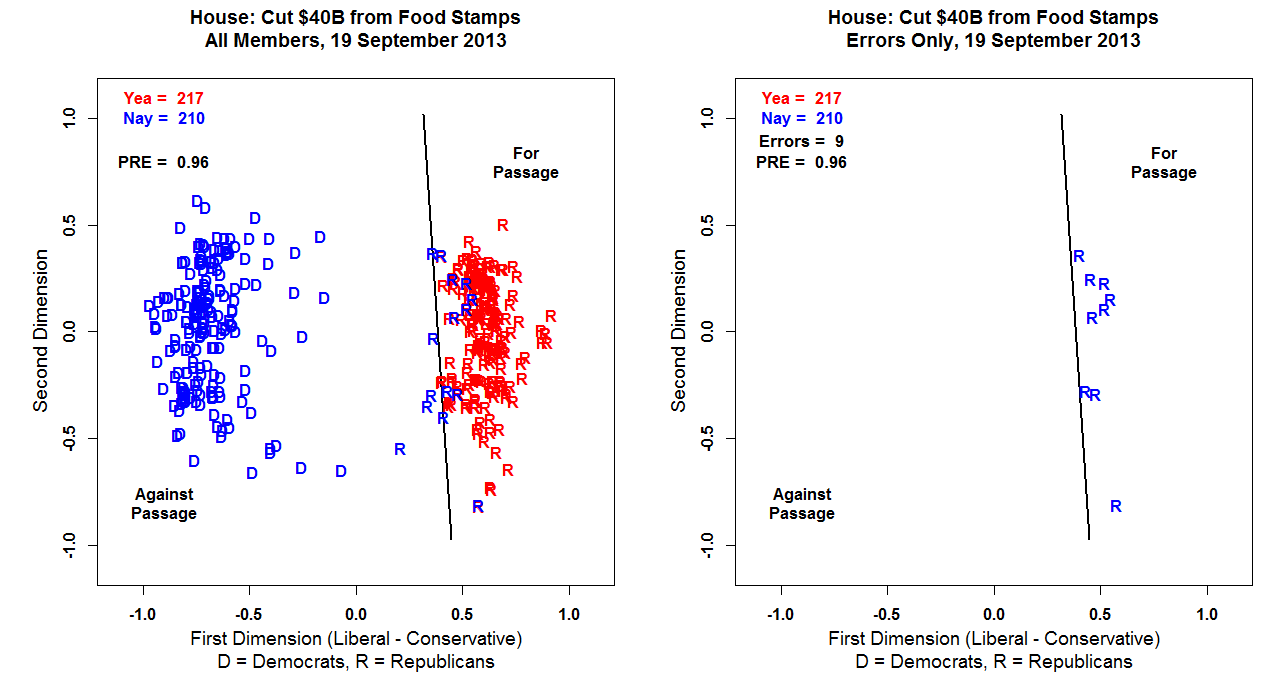
Here, for example, is the vote to reduce the food stamps program. The letters indicate the legislators. The line shows how the bill partitioned the space.

OC_House_113_cut_food_stamps

This bill was nearly perfectly aligned on the economic left/right spectrum.  With the left wanting to aid the small players in the economy.   The right panel shows the errors in the model’s fit.  You can notice how there is no overlap between the Democrats and the Republicans.  That is unusual from a historical perspective.  This model was the first clear way to show that the congress was growing extremely polarized over the last decades.

The meaning of the vertical score has become less clear over the last few years.  As for various reasons social left/right issues have tended to condense into the economic issues.   It is interesting, and somewhat rare, to see an example vote where the 2nd score has a lot of power.

OC_House_113_approve_journal_Sept26

But what the heck is “Approve the Journal”?  Well you can read all about it here.  It is the a record of what the house has been up to (votes, conference reports, vetoes, etc. etc.).  The voteview community tends to believe that the vertical axis is now measuring some they call insider/outsider – that the people with lower scores are in the outsider group.  If so, what we are seeing here is a sort of protest vote by the outsider group.

Remember the second score adds only a little to the model’s quality.  I wrote about voteview a decade ago.  There you can see how little the second score adds to the model’s fit in that post. I’m not aware of any published data on how that has changed over time.

The voteview blog always gives an interesting clean perspective on current events.

Adding Javascript to a WordPress blog post.

I want to put a bit of JavaScript into a blog posting.  Here’s an example doing that.

This is an example!

In WordPress, toggle the editor to “Text” and then insert your Javascript similar to the following example.  Here I load jQuery and then use it to animate a div.

<script type="text/javascript" src="/wp-includes/js/jquery/jquery.js"></script>
<script type="text/javascript">
jQuery(function(){
var x = jQuery("#a1148");
var f = x.css('font-size');
var restore = function(){ x.animate({fontSize: f}); };
x.animate({fontSize:'120%'}, restore);});
</script>
<div id="a1148">This is an example!</div>

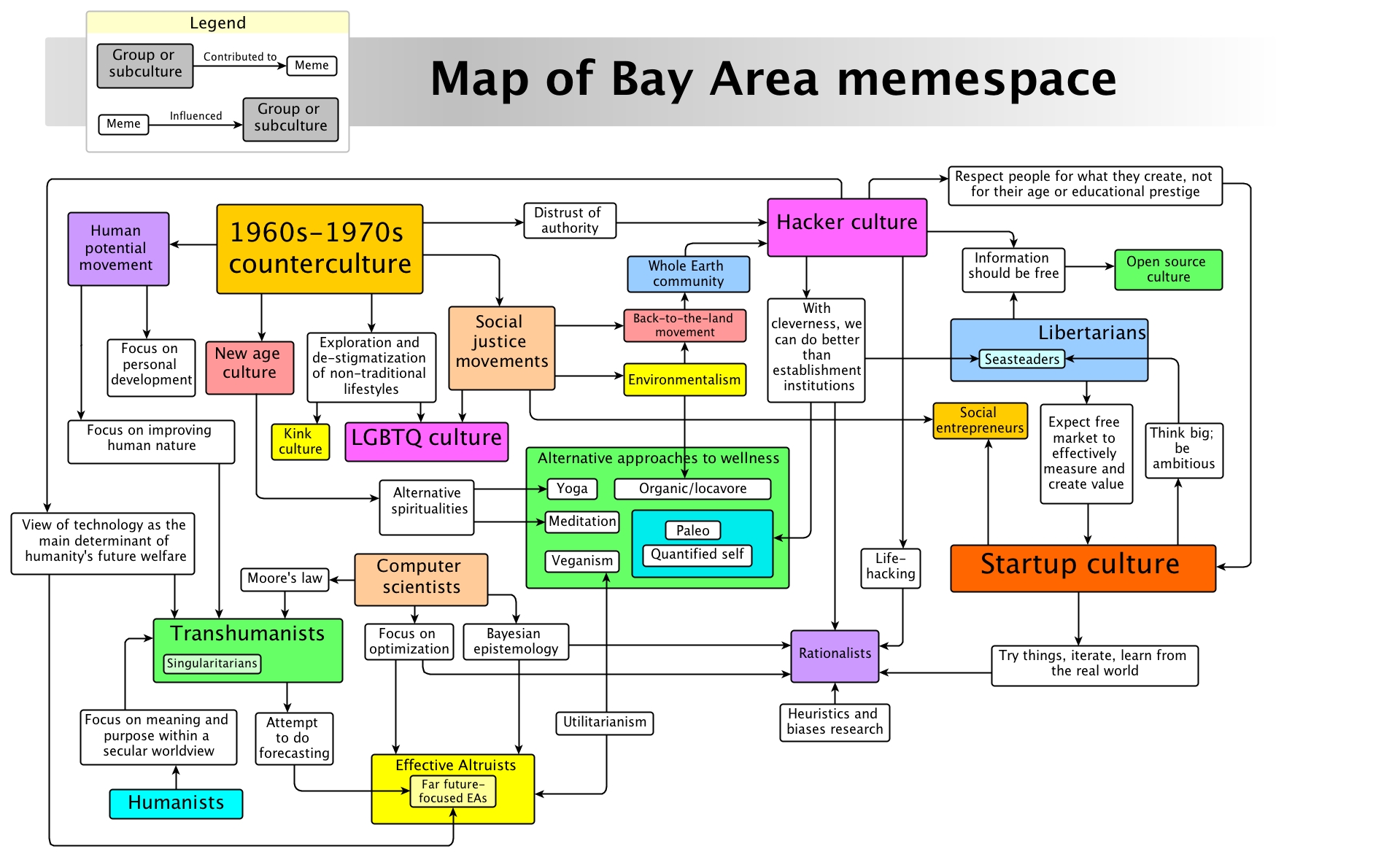
Bayesian Epistemology

I do love a big picture.

Taken from this posting.  Click for full size.

I’m sad that public service isn’t on the chart.

I’m surprise that wealth seeking is missing.  Also there is something about diversity in the Bay Area that’s missing, but exactly how to frame it is hard.  Where is social?  Where is Biotech?

The 60s and 70s are so outside of many people’s experience at this point; incomprehensible and misunderstood really.  At this point doesn’t burning man get a little box somewhere?

This and That

A new Whole Foods Market opened in my neighborhood.  It has a twitter account.  As do all the other stores around the area.  They all twitted their congratulations.    I wonder if their little community of stores has problems with bullying.

I do enjoy following testually.org, a blog about texting.   In this episode we learn about the effort to prevent marathon runners from taking selfies during the race after somebody dropped their phone as the Hong Kong marathon started.

But wait, what about the social network of brands?  Why don’t we see more brands flirting on twitter and facebook?  Here’s a bus in DC with a blog talking about a craft fair.  Of course every transportation network should have social network too.

Apparently in-spite of it being legal to ship wine into Massachusetts now it remains rare.  Only Fedex has done the paper work; and they will only ship from a seller who has registered with them.  And, the shipper maybe reluctant to ship to you into Massachusetts since he can’t discern if your getting close to your annual limit.  Which goes to explain why there are only a few places that will ship.

People!  Don’t forget the metadata!  We need an catchy name for the practice of enticing people to click thru with a content free teaser.  I.e. “This make me think!”,  “Best video ever”,  “Must watch”, “4 key risks you can avoid”, … etc.  Then we can tease people for using them, and pledge to never click ’em.

embroidery-flipbookLet this be a warning of the risks of letting you children watch too much Gumby or Gromit.  Clearly claymation is for wimps.  Be sure to scroll thru the photos so you can see the flip book the made from the individual pieces of embroidery.

Mentor market

adviceWhen I arrived at college in the early 70s the basement of the student center had a ride share board I could use to hook up with somebody for the trip back home.  It died out pretty quickly, apparently the cost of travel crossed some threshold (or the coordination costs rose) and the students started traveling on their own.   These days there are services to help you find a second passenger so you can use HOV lane, and there are a few rider matching service popping up that are in fact more analogous to taxi companies.

Matching services (Intervac, OK Cupid, etc. etc.) a subset of middlemen, account for a large swath of the various species of internet business models.  There are even firms that have portfolios of match making sites.

There are have historical precursors for all these match making buisness; like my school’s ride share board or the gay hook up that used to circle the block across from an apartment I rented.

And then, I was triggered to recall ads in the subway in NYC for SCORE.  And I see that SCORE, service that matches small businesses with retired business mentors, is still around.  I was reminded by a PR piece in today’s paper about an internet business based on a similar idea. PivotPlanet brokers matches between small business operators and folks that are thinking about getting to that line of work.  It’s pricy; for example say you wanted to shadow a micro-brewery operator for a few days; that might cost you $120/hr – but they are all booked up.  So maybe an ice cream shop instead.  They have a long list.

There is a bit of literature about why small business men in a given industry don’t actually compete with each other, but instead generously and enthusiastically share information with each other.  So I don’t find this surprising.  And then there is that pattern where the house flipper gets out of the business and instead sells a training program buy renting a boat hiring some pretty girls and making a late night infomercial.

I find it fascinating that the founder originally started Pivot Planet as a kind of travel agency.  He was selling “vacations” where you visited the mentor.  That’s kind of similar to the agencies that broker trips to interesting places where you do some service work as part of the trip.  But then there is a lot of specialty travel brokers.  The boundaries between education, training, and recreation keep getting fuzzier.

Ray Dolby’s business model

8trackI read Ray Dolby’s obituary in the New York Times because the Dolby noise reduction system is a textbook example of a two sided network business model.  Invented in the early 60’s the system enabled you to get better audio quality out of recorded sound.  It transformed the audio signal to route around flaws in the tape, tape heads, and transport mechanisms.  The problem it solved grew quite severe when cassette tapes became popular.  To get the benefit a lot of parties along the supply chain needed to play along.  Two in particular.  The companies that manufactured cassette players and the companies the manufactured the cassettes containing the entertainment.

DOLBY_Product_header-NOKIA-N8The obituary get’s it wrong.  Dolby’s achievement wasn’t the signal processing algorithms; his achievement was getting all the players to sign onto his system.  Two-sided networks (standards) are all about the difficulty of attracting, coordinating, and locking-in two diffuse groups.  Dolby managed to own a standard.  And so he got to charge a toll for his small part in intermediating between sound producers and consumers.  .  He them managed to steward that role so that even today his company (DLB) stands at the center of the standardization of sound.  Next time your watching a DVD notice how right there in the credits the Dolby name will appear.  Think about how much time and space that credit takes v.s. other contributors.  And today, it’s all digital!

I wonder if any of the New York Time’s obits talk about the deceased’s business model.

This and That

It’s interesting that Microsoft choose to leave the Nokia patent portfolio behind, effectively encouraging a known patent troll.  I seem to remember some other cases where they left the patents behind, taking only a license.  That provides a clever way to achieve the benefits of a patent rich market without having to look like your the problem.

This reminder feature in Google’s card scheme might be an interesting foreshadowing of the user experience that they intend for what ever finally replaces Google Alerts and Google Reader.  It starts to follow thru on the value of prospective search; i.e. allowing users to have standing queries related to their interests.  … or do I mean their buying signals.

Excellent short article about the way Google is slipping a runtime library between the (open) Android OS and all their (proprietary) Apps.  The fragmentation in the Android space is a problem.  But, this threatens the promise of an open platform.