Author Archives: bhyde

Social – needs more thought

I have always thought that Friend Feed was built to flip, and further I’d presumed that when imagining who’d acquire them they always thought it would be Google.  But over time, no doubt, Facebook came to seem just as likely.  So, whatever.

But,  I’m stewing a hypothesis, call it: Google doesn’t get social.  Google’s not buying Friendfeed is another small potato into that pot as are Talk, Wave, Docs, Profile, iGoogle…

Google and Facebook grew from distinct social cultures and their approaches reflect what social means for those cultures.  Facebook’s, the social activities of ivy league college freshman, was a better starting point than Google’s – the collaborative open source graduate-school development model.

I’m not deeply committed to this theory.  But there something different emerging in the Facebook, Elgg, and Linked-in model of sites – and maybe Twitter and Friendfeed as well.  It is a thing that’s different from what you get in the forum or bboard model.  And it appears to be different from what firms like Ning or Acquia are chasing with their group forming (Reed’s law) model.

Needs more thought.

Perils of Punditry

No doubt most of my readers have columns in the New York Times, and so they are in need of a list of rules to follow to help assure their columns are highly impact.  I’ve taken a stab and distilling out actionable rule of thumb implied by this old and interesting critique of Bob Herbert’s columns in the New York Times.  It has a nice subtitle “The perils of punditry for the powerless

  • Good: Stories about the rich and powerful
  • Bad: Advocate for the disadvantaged and disenfranchised
  • Good: Emotionally evocative stories about individuals
  • Bad: Emotionally neutral arguments, particularly those involving math or statistics
  • Good: Confirm conventional opinion.  (Inside the echo chamber.)
  • Bad: Inform: particularly things your ought to know but don’t
  • Good: Humor, Surprise, Conflict – activate those emotions
  • Bad: Rationality – distance from emotions
  • Good: Draw your legitimacy from association with those who are famous. Name drop.
  • Bad: Draw your legitimacy from data, facts, research.
  • Good: Balance the good and bad
  • Bad: Emphasis the bad
Amusingly that essay suffers from what I think is the one difficulty he doesn’t mention.  When you finish reading a pedant’s column you want to have a clear next step.  That might be the expected pleasure of relating what you just learned over the water cooler.  It might be a moment of high emotion coupled with shaking that off.  It might be an action to take.  If all you get is the chore of reframing your world view, making an incremental edit to one of your models on this or that topic – well that’s not entertainment, that’s work.

The Races

This first chart shows the economic growth of various nations during the years of the Great Depression.  The red arrows show when each nation abandoned thier commitment to extremely ‘sound money’ as represented by the gold standard.  (The original source  pdf.)

This second chart is about the current recession.  It shows the  correlation  between the level of fiscal stimulus and GDP growth in various countries. Aggressive  stimulus  leads to a faster recovery.

I have wondered how much that first chart is all you need to know about why we ended up at war with the Japanese.  Word for the day: calutron.

Displaced People, Late Movers, and Bad Timing

A portion of City: Urbanism and Its End by Douglas Rae bears retelling.

Rae argues that cities solved a coordination problem, but only for about a century bringing together energy, industry, transportation and labor.  That century started around 1850 and ended around 1950.  Everything changed.  The car and truck displaced the railroad, so factories could be sited outside of the urban core.  Electricity displaced coal so that you didn’t need to be sited near flat water to get your energy supply.  Telecommunications displaced physical presence so the need to be collocated declined.  Television and the melting pot displaced the motivations that held sustained a rich fauna of civic organizations.  Industry consolidation – into national rather than local firms – broke the common cause between civic and commercial interests.  Hobbled city government, an American tradition that cities are particularly crippled by since they exist only at the pleasure of their state governments, meant cities could not effectively react to those changes.  He makes a very convincing case for all of that.

But the story that bears repeating is about the black migration out of the South and into the Northern cities.  It’s timing could not have been worse!  He calls it horrible.  Just after the cities had begun their decline the migration picked up.  They moved toward the economically vitality centers, but it was too late.  Those centers were already imploding.  What that means, among other things, is the usual story of white flight is misleading.  Urbanism was evaporating and the black migration moved into those urban centers just after the trend had become unstoppable.  They moved into what was soon to be an increasingly empty carcass, abandoned.

Sort of like: buying real estate at the peak of the recent bubble, moving to Boston just as the mini-computer industry lost it’s way, or moving to Montreal just after the 2nd world war.  Timing is really hard.

Slacking Off

Brad DeLong reminds us of Okun’s Law.  Okun’s Law is derived from the following scatter plot showing that typically an increase in unemployment happens in tandem with GDP declines.  That in an economy that isn’t running at it’s full potential it seems obvious that everything, consumption, labor, capital equipment, etc. etc. wouldn’t be running at their full potential has always seemed obvious to me, but then that never stopped people from raising objections.

Close monitoring, profiling, and sin taxes

Cars get into accidents.  Adding cars to the system increases the number of accidents.  The paper discussed here argues that adding a car in a high traffic state adds about $2,500 worth of additional costs, almost $7 dollars a day!  Here in Boston, a bus/subway transit pass costs a bit less than $2/day.  My somewhat dated estimate of the cost of car ownership was  $13/day, of which $1.25 was insurance.  Of course that $7 is at the margin and the insurance isn’t.

The authors suggest using  Pigouvian taxes as a way to reveal the true costs of their $7/day externality.  Sin tax is the common name for Pigovian taxes, i.e. taxes that are designed to bring market forces to bear on behaviors that are high cost in the big picture but  appear to be costless as they are being engaged in.  The authors suggest a gas tax or a change in how insurance is priced.  Per-mile charging would be preferable to per-year charging.

There is a trick some groups use to get people to show up on time.  They set out a jar and if you show up late for the meeting your required to quietly deposit a dollar in the jar.  That’s a  Pigouvian tax.  Otherwise the guy showing up late is inflicting a coordination cost on everybody in the room.  He’s getting a free lunch.  Later you can buy everybody a free lunch with the content of the jar.  This can backfire :).

Tax design is a fascinating puzzle.  Lots of dimensions!  One dimension that is often ignored is how easy it is to avoid the tax.  Back when I lived in NYC it was common to observe cars who’s license plates signaled that my neighbors had registered the car at their summer place in Vermont.  Here in Massachusetts it’s common to slip over the border into New Hampshire to buy larger items sales tax free.  A friend of ours reports that the current tight credit situation has move more of her income into the cash economy.

In practice it is easier to tax immovable things, like real estate.  Pigouvian taxes are hard to implement because behaviors are hard to tax compared to capital assents.  To first order it’s behaviors that cause externalities.  A consumable (beer, cigarettes, gas) can help with that.  Profiling can help, i.e. if we know John runs red lights, a smokes, a he’s a heavy drinker…

Just as we are doing more behavioral advertising, as technology lowers the cost of close monitoring and erodes our privacy we can do more of  behavioral  taxation.  Charge those guys that grab a free lunch by darting thru the intersection after the light’s changed.  The public will have mixed opinions about all this, but framed right they are likely to like the idea of taxing behaviors that have high externalities.  The congestion pricing schemes for cities are an example of this.  Are we at a tipping point for this stuff?

I’m surprised that the current crisis hasn’t triggered any (?) moves in this direction.  How hard is it?  For example, most states have managed to get most of their drivers to adopt their drive-by toll collection systems.  They could make that manditory and institute a mess-o-tolls.  I’m confident it wouldn’t be hard to repurpose that system to catch red light scoff laws.

Or states could use their drivers licenses to raise taxes on people who have a problem with alcohol.  They could even do that entirely on an entirely volunteer basis, following the model that Arizona uses where people can sign up to be barred from entering casinos.

I’m amazed that not a single state has  raised their gas taxes.  Many states have raised their sales tax.  Treating undifferentiated consumption as a greater sin than driving seems bizarre to me.  Sales taxes are also a very regressive tax.

I don’t know how this will work, but you can play the design your own  Pigouvian tax game here.  That uses moderate.google.com, which lets you post issues, collection ideas, etc.  I’ve posted some things that have short term pleasures for those who do them, but longer term costs for the rest of us.  Feel free to add others and possible  Pigouvian  taxes to compensate.

Hot MacBook and CPU pegging

Apparently since last summer Apple has changed how my olde MacBook Air deals with the heat.  Last summer the machine would get hot and then it would slow down, disabling one of it’s processor cores.  I’d observer that in my Menu Meters where on processor would go idle.  This summer they are doing something different and the Menu Meters report that both processors are running at 50%; which they aren’t.  Rather the operating system has decided to slow them down.  If you look at the process tables it shows a kernel_task eating all those cycles.  So, it’s out with the cold packs again.

Separated

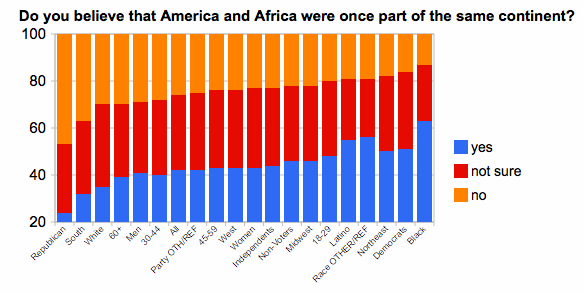
The folks at DailyKos have an interesting series of surveys.  The second question from this one has been getting a lot of play recently, but the first question is interesting as well.  A lot of people no longer identify as Republican and those left behind are settling into increasingly minority opinions.

Thanks to Jim I’ve updated the chart so the two uses of OTH/REF (presumably Other/Refused) are  distinguished.

Now to a second question, how come I’ve never seen stacked bar charting software that let’s be adjust set the bar chart width based on yet another number, i.e. how part a share of the sample was in that vertical?

Drumbeat

One of my favorite managerial tricks is to introduce the idea of ‘coordination cost,’ as in “How are we going to manage to coordination costs here?”  or “What would estimate the coordination cost on this is going to be?”  or “Looks like a coordination problem.”

I find this helps people step back from the problem at hand and reframe things, looking at it more as a dance.

When I’m feeling particularly silly I like to be sure everybody gets to listen to this amazing recording: Postal Workers Canceling Stamps at the University of Ghana Post Office.  And then we can talk about the possibility that we just might achieve that imaginary happy state.

There is a huge amount of friction in organizations around coordination costs.  And most schemes for organizing things are really, at their heart, just a bundle of choices about how to lower that friction.  In a sense that’s all that Paul Graham’s nice recent essay “maker’s schedule, manager’s schedule”  is about.  Though in this case he’s highlighting a sort of meta-friction that arises when the standard that achieves low friction for one group runs up against the standards that achieve low friction for another.  I was pleased that he is much less polarizing in this essay then he often is.

Reading his essay I was reminded by a posting I made a long time ago about what makes for a great environment to assure high programmer productivity.  The environment outlined there is much like the one Paul appears to be advocating.  But I have my doubts.  Bill Tozer’s comment raises some of those concerns.  He’s more confident of what’s right than I am.  I tend to think what works varies a lot.  Which if true only makes for more friction as what works for this part of the process or people rubs against what works for something else.

I recently had a friend recommend what I should read about Scrum, and he pointed me to an excellent long essay (pdf).  Given my allergies to singleminded frameworks for solving all the worlds problems I was emotionally prepared to dislike what I read.  But I loved it.  I mostly found myself recalling when in my life I puzzled out this or that rule of thumb that I seen these folks have adopted.  So instead me rolling my eyes and saying “Oh please?”  I found myself saying “Oh yeah! Ain’t that the truth.”

So for some large class of software development activities I think you could do much worse than to adopt those methods.  But, these methods are quite disconnected the list of what makes for a great environment for programming, and there is reason for that.

The Scrum methods reside in a middle ground between Graham’s manager and maker time.  In the middle between the social network managers live in and the work of individual craftsman – a place where focused teams reside.  So these rules are about managing the coordination costs that arise there.  Between team members, between product and program managers, between designers and engineers.  In that world you need to strike a balance between coordination costs – interupts, meetings, et. al.  and pure versions of maker or manager time.