Paul Graham remixes Sheryl Crow.
VC firms executing on a K-selected strategy must sow their oats widely and devote the majority of their resources to drumming up a sufficient supply of fetile meritorious young talent.
Paul Graham remixes Sheryl Crow.
VC firms executing on a K-selected strategy must sow their oats widely and devote the majority of their resources to drumming up a sufficient supply of fetile meritorious young talent.
I enjoy bantering, Its a New Yorker’s pleasure. It doesn’t go over well in Boston. Puritans and Academics, what can you do?
I buy my sausage from a butcher in the North End. The North End is a rare urban neighborhood, at least in the US. Dense, old, somewhat unchanged by time. Jane Jacob’s argued that it had survived because it was walled off. Walled off from capital and walled off from the rest of the city by a butt ugly raised superhighway. She made that arguement as part of suggesting that one of the forces that kills urban neighborhoods is fast money.
They have torn down the ugly super highway, and money is flowing fast into the North End. The good liquor store has shut down, a bank will step into it’s shoes. Across the way the amazingly small two story pub where two dollar beers were sold to next to the vegetable market has been bought and a posh faux Irish bar has taken it’s place. Condo’s are going on top.
I joke with my butcher that the sausages are loosing their flavor now that his supply of road construction waste has dried up. He assures me he’s got a stockpile in the back; but I doubt it. I point out that the cat that sleeps on the freezer appears to be getting fat.
How the sausage is made is a surprisingly fascinating topic. When you buy stuff it’s full of ingredients who’s provenance you can’t hope to fully know. And there are always surprises. The securities you bought turn out to be full of badly originated mortgages. The blood thinner dad’s taking turns out to kill him, and the press discovers that poor families in China scrape sausage casings to gather a key ingredient.
Markets, firms, and societies solve the inherent quality control problem that arises from are long and confusing supply chains with various quality control schemes. My butcher has a variance from the health inspector pinned up on his wall. His tiny store is too small to conform to regulations about how far this should be from that. I don’t doubt his cat is, officially, a problem too. I was fascinated by how far the US’s drug administration’s reach goes, i.e. all the way back into the homes of those families in China.
That the world is all about sausage is delightfully frame busting. For example consider web sites. Back in the day we assembled the web pages on the server; using PHP or Perl for example. Talk about sausage!
PHP is case study in sausage making. PHP’s vitality comes from how wonderfully easy it is to paste together all kinds of bits and pieces; particularly C code libraries. It’s a wonderful – almost all bubblegum and bailing twine holding together this vast array of really nice C libraries. The only problem is quality, those libraries aren’t particularly secure. Expose those libraries on the open internet and your moments away from a security breach.
These days we don’t make the sausage on the server any more. We mix the final page up only at the last possible moment, in the browser, using Javascript. These days many suppliers can feed into the final product. I can recall a time when web masters would forswear that kind of thing, since they didn’t want their uptime dependent on 3rd parties. No doubt some Luddites still say that. But I don’t see how that attitude can stand. It’s like trying to live an entirely self reliant existence, growing your own food, cutting your own firewood. Romantic but impractical. So this is a very different dynamic; one where the quality of your suppliers becomes much more nuanced. I’m finding it fascinating to try and think through it’s implications. For example, just to pick one, how can you possibly archive pages like these?
Another good posting on inequality.
I’ve been musing recently that there are a few words which you can use to kill most any software project:
I needed to post this so I stop seeking more S words to add to the list.
Craftsmen always love their tools. Further most of them love their problem.
The policeman must sympathize with the criminal; otherwise how will he be able to model his thinking. Negotiators recommend that you to walk in the other guy’s shoes.
Solutions are a complement to a problem. This demands a synergy. The best engineers know a bit about sales, manufacturing, quality assurance, or product marketing.
Perversely this leads to a pattern where in the problem solver becomes the problem’s advocate. Defending it. Assuring the problem persists, that it survives. It when the problem solver’s survival becomes tightly linked to the problem’s survival. When they have become codependent.
Clay sketches this out nicely in his new book (go get a copy).
The modern example is the record company. Your business solves (what used to be) a hard problem; e.g. how do we get excellent high quality audio performances widely distributed to the general public. Back in the day that was hard! Wax cylinders for heaven’s sake! Limited shelf space! Damn radio station play lists!
Now days anybody with a computer can do it; so it’s not really a problem anymore. But for the industry, given that they are in the business of solving that hard problem, they have become the problem’s best friend. Fighting tooth and nail to keep the problem hard. Odd, isn’t it?
Say you’re a religion. Your business solves the hard problem of giving people a way stay true to a set of principles; call them ethical principles if you want. But these days modern societies have spun up dozens of schemes to help groups of people stay a chosen course. Some are organizational, like hierarchical management or professional societies, some are technical, like PDA’s, some are very transient like flash mobs or flicker groups formed on a single tag; but none of them look particularly like the classic mainstream religion. Again the religion becomes an advocate for the problem.
Clay tells the amusing story of finding some rants defending the craft of monks copying manuscripts in the face of the printing press. He derives a bit of fun by noting that the rant was run off on a printing press.
Recall that Clay’s book is an investigation of what’s unfolding as the cost of forming groups has radically different. He suggests that there is a phase transition when the cost falls below what he delightfully calls Course’s floor. Firms, i.e the kind of groups that Course was studying, are glued together with contracts, long-term relationship, and hierarchy. One of his ideas is that these new easy to form groups are often bound by light forces. For example affection.
Problem solvers don’t just defend their problem when their livelihood is threatened. They will do it even in the face of threats to these lighter binding forces. The problem solver has affection for his tools, his profession, his institutions, his clients. When the shift happens and the displacement arrives these ties can not be casually unbound. To me, that makes it a lot easier to sympathize with a what looks at first to be quite hypocritical behavior. Gotta love ’em.
First off, you all, should go read Stefano’s posting about how he’s also on the job market.
I originally firmed up the rule about never ever posting about my job because I found that my coworkers would always assume that what ever I posted it was about them. Such is the human mind. I’ve backed off that rule only slightly over the years, so that now the rule is that I absolutely label such postings right up front.
So this posting is job related.
As you may or may not know for the last few years I’ve been doing project management for the Simile project at MIT, a wide ranging effort to puzzle out what the heck we are going to do about the emerging mess of heterogeneous organically produced metadata. It’s interesting work with a bridge to the traditional well regulated and standardized metadata you’ve all experienced in library or product catalogs.
We have done some amazingly cool stuff. We have dozens of code bases; just to pick two of the lesser known examples. Ryan Lee‘s Appalachian shows how you might solve the phishing problem inherent in OpenID. Stefano‘s Gadget is indispensable when ever a few megabytes of XML appears on your doorstep.
We are wrapping up this round of Simile. I’m looking for what I’ll be doing next, hint, hint.
Also, don’t miss David Huynh‘s recently released cool plug-in for Thunderbird. Let’s be clear that only the very brave write Thunderbird plug-ins! It provides some really sweet browsing additions over your email; watch the video!
I enjoyed skimming a paper by Edlin, Kaplan, and Gelman on what motivates people to vote.
Snarky wags like to argue: “It is a waste of your time to vote! It is irrational. So, it is stupid to bother.” The argument goes as so: the cost/benefit doesn’t work. So many things need to happen to capture any benefit. Your vote would need to be critical. He needs to win. The benefit you hope for needs to get back to you. If you get the benefit, how big can it be? In some circles this is treated as conventional wisdom.
This argument is a tool of voter suppression, which is reason the meme is so virulent. It an effective tool for convincing your opponents to say home on voting day.
The arguement gleans it’s gloss of credibly from the math like analysis and the appeal to that high principle: rationality. You can dispute the arguement in assorted ways, for example substituting some other high principle such as responsibility or community.
The paper undermines the arguement on it’s own terms. And it is very simple.
It is stupid to argue that the only rational benefit we get from voting is selfish. Once you break the connection between rational and selfish the arithmetic changes. Benefits have two components: one selfish and one unselfish. Call that second one social benefit. This changes everything because the social benefit is multiplied by the size of the population! Put a million people into the population and even a 20 dollar benefit per citizen gets big.
Most of us think the per citizen benefit of our candidate winning is much larger than a few bucks. Of course both the selfish-benefit term and the social-benefit term are discounted. But notice that means the more social minded you are the more likely you are to vote. One reason the “it is irrational to vote” line of arguement works to suppress is how it makes the selfish term more salient in the mind of the voter, making him forget his more socially aware side.
In fact most political activist usage of the rational choice ideas in political debate is playing that card. I’ll note that this has changed clarified my thinking about mandatory voting laws. I’ve always found them a bit distasteful. I’ve had a few arguements for while I don’t like these laws. Coercing people into good behavior is a bit troubling – it seems to put the cart before the horse. I’m also bothered by the tone of those who advocate such rules. That tone has always seems scolding and righteous. The model above provides another arguement; selfish is toxic to good governance. Forcing selfish people to vote? I’m not sure that’s wise.
You can grab the paper here: Voting as a Rational Choice: Why and How People Vote to Improve the Well-Being of Others. The paper is a bit more subtle, and hence interesting.
Many many years ago now I spent a while working on the Internet Identity management problem. In fact I have a whole category with postings I did during that period. Boy, talk about a tough problem!
Back in day one of the problems we worried about a lot went under the name “account linking.” This problem comes up in lots of guises. One most people are familiar with is the problem of removing duplicates from a mailing list. Another is using social security numbers to link together account information. Account linking is one of the corner stones of the privacy problem. Account records are journals of somebodies’ behavior, but if you can’t link that record to them then the privacy question is muted.
As a result of that period I tend to be fastidious, some would say obsessive, about keeping some accounts hard to link. I have a primary user name I use when I don’t care; but otherwise I have distinct user names, passwords, email addresses. I justify this as a hobby, ongoing research in privacy and identity. It’s a pain, but I seem to enjoy that exercise – whatever.
So it was with some amusement that I received an email from some valley startup that has offers a service for your inner stalker. Of course they advertise it as a way to follow your friends, yeah right. What they appear to have built is a scheme for doing account linking that is based on both the usual heuristic’s approaches (such as those seen in mailing list de-duping) and a modicum of social engineering. The later part is clever, if vile, they get your “friends” to link your accounts.
The email I got told me that they and my “friends” had figured out four different accounts I have; flicker, digg, pandora, and stumbleupon. Only one of these was interesting. The account they had uncovered for me at digg was one of the ones where I thought I had made it resistant to casual linking.
Their email went on to say; and I love this in a eye-rolling way: “you would like to make these accounts private, please change the privacy settings on the original network and Spokeo will update its search results to reflect your changes.”
So I head off to Digg to see if I can see what I missed. Digg has a complex page of privacy settings, it’s one of dozens of pages in their account management UI. At the bottom of that page is a toggle for advanced settings. Inside that is a toggle to disable finding me using my email address. I hadn’t set that. So I’d guess is that the stalker service is polling every email address they harvest to discover digg accounts. Digg and I slipped up, but at least we were trying.
Did I mention that this problem is hard? I’ve grown increasingly doubtful we can solve this one. But yeah, what choice do we have but to try?
This chart is pulled from a good report (pdf) circa 2001 out of Sandia National Labs which is full of nice charts like this one. Energy storage systems have numerous facets you can sort them out over. For example up-front costs, lifetime, cost per cycle, etc. etc. This shows seven different technologies, including superconducting magnets (which I must say do threaten to take the fun-geeky crown from fly wheels). It doesn’t include some very viable and useful storage tech, including sodium batteries, flow batteries, phase change materials such as ice used for daily load leveling, etc. It would be better yet if those were on here, as well as some others that are a bit off to one side; like a train load of coal or a typical LNG tank.

The these are scattered over two metrics. How much power the tech can supply and how much total the tech can store. It’s a shame that there aren’t points in all four corners. I guess the sun kind-a-sort-a goes up above the upper left corner. I assume the dots show existing systems and there large practical areas around those points.
One of the metrics not shown is the maturity of the technology and the market. SMES looks like it’s close or just past solving the major tech-maturity questions. I enjoyed, for example, a fun essay about using the magnets pulled from old medical scanners for energy storage. CAES is ready to build out large market share; but as of yet there aren’t a lot of existing systems. Flywheels are even further along and look like they have lots of potential for sales in the next few years. PH is probably tapped out – i.e. fully built out, at least in the industrialized countries.
Regions of the chart are delimited and labeled to show what applications fall into that region. As the entire system comes under increasing stress power quality applications are going to get a lot of capital. Load management is quite a range of problems: balancing daily load, weekly to monthy variations in solar and wind sources, and seasonal variations from demand or distribution bottlenecks.
This chart is lifted, and slightly edited, from a post discussing how much land area it’s going to take to generate power from wind or solar. No surprise there, fossil fuels are amazingly dense sources of energy.
In any case the horizontal axis is showing how large various things are. There isn’t really anything surprising along that axis. Hydro systems are large, solar panels are small. Cities are bigger than houses! The red regions are demand energy, the blue regions are ways of supply in. The vertical axis shows how concentrated the flux of energy flowing in or out is. Oil fields and power plants have very dense energy flows; while plants and hydro-electric impoundment areas don’t.
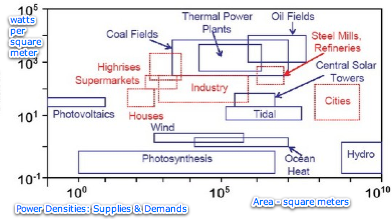
This suggests that one big change that will come if we step back from fossil fuels is a change in which side of the energy distribution system consumes the most real estate. Right now 10 to 100 times more real estate is used on the demand side, and afterwards it might be 10 times more on the supply side. That is quite a flip.
I love this kind of chart, i.e. big broad overviews.