Energy per passenger-mile

From Chapter 2 of the “Transportation Energy Databook” from the US department of Energy (with slight format changes).  The Commercial air numbers maybe high do to freeloading cargo.


Thousand BTU/Passenger Mile
4.2 Public Transit Buses
3.9 Personal trucks
3.4 Cars
3.3 Commercial Air
3.0 Rail - commuter
2.8 Rail - transit
2.6 Rail - intercity
2.2 Motorcylces
1.3 Vanpool

My motorcycle/scooter riding friends may continue to gloat. And no this is not an excuse to to drive rather than take the bus, since adding you to a bus costs about zero btu/mile; and of course motorcyclists who ride in packs should get a car.

Gridlock Economy

Michael Heller’s new book looks interesting.  Heller was, for the last decade, been working to introduce a bit of balance into the discussion down stream from the idea that goes by the name “Tragedy of the Commons.”  He originally called his idea “The Tragedy of the Anticommons.”  Those who public goods coming to tragic ends often prescribe a dose of property rights.  Heller is interested in situations where too many property rights create grid lock.

His Authors@Google talk is a good introduction.  About a half hour long it touchs on various coordination failures with substantial social costs that arise from an abundance of property rights: Drugs that don’t get developed, families displaced from their legacies, urban development frustrated, air traffic congestion, foul ups in the post soviet privization programs.  Good stuff, and he is reasonably straight forward about how societies should be more aware about the balance they strike when they architect their property rights schemes.

That last point is of particular interest to me, since it goes to the question of how you shape the power law curves.  Is the single property owner who frustrates the urban developer the hero of the long tail; or is he just the worse case of ground cover strangling urban vitality?  Guess I’ll need to read the book.

I’m bemused, or confused, by the realization that both these tragedies arise because some coordination problem blows up when too many parties have simultaniously have rights.  I guess you might say the anticommons goes down the tubes when one player says no (or more often just lies silent) while the commons blow up when too many people say yes.  After a bit I can’t see these as really different, it’s back to the group forming coordination problem.

Billmon

Billmon used to write on politics at his blog the Wiskey Bar.  He was brilliant.  Like many of the bright angry lights he burnt out; and moved on.  Sad for we who read him, but hopefully good for his mental health.  He has now reappeared with a diary at Daily Klos, which is nice for us.  I hope it’s good for him too.

In his most recent posting he digs into exactly how bloody miserable the hole we find ourselves in with situation in Georgia.

First, recall that NATO is first and foremost a mutual defense pack.  No firewall – if a member is attacked the rest of us go to their aid.  Mutual defense packs are what caused the first world war.  NATO’s reason was to create a clear bright line the Russians would be unlikely to cross.  It is a vistigial organ of that strategic nightmare that seems to have workd – mutually assured distruction.  Joining Nato is not like joining the EU, or the Rotary club.  Each member gets a hand on the cord which can plunge us into that nightmare.

We have been expanding NATO into the former Soviet sphere.  Think about that.

For example Poland joined NATO recently.  The process for this expansion appears to be, well, cavalier.  First the Congress, quite casually, passes a law that allows us to treat a nation as if we have a mutual defense pack with them – but without the pack and without the promise to come to their aid if their attacked.  Mutual defense light – all the arms trading, military bases, joint operations, etc. but yet a bit of the fire wall is retained.

Then if that works out they join NATO.  Apparently at no point in the process do we take to heart what the nature of the promise being made is.  If Slovakia happens to have a disputed border with one of their neighbors that gets heated, we’re there for them.  That’s insane.

If you don’t care what the other guy thinks, and your confident you can get away with this kind of pushing out of our sphere of influence then I guess this makes sense.  But Russia’s not toothless, or are they stupid.  At minimum they hold Europe’s energy supply hostage, at worse they have nukes.  And never ever forget: nationalism always plays well at home.

So having played this process out with countries like Poland, Hungary and others we decided to this with Georgia and Ukraine.  Bleck.

Well I guess it’s nice that Billmon is back.

Parallax

David Huynh and I worked together at in the Simile project (simile.mit) for the past few years.  We burnt through our funding and many of us have moved on; he moved to MetaWeb.  MetaWeb makes the horribly named Freebase.  Freebase is this era’s version of AI knowledge representation (think frames).    People these days tend to mumble Semantic Web, Wikipedia, and Social as well when they talk about these ideas.

At Simile we were more focused on more formal collections, like library catalogs, and so our data sets tended to be more homogeneous than the sloppy mess you get in collections that emerge in open socially contexts like Wikipedia.  We were often stuck with collections with a limited assortment of item kinds (books, authors, subjects followed by a short tail … satellite photos … audio tapes …).    Things get more “interesting” as the collections become more unruly.

David has a beautiful new demonstration of some the ideas, often his ideas, about how to work on one of the tough problems in this space.  What’s refreshing about David’s work is he’s found a portion of the problem space that isn’t cluttered with other people and prior work.  Most of the Semantic Web work suffers from stepping on the toes of prior work – or worse ignoring – the excellent work done on knowledge representation over the last 50+ years.  What David’s found is fresh turf to work on in the problem of how to allow users, meer mortals, to browse and search on top of these knowledge bases.  That’s fresh because the AI crowd have always been so fixated on the singularity, rather than on helping people.  Not a very social crowd the AI guys.

Before I start musing about what David’s demo shows, to me, you really have to watch the video.  The rest of this will make little sense without that.

The idea here is that if you have done a search resulting in a set of objects you should be able to use that set to drive the next step in the search.    In a sense this is the classic unix pipe idea refreshed, where each linkage in the pipeline passes a set to the following step.  Or if your of a more mathematical mindset then each transform in the pipeline is a many to many mapping from items to items.

One of our problems in making these ideas work when we were at MIT was the lack of a sufficiently heterogenous universe of items; you really need a vast universe with lots of item types.    His cities/buildings/architects example, or his presidents/offspring/schools examples helps to demonstrate that.  What Freebase with it’s aggressive rolling up of things like Wikipedia provides is a step toward that rich universe of items.

If your user is very sophisticated then a command line UI like unix pipelines would be sufficient.  You’d then give him various operators for mapping item sets into other item sets.  He, being sophisticated, would then demand the ability to code up his own mappings (e.g within 20 miles/years/generations/links etc. etc.); and to annotate the items as he is working with (e.g. scoring and statistics).  And needless to say he’d want the pipelines to persist and generate feeds for other pipelines of various kinds.

The problem become much harder if you want to draw in the non-sophisticated meer mortals.  What faceted browsing does, and what you can see here repurposed, is it prompts the user with a reasonably clear signal as to what his next options are for moving forward in the search space.      So if your shopping for lawn mowers a facet’d browsing UI can prompt with price categories, power sources, etc. to draw the user into the next step of the search.  This is all well and good until you meet real world searches where the number of facets are huge and the number of options in each of them is even larger.  Even if you pick something as dull as library books the number of facets runs up into the thousands.    Facet browsing actually works best when the goal is to drive the user toward down the path to a single choice – i.e. shopping.  No need to offer the shoe shopper a facet for labor practices used during manufacture, or materials used in assembly, or nation involved in the manufacturing.

David’s sliding plays the same card to help the user.  He throws up a set of options for the user’s next moves.  Note how the facet browsing UI is on the left, and the sliding is on the right.  Note also how rich and there for difficult to present the options are for where to slide next.  It’s admirable that the video doesn’t gloss over that – as illustrated by the example where he slides from offspring of presidents into educational institutions they attended.

I guess this note comes off sounding a bit cranky.  Hopefully it won’t be taken that way.  The problem is very hard and real.  Search of this kind is going to common for some class of users in the days to come.  The more progress that can be made on making the UI accessible to mortals the more widespread it will be.  The brilliance of David (and Stefano’s, and David Karger) strategy in working thru this problem has been to ground their search for solutions in demonstrations that draw in actual users and work on actual pools of data.  It keeps them honest and it creates feedback loops they desperately need.

Oxygen?

Maybe somebody can explain what’s actually going on here.  MIT has a press release out, it crows about the discovery of a catalyst for splitting water (the pod cast there is good) into it’s constituent hydrogen and oxygen.  Now I thought that was pretty simple stuff.  What’s the hard part?

My model of using hydrogen as an energy storage system was that it became inconvenient in other parts of the system.  Hydrogen is a pain to store; transport, etc.  The conversion of hydrogen back to energy required over engineered devices; like fuel cells.  I’d presumed that making hydrogen wasn’t a problem.

In any case they formed a thin film of cobalt and phosphate on a conductive glass.  When they slip the water, using electricity, they get oxygen.  I gather that what’s good is that they get the oxygen directly and not thru some inconvient intermediary?  Apparently their is a second step that helps to assure they get the hydrogen more directly as well, and I’m not following that either.  This second step while straight forward typically is done using platinum as a catalyst; so there is some separate story about how to work around that cost – but that’s not part of this invention.

Apparently it’s very nice that this all happens at room temperature and neutral PH.  I guess that’s good, presuming that the existing efficient processes are far from that.

There is apparently a subplot about how the water isn’t pure; but has a dose of phospate in it so the thinfilm is self repairing.

I guess these are my questions.  First how much does this simplify existing practice.  Second is this actually significanlty more efficent than existing practice.  And finally, and I think this is outside the scope of the press release, what is the round trip efficency and complexity of an energy storage scheme based on this?

Update: This posting over at The Oil Drum is quite snarky and dismissive of this “breakthru.”  It is a refresing counter point to the ripple of republished MIT PR.  Presuming it is correct then what’s different is that existing high efficency electrolisis schemes are more complex than this.  How much that effects the capital costs isn’t clear to me, but not much looks likely.

Update: This video is pretty nice and reasonably clear.

“Systems dump excess energy in the form of structure.”

Tim Oren relates this aphorism “Systems dump excess energy in the form of structure.”  He credits James Burke. Delightful.

If true it goes a long way toward explaining why large firms, who almost by definition succeed in capturing proportionally larger rents, become less adaptable.  Comfortable abundance gives you the luxury for polishing all your policies and procedures, and pretty soon “they’re being pursued by a snail and yet they cannot get away! ‘The snail! The snail!’, they cry. ‘How can we possibly escape!?.”

Spotted Owl?

This seems like sort of a landmark.  Surely Stalin wishes he were alive today.  The Chinese must do this all the time.

[first name of a candidate] and pre/2 [last name of a candidate] w/7 bush or gore or republican! or democrat! or charg! or accus! or criticiz! or blam! or defend! or iran contra or clinton or spotted owl or florida recount or sex! or controvers! or racis! or fraud! or investigat! or bankrupt! or layoff! or downsiz! or PNTR or NAFTA or outsourc! or indict! or enron or kerry or iraq or wmd! or arrest! or intox! or fired or sex! or racis! or intox! or slur! or arrest! or fired or controvers! or abortion! or gay! or homosexual! or gun! or firearm!

In other news, I find it sad that I notice that intox! appears twice almost instantly.

New search engine makes you look fat

Brett Porter wrote up a nice summary of his first impressions of that new search engine, Cuil.  He had exactly the same  experience  I had, and my wife had.  You ego surf only to discover they have a very odd model of your internet presence.  Feeling disappointed you then wander off.  We learn from this is that any new search engine better make us all appear even more above average than we already do.

cl-ppcre as a tokenizer

CL-PPCRE is a Lisp clone of the perl regular expression subsystem (i gather it’s even faster).  I  love it because lots of things I used to do in Perl or AWK can I now do in Lisp.  Each language has it’s coding tricks and there are lot for Perl’s regular expressions.  The Perl regex manpage is 30 pages, and the FAQ is 20 pages.  That’s a lot of clever, and double or triple is once you recall how concise Perl is!  I often is use all this to build lexical analysiers using regular expressions to nibble tokens off string. (One variation on that is outlined in the Perl FAQ.)

Both Cl-PPCRE and Perl have two notations for their regular expressions.  The concise one you’ve certainly used; and a much more verbose one.  For example you might write “alpha|beta” to match either of the two strings in the concise form, and in CL-PPCRE’s long form you’d write (:alternation “alpha” “beta”).  In Lisp you might write something like: (setf (parse-tree-synomym :tokens) ‘(:sequence :start-anchor (:alternation :begin :end :if …))) and then nibble off tokens by doing (scan :tokens program-text :start start).

The only problem with that is you lost track of what token was recognized.  My trick for that is to define the individual tokens so when they are matched the set a variable in the dynamic extent established for tokenizing.  Along these lines:  (setf (parse-tree-synonym :if) (:sequence “if” (:function set-token-kind-to-if)). The :function form is used to do call outs in the midst of the pattern matching.  It is the analog of Perl’s (?{ code }) construct.

That of course all get’s wrapped up in macros so it reads nicely, e.g: (deftoken :constant (“\\\d+”) (parse-integer (token-text))).

You can juice this up by having parse-tree-synonyms that keep track of the line number in the file your parsing.

If you get the details right this can be very efficent; both in time to code up and at runtime.  When combined with CL-YACC you can whip-up a parser for yet another language in a few hours.  Yesterday I built one for XDR.  Here is a simplified example.

The Triangle: Supply/Demand/Price

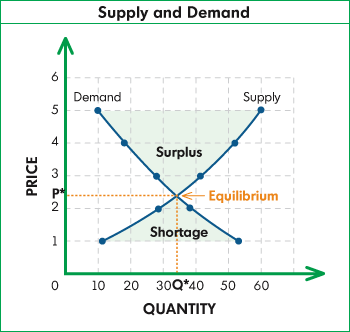
Back in school when I took economics 101 we would draw these curves showing that if you raise the price you don’t sell as much.  In real life I’ve been surprised how rarely this seems to be true.  In fact I’ve observed far too many cases where the price goes up and you sell more.  Even more common are the cases where the lines are practically flat.  I.e. the effect is very weak.

For example much is being made of the fact that miles driven has dropped by 3.7%.  The price of gas doubled!  Up +100%, down -3.7%

Now some of this is lag.  So presumably there is a lot more pent up in the system as people adapt.  But you’d think, wouldn’t you?