
One thing I’m finding particularly hard is getting a sense of scale for what’s unfolding in the markets, but here’s a run at the question.
Katrina was maybe a $80 Billion event, and it looks to me like Ike is probably a $30 Billion one. The Iraq war’s direct costs are probably 2 Billion a week. The 9/11 attacks destroyed about $16 Billion in physical assets, and the clean up cost about $11 billion; lots more in the ripple effects.
Microsoft, Apple’s, and Google’s market cap are roughly $230, $119, and $140.
AGI’s market cap a year ago was around $200 Billion, today it’s around 10. A year ago Fannie Mae, Lehman Brothers had market caps of was around $60 and $40 Billion each. That’s $300 billion total, about twice the size of the numbers in the 2nd paragraph.
These are big storms. With about 100 million households in the US, $300 Billion is three thousand dollars each.
These estimates are all aweful rough. I couldn’t quickly find estimates for the wealth distruction in the house markets, but here are a lot of write downs. Nate Owan takes a run at a similar question.
While I’m still liking Paul’s metaphor, where in he points out that some firms are like the springs in the mattress the entire economy lies upon, Felix Salmon plays with a nice alternative, the weather.
Most of the companies listed on the stock market aren’t, and they should be able to weather a financial storm with relative ease.
On the other hand, that financial storm really does seem to be more of a heavy breeze than a major hurricane. The Standard & Poor’s financial-stock index is down by only 3.5 percent this morning-hardly a bloodbath. And the TED spread-a measure of distrustfulness among banks-is up sharply at 192 basis points, but is still below the levels we saw in the summer of 2007, and again in December, and again in March. Indeed, each spike upward in the TED spread seems to be lower than the last, which has to be a positive sign.
The big unanswerable question, though, is what happens next. Hurricanes start out as a heavy breeze, and then get worse-and the preconditions for a financial hurricane are very much in place. If a real hurricane needs high ocean surface temperatures and warm humid air, a financial hurricane needs generalized nervousness and a general lack of liquidity. Once those are in place, a few failed trades are all that is necessary to precipitate a very nasty chain reaction.
Unlike the weather we lack nice high resolution photos from space to show us what’s just over the horizon, all we have is pictures of what happened yesterday. We can look at the temperature, check which ways the gusts are blowing, tap on the barometer. He draws our attention to one of these simple instruments.
“How big is settlement risk right now? An indicator one might look at is the number of “fails to deliver” and “fails to receive” reported by primary dealers in U.S. Treasury bonds.”

That’s 20 year’s of data. Squeek’s from the springs in Paul’s mattress. That first peek is just after 9/11. The last burst is so far this year; but the data ends on the 3rd of September.
As Ike approached landfall last week the National Weather Service warned “Persons not heeding evacuation orders in single-family one- or two-story homes will face certain death.” I was quite shocked to hear various news sources question that. Below is a picture of a portion of the Texas shoreline, Gilchrist, Texas on Bolivar Peninsula. Galveston is south of the channel up to Houston and Bolivar Peninsula is north. The eye crossed the tip of Bolivar Peninsula and the regions just north-east of there got the worst of it. I gather 400 people did not to evacuate from the Peninsula.

That photo is one of the set at the Globe’s excellent big picture feature, go look! Anybody know the address of that house? I suspect that Google street view and Microsoft Live have pictures of the old neighborhood.
 In a great posting by Paul Kedrosky explains why the financial industry is just like a traditional mattress. Must educate those exuberant crony capitalists to abstain? Should chill the water bed? Ah platform engineering.

I skimmed the book Control through Communication. The book is about firm size. As we learned to manage information and communication at larger and larger scales the size of firms grew. Which is all fine, but the aspect of the book I enjoyed was the schemes and gadgets. Mostly the gadgets. At one point the boss managed his communication with grid of pigeon holes, one for each day. This scheme evolved; getting larger and larger until you could buy single unfolding desks, the size of a modern SUV, with hundreds of pigeon holes.
This picture shows the Dupont executive chart room. Using charts to illustrate the status of the firm’s many operation was, at some point in time, an innovation. About the same time Dupont started to use crude modern financial modeling, ROI and such. Somebody at Dupont was sufficently enthusiastic about charts to have this marvalous contraption built.
The executives would sit in those chairs shown in the foreground, and as each portion of the operations came up for review their assistants would slide forth the handful of charts illustrating what’s happening with that. It reminds me of a dry cleaners.

On theme in the book is how the meer idea that information should flow up and down the corporate hierarchy was innovative. And then that these communications would become formalized was yet another. I don’t know if the word innovation, rather than say enivitable, is the right term. The book disappointed me, but then I only skimmed it, beacuse it doesn’t really engage with the two questions I’m interested in.
First how did firms manage the puzzle of how to negotiate out what should be communicated and how hierarchtical that communication ought to be. It was interesting to realized that the the practice of highly hierarchtical communication may well have emerge almost entirely because that was what the technology could support. The complexity of printing and it’s scaling characteristics meant that the central office could execute communication acts that the periphery could not. If so the xerox machine must have created a bloom of lateral communication.
Second how much did this wipe out smaller businesses. Was this really a major driver to the condensation where single large firms displaced smaller firms. The roll up that happened in the telephone industry reprised in multiple other industries; but it’s a provocative thought that it happened for almost identical reasons: communication based network effects.
These two questions interact in some cases. When railroads merged the operational rules of the dominate player would have to displace those of the weaker one, and in many case the stronger one had more effective communication and control schemes.
Looking at that picture I’m reminded of a reporting framework that a new senior manager once deployed into a firm I was working at. The frame work was extremely standardized, N slides, M panels in each slide, with rules about what was expected in each slot. It wasn’t a bad scheme, and it certainly made his job much more efficent. Which was good because it allowed him to cut thru a lot of middle management and see deeper into the organization. But yet, it tended to eliminate from discussion anything that didn’t fit. If the slide lacked a slot, say for employee morale, then an issue was invisble. To exagerate it was as if he was looking at the company thru a straw. I’d say it created a puzzle for those who wanted to signal something up stream. You had to get it into the straw’s narrow view. I suspect his scheme was the direct decendent of that chart room.
I’ve been trying to think about the financial structures around processes that exhibit highly skewed distributions. The insurance industry is a great place to find the examples. We buy insurance to hedge against the small but awful. Most of our houses don’t burn down, but it does happen. The chance of a fire is scale free, the insurance company protects it’s clients at the scale they care about, but who protects the insurance company against the rare event the burns down the entire town. There are three ways the insurance industry handles that scenario: they don’t cover it (excluding acts of god for example), they reinsure into a yet larger pool, or they avoid it by not insursing in certain venues. Over here at Bronte Capital is a posting arguing that Warren Buffet, who moved into the insurance industry in a big way over the last few years, has been working this third angle.
When process with a highly skewed distribution delivers it’s rare but powerful shock into the system, it’s black swans, everything designed to work with the median shocks is blows up. I’d be interested to know how the insurance industry handled the New England hurricane of 1938. I’d be interested to know how the insurance industry in Thailand handled the AID’s epidemic.
Another place I’ve been musing about exceptional, but inevitable, events is where you situate your career planning. I’ve a friend who likes to say that almost all the people he knows who made a fortune in their life “fell off a log into a pile of money” thru no special merit of their own except in some cases they consciously picked a good log to sit on. On the other hand a lot of people just fall off a log sooner or latter. It would be nice if, as you plan your career, you had a better sense of what the chances are in the trade you pick, in the economy at large. The fetish people have for presuming that career path probablities are entirely a matter of personal merit seem wreckless. I was quite impressed when an acquantance of mine with a degree in biology explained he was moving into lawyering because, well he didn’t put it this way, the climate was more predictable.
Recently I’ve been trying to explain how wily US cell phone pricing is. They sell monthly plans with N minutes and then when the exceptional crisis comes down the pike, you fall in love example, they charge you huge over charges. The typical plan delivers minutes at about five cents each and forty cents a minute. Better, at least for them, is that as little crissis come and go your start changing your plan to buy more minutes, which in the absense of a crissis you don’t use. That in turn raises the real cost of even you noncrisis minutes. It’s a very impressive pricing scam isn’t it! I recomend prepaid (t-mobile for gsm, pageplus for cdma on verizon).
If we ignore prepaid cell phone service, the cell phone contracts with a bundle of minutes every month are a bit like lousy insurance policies. You buy the option to use five hundred minutes, not because you need them, but because your insuring against the risk that you’ll run over and get stuck with the over charges. That’s great, and I mean that sarcasticly, they are selling you insurance against a risk they created.
It amuses me to wonder what would happen if everybody in the country could be coordinated into using all those free minutes one month. I very much doubt the phone companies can fufill that promise.
The options contracts implicit in those monthly cell phone contracts are analogous to the insurance pools. If we could coordinate the month of the phone it would be the analogous to a hurricane or a plague, at least from the point of view of the phone company.
That scenario has been playing out with the internet service providers, at least for the incompetent ones. For example Comcast sells me a package with certain assurances about what bandwidth I get into the Internet. Unsurprisingly the consumption patterns of their customers is highly skewed, and I’m one of the higher users since this site runs over that connection. Inspite of 20 plus years of history showing that Internet consumption grows extremely fast and quickly grows to fill the pipe provided Comcast was suprised when more users actually exercised the option they had bought. It is not relevant what these users are doing with the bandwidth (P2P, video, voice over IP, spam) because if it hadn’t been one of those it would have been something else.
This last example, the ISP’s problems, is not actually an example of pricing design in the face of a highly skewed distribution. It just looks like one at first blush. The real problem the ISPs face is the rapidly rising tide of usage. They thought they had a slower growing usage situation, something more like what is seen with the cell phones, but they were wrong. When they discovered some of the users were consuming all the bandwidth they thought they had purchased the ISPs presumed those users were little trouble makers rather than early movers. But that’s a mistake, soon everybody will consume all the bandwidth they can get.
 WANs are wide area networks, like the internet, and LANs are, local area networks, like the wifi in your house. PANs, personal area networks, are – i thought – a joke. Presumably each Borg has a PAN so his headset, pda, cell phone, and ankle bracelet can talk to each other and when he sits down in his car the engine, radio, gps all join in.
So imagine my surprise when this weekend I found I was creating a PAN using Bluetooth. Bluetooth is a standard full of promise which seems to specialize in delivering a frustration. Two things lead to that frustration. First there is lots of bad hardware. Chips that don’t work very well, headsets that sound awful for example or software stacks that are buggy. Second the standard has volumes of optional bits and peices; so usually it turns out the two devices you want to talk to each other don’t happen to support the necessary bits. Sometimes that’s intentional, for example you can’t use your phone as a handset to talk to your computer since that would let your route around the cell phone company using voice IP. The structure of the Bluetooth standards with all those optional bits and peices is typical of telco standards.
The fun I had this weekend was discovering that this phone I got and some of my Macs support Bluetooth PAN, one of those optional bits. Using this it was trivial to let my Mac talk connect to the internet connection that the phone provides. One, two, three: Do the usual bluetooth pairing, select connect to network from the bluetooth menu, oh … there is no step three.
In theory Bluetooth PAN supports multiple devices sharing the internet connection, but apparently my phone doesn’t do that.
This worked trivially on a MacBook Pro running Leopard. But sadly it does not work on the MacBook Air – which in a typical Bluetooth user experiance – pretends to support Bluetooth PAN but it is unusable slow. So for that machine I’m forced to switch back to more traditional Bluetooth DUN (dialup networking – a simulation of the dialup modems of my childhood).
I got into all this because I’ve been wanting to try AT&T’s $20 a month “unlimited” prepaid internet. Right now you can buy a Z750a for $60 from their prepaid store – and if you poke around you can find online sites that will send you a rebate (after 90 days) of $25 or $30. If you pop in $100 then the phone is good for year (buy from CallingMart with a coupon). I don’t intend to make any phone calls so that’s five months of internet access. The Z750a supports Bluetooth PAN, DUN, and it can be a remote control for you Mac (I recommend declining all the options you don’t need). If you buy the USB cable it is faster (800/300kpbs down/up) but the G3 HSDPA over bluetooth is pretty nice (400/30) as it is. The USB cable appears to charge the phone as well.
This seems like a great solution for getting pretty good broadband into the home at a reasonable price. A mac can share a connection to WIFI for example.
If you find your reduced to using BT DUN rather than PAN then you need to setup the modem’s dialing setup … I used this setup: dial: *99***1#, Username: WAP@CINGULARGPRS.COM, Password: CINGULAR1, APN: <leave this blank!>, CID: 1. It picked the right modem dialing script automaticlly.
I’m enjoying having broadband pretty much everywhere I go. The phone just sits in my bag. ATT isn’t everywhere (click on data).
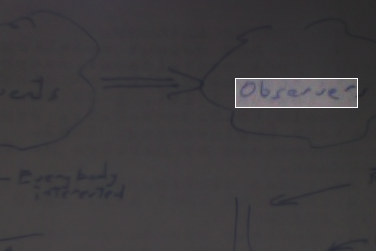
Evernote is a cool idea. They want to enable you to keep copy of all those random notes. In this example I drew a quick sketch on an index card (on this topic). I held it up to the little video camera on my Macbook and took this picture.

Then I dragged the resulting image into their application, and sychronized to their server. Less than a minute later I syncronized again and they had run a bit of hand writting recognition over my sketch. Not all, but some of the text was now searchable.
It works pretty well for business cards too. Fun.