Monthly Archives: October 2005

Another Hub for Verisign

The Verisign acquisition of the original hub for blog pings ought to deeply concern the high volume ping producers and consumers around Feedmesh. Verisign knows hubs. It has exceptionally large market share of two of the key Internet hubs DNS, and SSL key signing. They know how to encourage further consolidation of those hubs. They are willing to agressively go after revenue, such as selling advertising on every misspelling of a domain name under their stewardship. They are very active in the supply chain RFID space, where we can expect to soon see a bloom of blog-ping like traffic.

The most central struggle in Internet systems is between the architectures dependent on a central authority and those known collectively as end-to-end; i.e. those where the ownership is left with those on the periphery. That choice is not a boolean; there are plenty of architectures that leave large midsized players in the system.

The central authority advocates always emphasis the same things: reliablity, policing, simpler. It’s always simpler to just ask the landlord, and sometimes that works. So Verisign writes about reliablity: “Those days have passed at least for the popular ping servers; pings are well on their way to requiring serious infrastructure. That’s where VeriSign comes in.” Policeman: “there are an enormous number of splogs out there, and the number is growing faster than the number of real blogs.”

The key balance between central and periphery designs is around who owns the rights to innovate an who captures the revenue from those. So Verisign writes: “… a host of new opportunities for delivering network services in a user-friendly (and often user-powered) way. In order for that to happen though, there’s a lot of work to be done underneath the application layer.” That’s the Microsoft slogan “Your potention. Our passion.” Which I can’t resist reframing as: “You take the risks, we’ll take the profit.”

It’s a shame that Dave Winer’s failed in his aspiration to solve the scaling problems without an acquision. The complexities of collabrative open institution building aren’t really his strong suit; he’s a different kind of entrepreneur.

The struggle between concentration toward the center and diffusion toward the periphery isn’t just driven by technology. We make the bed we sleep in.
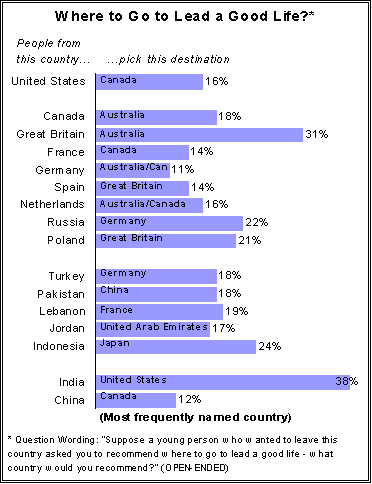
Australia

The Pew Global Attitudes project asked “Suppose a young person who wanted to leave this country asked you to recommend where to go to lead a good life – what country would you rcommend?”

Everybody is going to end up in Australia! But a lot of people will pass thru Canada on their way there.

The Gap

I need a word. A term I’d presume exists in economics. If you say the supply or price of X is changing it triggers a nearly  superstitious  invocation of faith in markets that they will adapt. The word I’m looking for should help to characterize that adaptive process.

To a degree this is a tautology. If the supply of natural gas this winter is 8% less than last winter then it is necessary for 8% of the demand be removed from the natural gas market.  That process goes by assorted names. Demand destruction, for example. If people insulate their houses and close off the extra bedroom, if people switch to annual billing, run up the credit card debt that’s another, if people freeze to death in their homes it’s all just demand destruction. But, in those examples, the variance in the social welfare is huge.

In the modern world we often look to technology to  accelerate, and reduce the pains of adapting.  But, “Technology  will save us” is small comfort if you freeze to death in your bed in the  interim. If technology were the only source of adaption then I could call the term I’m looking for “the technology gap.” Maybe the term is adaption gap. During the gap, people are freezing to death.

So broadly the term I’m seeking might be defined as the estimated interval between two events. The first event is when the market gets the signal the things have changed.  The second event is when the market reaches approximately the same level of social welfare.

For some markets and signals the gap is small. When the price of European cheeses rises and American consumers switch to alternative luxury goods the demand destruction is fairly benign.  So unless  you’re  running a cheese shop since the social welfare is hardly effected and the gap is minor. If your own a shop in a small town and Walmart opens on the periphery you die, and the gap is very large. You may never recover the same level of social welfare. You complementary economic actors (suppliers, employees, landlord, local tax authority, etc) may recover, but only after a very extended period. In the Walmart story the economy at large might actually see a total rise in the social welfare – it being a widely held belief that lower prices are a good thing.

Of course we lack good metrics for social welfare. It’s about this point that one comes to suspect that there isn’t a term in economics for this.  Albert Hershman talks about this question a bit near the beginning of one of his books.  He pointed out the lack of any research proving that firms react to market signals.    Countering the point that it’s too obvious to need research he points out that firms might ignore weak signals.  And that strong signals may kill them.  How big is the band between those two cases

To cut to the chase. The lack of a term like ‘technology gap’ or ‘adaption gap’ is a serious problem when it comes to trying to talk thru the consequences of this or that shock to the society. How long does it take to adapt to a major event? A 4% drop in available oil and gas every year for a decade, say?

The lack of a term means the discussion quickly implodes for lack of a problem to focus on. One camp arguing that economic and social systems adapt, smiles and move on. Another camp points out that people are dying here; and settles into a tar pit of gleeful cataclysmic story telling. Finally a third camp’s emotional center is their enthusiasm for this or that technological silver bullet. Faith, panic, and enthusiasm are not problem solving. How to reduce the gap and thus minimize to total impact on the overall social welfare; that’s the problem – but what to call it?

Stuff Addiction II

I haven’t posted anything in my happiness category for a long time, isn’t that sad?

One of those postings is about a syndrome I named stuff addiction. News on that front. It might be worse than I thought:

the brain systems for liking and wanting are separate. … a drug like nicotine produces much craving but little pleasure.

A good advertisment induces craving. Golly, the distinction between use and signal value runs deep.

That’s from a Sunday supplement article on happiness research that appeared in the Times of London. That’s light and fun to read.

One teaser in the article is the mention of a 100 “interventions” for building happiness; and even that 40 of these have now undergone at least some clinical testing.

Not that these interventions would necessarily be fun in and of themselves. This frightening one is outlined:

A third technique involves writing a long letter to someone you’re grateful to but have never properly thanked, and visiting them to read it out in person.

Seligman and his graduate students weep tears of joy when they do this exercise, but most Brits would probably rather be miserable than do it.

Same in New England I suspect. Thank goodness! That one’s not particularly effective.

These get higher marks:

In one internet study, two interventions increased happiness and decreased depressive symptoms for at least six months. One exercise involves writing down three things that went well and why, every day for a week. The other is about identifying your signature strengths and using one of them in a new and different way every day for a week.

Of course what’s the point of a Sunday supplement if your not selling something.

Seligman speculates that doing more exercises for longer would bring greater benefits. Hundreds of thousands of people have registered with his website www.reflectivehappiness.com – where, for $10 a month, they are given a happiness programme including instruction in a package of positive exercises.

Cheaper than cable!

Boundries and Identities

Boundary activation consists of an increase in the salience of one such boundary, hence one identity, at the expense of others that are available. ”

The identity problem has three parts: the individual, the relationship, the other. Your identity is a bag of these triples; which I find useful to call persona. Over time various persona ebb and flow; so one’s identity is an extremely very dynamic construct. The other entities; found on the other side of these relationships are also extremely dynamic.

More often than not the others are institutions; clubs, gender, race, nation, guild, religion, bank, shop. Social networks. These must all be treated as first class citizens as we search for designs to solve the problem. We can do serious damage to the enterprise, even it it has a certain emotional appeal, if we ostracize these from the design.

Dick Hardt’s marvelously entertaining OSCON keynote consolidates a pile of sharp insights. But it concerns me that he appeals to the emotional when he suggests that the Identity 2.0 meme is about moving the individual to the center. That just doesn’t make any sense to me. It don’t think it helps our ability to find a functional design to activate a boundary that forces people to pick sides between the social institutions and the individuals. In that light the subtext in Dick’s talk regarding Canada seems particularly poignant.

Catalyze

I like this paragraph is Stefano’s latest posting where in he collects his thoughts after releasing a fresh verison of Piggy Bank.

Just before last weekend, during my final Piggy Bank wrap-up’s, I sent an email to the Cocoon development mailling list airing my concerns: the web is slowly but surely changing. Some call it the Web 2.0, some call it Ajax, some call it “told you!” and some call it “so what?”, but the truth of the matter is that web services are coming and their impact has very little to do with what protocols or architectural decisions you make, but the amount of people you manage to catalyze.

I like the idea that Web 2.0 really isn’t about anything other than an attempt to the mob to rendezvous around something. That makes it entirely forgivable that some of the Web 2.0 chatter isn’t particularly coherent.

While buzz can cause people to take a look it alone ain’t durable. What’s works is finding a rich pool of options for people to select and exercise. Exercising those options creates commitments, those are durable. The presence of a large pool of options and lack of clarity as to what’s going to work creates a design space for the mob to poke about inside of. In time somethings dominate the design space.

Firefox has created a big fat pool of options. And people are beginning to exercise them.

I suspect that is it only matter of time before someplace in that design space some people uncover something so cool that it begins to drive a large population people to switch browsers. We shall see.

Skype Phishing

I used to put selected quotes at the bottom of my emails, a practice that broke down when I was forced to give up Emacs as my mail program. The fun part of that was collecting a pool of quotes to pull from. Here’s one of them:

“What I had not realized is that extremely short exposures to a relatively simple computer program could induce powerful delusional thinking in quite normal people.” — Weizenbaum 76

That’s from Weizenbaum’s paper on Eliza.

I just received a phishing attempt via Skype chat; very primitive. Not as crude as this example though. Reminded me of Eliza. I bet we will see much more sophisticated automation for IM phishing.

Ebay’s acquisition of Skype and the resulting challenge of merging the user accounts creates a moment of high drama in the phishing passion play. Particularly when you recall that Paypal is part of eBay.

Reading Old Code

About 25 years ago Symbolics and Lisp Machines spun off from the MIT AI lab. MIT licensed the intelectual property around a machine known as the CADR, or MIT CADR, to these companies. This was a landmark event in the history of open source. This event made it clarified a lot of people’s thinking, particularly Richard Stallman.

Licensing the CADR community’s code to private interests shifted the incentives around that Lisp community. In effect MIT transfered ownership of the community, which it did not own, to private interests. Where previously the motivations for community member were intrinsic, social, and in the final analysis about common cause afterward the motivations were explicit, commercial, and foremost monetary. The resulting boom and bust of the community was quite a ride; and just short of fatal.

Again and again over the last 25 years various parties have made a run at getting the MIT intelectual property licencing office to relinquish the rights to the CADR, to move them into the commons. At long last Brad Parker has succeed. Go Brad!

Looking at the code from today’s vantage point is kind of recreational. Most of the files are from 1980. There is one file dated 1973; making it the oldest file, who’s data seems accurate, on my machine.

Lisp machines instruction sets were sympathetic to the implementation of dynamically typed languages. With support for ephemerial garbage collection, exception handling, dynamic binding, etc. etc. The CADR was microcoded. The sources include all the microcode.

The 1970s marked the acceptance that people would get their own computer with a big display and related software. The code contains a complete window system.

While object oriented programming runs back at least as far as Simula circa 1968; it didn’t really begin to win the day over efficency until people found they were racing each other to see how fast they could build a window system. We still see people searching for the right cut point between class system and primitive types. It’s interesting to see that the class system in the CADR appears to have treating all the types all the way down as first class instances. But it looks like this code doesn’t use multiple inheritance!

When MIT did this, the larger Lisp community had lots of branch offices, each with it’s own dialect of Lisp. Common Lisp the ANSI standard dialect that attempted to reduce that diversity and create some standard around which people could rendezvous came latter. The elegance of the Common Lisp dialect, particularly the beauty of it’s original specification, was an important part of what triggered my decision to switch over to Lisp.

The dialect of Lisp used for the CADR is interesting. Consider this routine that returns a tree of cons cells representing the class hierarchy:

;Returns a tree whose leaves are instances of CLASS-CLASS (DEFMETHOD (CLASS-CLASS :CLASS-CLASS-HIERARCHY) () (CONS SELF (COND ((EQ CLASS-SYMBOL 'OBJECT-CLASS) NIL) ((ENTITYP SUPERCLASS) (< - SUPERCLASS ':CLASS-CLASS-HIERARCHY)) (T (MAPCAR (FUNCTION (LAMBDA (X) (<- X ':CLASS-CLASS-HIERARCHY))) SUPERCLASS)))))

Methods were apparently invoked by the function “< -" and named using symbols from the keywords package, i.e. :CLASS-CLASS-HIERARCHY. In common lisp methods are simply functions so where this code has (< - SUPERCLASS ':CLASS-CLASS-HIERARCHY) in Common Lisp you’d write (CLASS-CLASS-HIERARCHY SUPERCLASS).

In that routine the object the method is working on is lexially bound to the variable SELF as it’s fields (or slots) of the class instance. That kind of syntatic sugar has fallen out of favor. These days you’d have to explicitly bind those.

I wonder about the quote on ':CLASS-CLASS-HIERARCHY; was it already vestigial?

The sources include some amusing litter. At the time in the MIT used a networking design known as Chaosnet; a variant of Ethernet. Apparently the physical address of hosts on that net were selected so they revealed the machine’s physical location along the cable. Sort of how many nanoseconds your machine is from the terminator on the cable. I’d totally forgotten how fickle those early networks were.

I actually doubt that history would have unfolded very differently if MIT had relinquished the license back in 1980 rather than in 2005; but it’s a debatable point.

Update: John Wiseman write: “I worry that the Lisp community’s fascination with the past is mostly pathology at this point.”

Absolutely true. All tiny ethnic enclaves have that problem. Members of a diaspora can and ought to say such things. Outsiders are best advised to mind their own business.

Idle Hands

Recently I assembled a bridge in between my interest in business models and my interest in the wealth distribution. Business models span some space of actors, coordinating their actions, driving actions with motivations of all kinds. If we rope in other institutions (church, state, professions for example) we need to reframe these as institutional model.

The sum of these models creates the distribution of wealth. That’s the bridge, but the consequence is how this ties to ethics. In the search for interesting business models the holy grail is the business model that once added to the societal sum increases equity rather than decreases it.

Ethics permeates the work of those actors who labor to shape institutions: Entrepreneurs who labor to make new institutions that respond to observed institutional failures, critics who attempt to illuminate institutional failure, guerrillas who labor to undermine institutions they perceive as sufficiently failed as to be deeply illegitimate, professionals who strive to keep institutions vibrant, efficient, and away from the many dead-ends that lead to failure.

How an institutional model effects the income distribution is largely independent of how much activity in enables and coordinates. How much eBay, Microsoft, Google, all create large amounts of economic activity. How they effect the income distribution is another matter.

On my more cranky days I suspect that most internet business models are not on the side of the angels here.

In broad strokes the standard internet business model works by realizing that the internet gives the entrepreneur access to a vast pool of labor. The successful model discovers a means to engage those idle hands. Given them something to do. This works best when their motivation is intrinsic while the motive force for the business is more fungible.

None of this should be taken as dismissing either the magnitude of the effort the entrepreneur goes thru to construct the new institution or the magnitude of the social and economic value generated when one of these institutions come into existence. This is not an argument that Google, eBay, Microsoft, etc did not raise the economic boat overall. It is an argument that they certainly appear to have contributed to the shocking disparity between rich and poor.

Short of deciding to forgo the economic and social benefits of these network businesses we are left with a search problem. Can we find designs that get the benefits without the corrosive social consequences? How your institutional shaping actions effect the skew is part of the metric that guides that search. How much is, of course, up to you.