Monthly Archives: February 2005

Credit

Interesting conversation going on in semi-public between Dave Winer and John Robb about getting credit for your work.

My personal take on this is that ideas struggle to get out and that we all work damn hard trying to help them. The way high tech markets are means that a lot of us end up holding a dirty shovel while other folks wander off with the bag of gold. The example that John and Dave are puzzling about is common. Most of us who work hard in this field will have that experience along with it’s near neighbors; for example Mr. What Could A-Beans. They don’t tell you that in school; but as Dave used to say “Dig we Must.”

The element of this pattern that seems to get my goat isn’t not getting credit. It’s watching fine rich complex ideas get turned into naive cartoons. Watching babies I’ve cared for get pinned to a wall and desiccated. For example I know a few dozen reasons why open source works. But then some actor comes on the stage and announces with great dramatic effect: “It is all just status seeking.” For few afterward the audience knows that’s the answer and the entire movement suffers as a consequence.

The cartoon phase is what happens as the ideas are repurposed to serve the goals of actors further down the supply chain. What Paul Krugman calls the “Policy Entrepreneurs.” Here’s a typical sentence that illustrates how he finds this species distasteful ” am also unable to pretend to respect ‘policy entrepreneurs’, the intellectually dishonest self-proclaimed experts who tell politicians what they want to hear.” These actors are no different than the rest of us; they are looking of a place to get some positive feedback. If you frame an idea in certain ways you get a commercially viable product. Frame it another you get a fat book deal. Frame it another you a durable notch in the belt of your reputation. Frame it as a open source project with sufficient worse-is-better affordances for other people to play and you create a bloom of activity that is really fun to watch.

A generous nature tends to give a lot of stuff away. If you get bitter about what the other guys do picking thru what your shovel leaves behind then it’s hard to remain generous. Hoarding isn’t pretty. In some market’s hoarding is best option; it’s a good thing when things are scarce. Ideas aren’t scarce.

We have all sat in the final meeting of a conference or the tail end of a dinner and had to suffer thru the thank you speech. One of organizers gets up and launches into thanking absolutely every person who did as much as think about unfolding a chair. On an on they go. But that’s exactly right. The generous stream of contributions that make a thing work needs to be matched with a similarly generous flow of credit.

So. Thank you John and Dave for all your work to reinvigorate authoring on the web. Your absolutely right. The web is not about watching, listening, reading; but it’s also about acting, speaking, writing.

Oh, and if it’s any comfort as soon as they allow cell phones on airplanes the whole market for golly gee business books will collapse.

Discrimination – good?

Is price discrimination a good thing or a bad thing is a topic that deserves a much more open and intelligent discussion than it typically gets. There are plenty of shades of gray in this one. It goes to the heart of the puzzle about economics v.s. the rest of the social sciences. The amateur economist assumes that the world is at it’s most beautiful when the cost of goods hew closely to the cost of production. But the world? It don’t work that way. The MBA strives to scrap the maximum price out from under the pricing curve. Taking home all, if not more, of the value the user gets from using the product. The gap between these two world models is huge. The ethical issues are tough.

Most conversation about this tends toward the absolute, which is useless if pure. Martin Geddes takes a swipe at trying to point that out, but his earlier posting about the market structure of telecom in the Caribbean islands is a more interesting entry point if you want to talk about reality.

This puzzle is deeply entangled with the identity privacy problem, because pricing is about knowing your customer. Which is why the rest of the social sciences need to be at the party. You can’t create islands of trust if trust is just another name for pricing games.

Open Source License Diversity

The chart at right has a dot for each open source license used by a project at source forge. Note this is projects, not installed base. I am not aware of good data for installed base. A typical power-law distribution.

All the usual forces are in play that would lead toward that. Preferential attachment for example means that licensing choice is can be modeled as nothing more than mimicry of the current license distribution. Then there is the multiplicative process where new projects evolve out of the substrate of old projects, tending to bring along their own licenses. Finally there is a certain amount of condensation where projects find it advantageous to adopt similar or identical licenses for functional reasons, e.g. the lawyering to figure out if license #12 is compatible with license #17 is enough to drive most reasonable men insane.

While those forces are far more determinative in driving this distribution than the functional distinctions between the licenses once the distribution emerges the distinctions between leading licenses become clear because that’s what you have to lawyer out. Like the distribution of human languages the installed base tends to be very hard to migrate; short of disruptive displacement of entire cultures.

It saddens me. Not that we have all this diversity, that’s to be expected. What saddens me is that we, the open source community, seem to get fixated on hair splitting about the distinctions between these licenses.

These licenses are a very high risk experiment. They are an attempt to find a means to create a durible vibrant commons. Something that will stand the test of time. Something that will be useful to everybody. While we have a lot of very smart people working on finding a solution to this problem we won’t know if we found it until much much latter in the game. In games with lots of risk and little certainty diversity is an very good thing.

It is a bad idea to put all our eggs in one basket. Oh sure, too much diversity would be a pain both in mounting out defenses well and in the cost of tedious lawyering about capability. But! I deeply wish we would all try a bit harder to respect and admire the choices that each license community is making as they run their experiment. People should back off on being some damn certain they have the future by the balls. I fully expect that over the years some of these models are going to turn out to be impossible to defend from those who would privatize the commons.

We are all on the same side here, right?

Hear hear!

I totally agree..

Utter bollocks. Mr Brolsma’s performance could only be described that way by someone with no capacity at all to recognize good comedy. The video is hilarious and, to anyone with eyes in their head, was supposed to be. It’s not earnest, it’s deadpan. I am sorry to say that Americans are renowned for their inability to grasp this distinction. Despite the article’s efforts to draw a parallel, it’s obviously a real performance, not a private bit of wish-fulfillment… it’s funny, you gobshites! And it’s meant to be!

osCommerce

Yesterday’s quiz was can you see the pattern here

Here you can buy 8-12 frogs legs. Here you can buy some sausages. You can get a thousand kinds of stamps over here. Need supplies for your revenge fantasies? Or maybe your ears are cold?

These all small online store running an open source software package called osCommerce.

If you search for “Powered by osCommerce” you get some very very impressive page counts; four and a half million pages at Google, eleven million pages at AllTheWeb. The real fun begins if you add niche products that your curious about. Sausage for example and you can get your safety sausage or your pewter sausage chain.

I wandered upon osCommerce because I was kicking the tires on Paypals’ developer network. Developer networks are a tool firms use to encourage a network of complementary products to appear around thier offering. There I came upon their list of this list of around 200 shopping cart or store fronts. Nice little example of a long tail. If you look at the other larger payment solutions you’ll see a similar list; for example at authorize net.

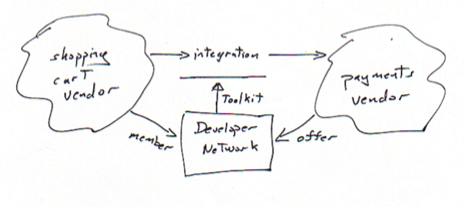
Developer Network for PaymentsThis illustration shows this business scheme. The payment companies, people like Paypal and Authorize Net, want a lot of shops to integrate with them. So they offer a developer network to attract the vendors who serve shop owners. Those vendors, the guys that make shopping cart solutions, join the developer network and use it’s services to integrate their offerings with those of the payment company. The more successful the developer network becomes the more this drawing begins to look just like the drawing that describes an exchange standard.
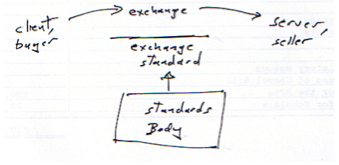
Exchange StandardWhich is probably because from an appropriate distance they are the same drawing. The work that a developer network does as it campaigns to attract developer members, get them to sign up, integrate, and succeed is identical to the work a standards body ought to do as it campaigns to drive adoption of it’s offering. Both the standards body and the developer network are attempting to define a platform (represented in these drawings by the line below the exchange or integration).

When I look at a group (a business, a project, etc.) one of the things I look for is how rich their set of connections is, their complements. One way to look for that is to find their developer network. Another way is to look at their customers. osCommerce is amazing because of the diversity of the store owners that use them.

Typo!

I didn’t get a job once. Have I told this story? They had me in for the interview. But I think that was just because they wanted to tell me the bad news. My letter wasn’t folded correctly. There is, it appears, a correct way to fold and insert a letter into an envelope. The CEO told me this right at the beginning of my interview.

Later, a different job. It was my first day on the job and I cheerfully informed this company’s CEO that I was dyslexic. The look on his face would have frightened others. I’d seen it before so I shrugged it off. People seem to get over it. The next day they instituted a three writing sample requirement on all new hires.

I was terribly amused by a scene in the movie Lemony Snicket. One of the good characters is deeply committed to the value of good grammar. When the vile count forces her to pen her own suicide note she leaves a coded message in the text. Each letter of the coded message marked off with a spelling or grammatical error. Of course the evil person, like myself, would be blind to these.

I’m aware that this handicap drives some people absolutely crazy. Good news. In the best traditions of leveraging the contributions of the many I have now added a way you can scratch that itch. Below each entry there is now a “Typo” button. Hit it and you can send me your corrections! Talent Scrapping

Update: Two fixes so far on this one. Thanks!

small vendors

I pushed the button on the microwave this morning and there was no breakfast in there. Breakfast was in the toaster. I feel the microwave let me down. Or possibly I’ve gotten the means confused with the end, or maybe it’s the distribution channel with the good’s distributed.

I love eBay or Google because of what they help me find. It’s easy to get confused about that. It’s not that they made those wonderful things and surely they deserve only the slightest credit for the pleasure I get from the things I find. While it’s not fair to blame this morning’s microwave for failing me it maybe fair to blame the intermediaries for similar failings.

I get a certain pleasure when I find a new rich appliance in the net that can feed me tasty things so look at some things I found recently and see if you can see the trick. Here you can buy 8-12 frogs legs. Here you can buy some sausages. You can get a thousand kinds of stamps over here. Need supplies for your revenge fantasies? Or maybe your ears are cold?

We need better ways to search, maybe the microwave wasn’t empty.

Keeping Things Positive

Our stove has been a disappointment. We bought it when we remodeled the kitchen. We had the repair guy in at least five times during the warranty period. I have disassembled the entire thing at four times. The grills don’t fit. Few of the exposed plastic bits remain unbroken. One of the bits of plastic in the control panel broke so you couldn’t turn off the oven. That control panel captures spills and then stains. etc. etc.

So I wrote a review at epinions. In the days after I wrote the review nice members of the epinion’s community rated my review as “somewhat helpful.” My reaction was ‘what!’ I write a review that should save people a thousand dollars and these folks think I should have included more information about the stoves dimensions and features!

Actually, I recognize this pattern. It is a good thing to keep your community positive. Maybe they just wanted to send a signal that I shouldn’t be so negative. Luckily other people have since piled on and written similar reviews about this poor stove.

This story is about some guy who has gone to court because he’s upset about the ratings people are giving his apartment complex If the guy that ran this place was more clueful he’d have gone to the web site’s community leaders and urged them to work harder to keep the tone positive.

Cause you know – negativity – it just turns people off! No money in that.

Surrender, finally, in a standards war

The benefit of owning a standard is that you get to control the fate of it’s community of complements. With luck and hard work you can use your whatever you want to call it, (ownership, leadership, power) to do a number of things. You can use that control to shape where the market goes. You move the immovable, i.e. the installed base forward. That’s key because it helps you to avoid being displaced by tech. innovations. Of course in the best scenario, for you, you get to draw off a tax from the market that spins up around your standard. Owning the land a city is built on, so to speak, and charging some rent.

So you get land grabs, attempts to move really quickly to define a standard and get a community of complements to appear around it. For some entrepreneurial startups this is the whole business plan. It’s a pattern that can demand a lot of capital, so it’s synergistic with the VC approach. Sometime this approach goes like a firework and nothing is left but an echo. Sometimes you get the walking dead. Sometimes you almost make it. Palm is a beautiful example of almost making it.

So you get war. War to control the land where an market is emerging. The wars tend to unfold more slowly. To get a standards war you need some big players who are locked in. On the one hand they need a huge installed base that ties them down. On the other hand they must see that movement is inevitable. Finally you need a rich prize, or at least the impression that big prize is in play. It makes for interesting times. Handheld computing has just this structure.

So Palm managed what the other fast movers didn’t. The Newton didn’t make it. Go didn’t make it. Magiccap didn’t make it. The first N rounds of Microsoft’s tablets haven’t. None of the calculator companies crossed over. None of the phone vendors have managed much.

Palm created a standard for how to keep your handheld in synch with the rest of your junk. A rich network of complements emerged around it. They pulled off that rare success, the land grab.

But this that standard is the slow moving kind. The cell phone industry, in particular, but also the rest of the consumer electronics industry, have huge installed bases which they can’t walk away from. So they have to fight it out.

These gorillas’ response was Synch ML. Slowly but surely they have been winning. So it’s a forgone conclusion that Palm would be forced to capitulate at some point. And now they have.

It’s curious how what was once their treasure becomes their albatross. They need to force the migration of the existing community of compliments without laying waste to their installed base. Few companies know how to do that.