Monthly Archives: February 2004

Atom – real open standardization?

Sam’s talk on organizing the Atom standardization activity via a Wiki is quite nice.

Even if you have a desperate community of people yearning for some kind of exchange it is an amazingly complex coordination task finding creating the concrete standard. But, there are few patterns for solving this problem. I’m very impressed by the Atom story. It really looks like we have a new pattern, a more open pattern.

One example one of the patterns people use is to create standards: a small elite group of invited members gathers to create a first draft of the standard. This can work. It approach is not without risks. Even in the absense of bad actors it creates standards biased toward the roles represented by the members of the elite group. All exchange standards have buyers, sellers, and middlemen. When buyers and the middlemen design the standard it’s unlikely to be a best fit for the sellers. Of course all standards activities have to guard against the risk of a stick-up.

The negotiation literature suggests that one way to resolve messy multiparty negotiations is to rondevous around a single document. The Wiki fufills that role. The liturature also suggests having that document cared for by a neutral party. Sam ended up holding that bag. In the talk he uses the term lightning rod; I visualize that at that point in the talk his smoking hair stands up on end and smoke comes out of his ears. The classic example of this pattern was Switzerland, a landlocked country, acting as steward of the Treaty of the Sea. Sam wasn’t entirely a neutral party; but he was a sufficently minor player in the market that other parties didn’t see him as plotting a stick-up; well most of them didn’t.

One of my cartoons for open source is that it’s a substitute for standards making. That a portable body of code is a surprisingly good means get to a standardized way of solving some problem. The code acts as the common-document around which the parties can coordinate their efforts.

But I then tend to say that open source doesn’t know how to do standardization. That we haven’t yet managed to write any new standards using the work patterns of open source. That new standards tend to be written the using the old design patterns. That’s why the Atom example is so thought provoking; it looks like a first case of an open source style of working on a nearly pure standardization problem.

Sam was very close to totally open. Everybody with a stake was welcome to come on down. While that was helped by the highly fragmented and rapidly growing market this standard was targeted into I’m still impressed that it seems like it worked. That’s so cool.


A Tradition of Intolerance

spalmer.jpg

As my fellow citizens in Massachusetts are hard at work protecting their culture from a plague of excessive marriage I am reminded of our history.

Joseph Palmer’s exuberance lead him to wear a beard. His fellow citizens, outraged, tossed him in the slammer.

Amusingly Joseph was a butcher, but latter moved in with Alcott to Fruitlands; a utopian community of “spiritual elite” where they labored toward paradise thru the “narrow gate of self-denial.”

“If Alcott felt Brook Farm was not

Smoking Factories of Innovation

I have to put up with a lot of talk about of how to create organizations that generate innovation. Smoke bellowing factories of innovation fed by train loads of recently clearcut ideas.

So I liked these two quotes that crossed my screen yesterday.

“Great ideas, it has been said, come into the world as gently as doves. Perhaps then, if we listen attentively, we shall hear amid the uproar of empires and nations, a faint flutter of wings, a gentle stirring of life and hope. Some will say that this hope lies in a nation; others in a man. I believe rather that it is awakened, revived, nourished by millions of solitary individuals whose deeds and works every day negate frontiers and the crudest implications of history. As a result, there shines forth fleetingly the ever-threatened truth that each and every man, on the foundation of his own sufferings and joys, builds for all.” ~ Albert Camus

and this one too, which though from an entirely different context strikes me as one of the things that makes open source work.

“No missed deadlines, only missed opportunities.”

Well, gotta run.

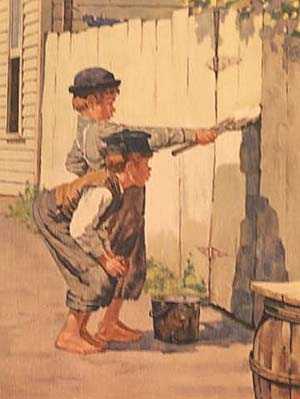
Tom Sawyer

tomsawyerbythefence.jpg

I may have to start refering to certain business models as “The Tom Sawyer Business Model.” Refering to Tim O’Reilly:

“Quinn nails it. Tom Sawyer with a network connection and a conference budget. (Hat tip to Cory.)” — Tim Oren

So what did Quinn write?

…”if tim really wanted a jet car, he’d throw a conference, invite some jet car enthusiasts and talk about how great it would be to have a jet car and then sit back and wait for someone to build him a jet car. it’s like the peter lynch investing philosophy in reverse: instead of investing in the things you use everyday, get other people to invest in the things you wish you had everyday.” … “you know what makes your conferences good, tim? we all act like 13 year olds. show me, make me care, and when you do, i’ll care so much, and i’ll believe that i can revolutionize the field.” …

The story I assume Tim’s refering to is well worth reading in the original (this web thing is pretty cool ain’t it?). Mark Twain was a genius, but also an enthusiast of the last golden age and lost his shirt as a venture capitalist.

I once listened to the head of Microsoft’s open source program opine that developers “Just want to have fun.” At which point you really need to go listen to Blondie’s “Girls just want to have fun”, but record companies are hording that so I can’t point you to the mp3. My thought at the time was – golly the subtext of developers as girls is like totally on message dude.

But yes, there are a slew of buisness models that work by creating a surface were contributors rondevous and leave behind value. Fly paper if you will.

Open source is one of these. The wise open source operative spends a lot of time mimicing the Tom Sawyer role model. But unlike some pseudo open communities, we at least we carefully craft a license that makes it clear that your contributions remain part of the common wealth.

It’s a trust thing. “Innocence lost” and all that.

Reciprocity: all my friends are sexy!

All my friends are sexy. Well, those in Orkut are. Well, they would be but Safari can’t believe it; so it crashes about half way down the list. Maybe it’s a particular friend in the list? Maybe Safari knows something I don’t know?

I was quite taken by David Weinberg’s comment over at many-to-many that prisoner’s in solitary confinement will tap on the walls to communicate with each other. It was just after that that I noticed the amusing way that in Orkut people are finding ways to hear thru the walls of their rating system; so they can figure out what the rules of the road are.

Orkut’s autistic model of a person is trust/cool/sexy. Those linked to you can vote on a scale from 0 to 3 on each of these. To help keep these votes slightly anonymous they don’t display your score (which is just the sum of all the votes you’ve recieved) until you have accumulated at least five votes.

One way that standards of behavior emerge is by mimicing the behaviors of others. If your friends are into the high-five then it’s likely your going to mimic that. If your friends use jargon or cuss a lot you’ll get with the program so as to create cohesion in the group.

Some group standards, like the common handshake, are more coersive than others, like wearing the same color ties. Exchange standards, like handshakes, force the two parties into conformance at least for the duration of the exchange. Where as a the community uniform only signals membership and always has some non-conformance around the edges. Well, to be perfectly honest and remembering the alpha-male behaviors revealed during some handshakes, you get a lot of non-conformance around exchange standards as well.

In anycase people in a community labor to conform to the community’s standards as part of contributing to the public good established inside that community. And since we all know there are risks of being talked-about, scolled, shunned, ostracized, or beaten up in the play ground, if we fail to get with the program.we all expend energy puzzling out what the community rules are.

So I’ve noticed that most people in orkut seem to vote either zero or three. And I suspect that they tend give the same vote to all their associates. I infer this from the tendency of my scores to step forward in units of three. People seem to vote early, but not often.

It looks to me like a lot of people have decided to either opt-out of the rating system; or they have decided to turn all the dials to eleven. The second choice seems kind of friendly than the first; though both signal that we’re too cool to take this autistic model of acquantance seriously.

This is not dissimilar from the tendency of eBay ratings to be effusive and over the top; or a similar patten I’ve noticed at epinions. I don’t think I quite know what this says about the hypothisis that diffuse internet based rating systems can displace proffesional reviewers – a theory I generally agree with. But, you just can’t stop them – people trend toward nice and cooperative.

Who took my bottleneck?

bridge_collapse.jpg

In yet another example of how the Internet has deeply eroded the value of the distribution bottlenecks that defines the bedrock of most publishing firm buisness models Freedom to Tinker reports that the editorial board of the Journal of Algorithums has resigned over rapidly escalating pricing.

Eszter Hargittai over at Crooked Timber points out Knuth’s letter which provides a wonderful overview of the dynamics of this transformation from the point of view of one side of the channel. In this example the content producers are a small enough group that they can organize this kind of revolt. In the music industry the revolt is more organic; though Apple’s having fun helping.

One thing that Knuth points out is that as the publishing industry has concentrated they have been furiously raising prices for high end journals. If I was a publisher of a high end journal I’d view my days as numbered. The business model is a deadman walking. So, what to do?

That puzzle reminds my of Axelrod’s book on the prisoner’s delimia. One element of Knuth’s letter I found particularly telling was the nostolgia for a how the authors, publishers, and libraries where once fellow travelers in a grand enterprise. As the industry has consolidated that’s evaporated. Axelrod showed that in a repeated series of games cooperation (with tit-for-tat) is the best strategy. Except.

Except in the last few rounds: as soon as the players know the game is about to wrap up the cooperation breaksdown. This end of game breakdown of cooperation is what I see happening in the high end journal market. The publishers are attempting to capture the maximum revenue their monopoly on the channel can deliver. Every man for himself. This is not dissimalar to my model of why the media companies are suing their customers.

These are last gasp strategies, born of desperation. For the channel operator they are subtle calculations. Doing this accelerates the destruction of the channel, but if the channel’s destruction is assured then it’s just a matter of timing how to get the maximum income out of the game before it’s over. These subtle calculations are made simpler for the “rationally” managed firm; which typically doesn’t understand the value of longterm cooperation. Knuth points out that Springer Verlag charges the most for journals, sometimes managing to charge almost two dollars a page. I’d argue that the indicates they are the most rationally, aka autistically, managed publisher.

It will be interesting to see if the Libraries find a way to join the revolt. Library Napster?

Prizes

I see here that Nasa has decided to have prizes to pay for accomplishments rather than for proposals for ongoing research.

Prizes are an interesting organizational device. They have some benefits for those who run the system. They tend to work better for innovation, and less well for durable systems. They are open to abuse by those who run the game.

The abuse problem is obvious; though two fold. Like the lottery they tend to draw in a large population of players that don’t appreciate the terms of the game; i.e. the odds. The second aspect is that those that set up the game can often rig it so they capture the long term benefit from innovations done by the winners. Academic research has historically been framed in a way that the innovators gained only prizes and reputation but did not typically get to capture the economic benefits of their work. Of course, in exchange they did get tenure. That can be a fair deal. Particularly when the probability of most academic research leading quickly to economic return is very low.

Microsoft’s developer network is a good example of a game you can play where you might win a big prize but chances are they will own the long term benefit of your work sooner or later. If the players believe that the game has lousy odds and is structured poorly they won’t play. This is one hypothesis about why Microsoft has been forced to create it’s own R&D department. Another example, somewhat less dysfunctional, is the venture capital game. But if you look at the number of cases where a startup was swallowed by a large firm and then comes to naught you might suspect that’s because the startup’s owners didn’t see any reason to design for the long term since that was the problem of the firm that buys them out.

People talk about converting the patent system to a prize system as a way of getting a more functional framework for generating innovations. Innovations, as information, are public goods; but they are a species of public good where you only need one innovator out of a vast pool of contributors. The cure for cancer is the classic example. At the other end of the spectrum are the public goods like safety that require that all contributors remain vigilant. The classic example of this is the maintenance of a river’s levee.

Since I consider Nasa to be a murderous institution that has lost all ability to manage the safety of it’s operations I’m not amused by further organizational moves in the direction toward increased risk taking and reduced collective attention to safety. Prizes are a lousy way to make safe systems – particularly if the innovator doesn’t get to bear the cost or the benefit of the long term. This is at the heart of the generative force that creates a our parade of superfund sites.

Game theory dudes like to treat all activities as a game and there is some validity to that. It breaks down when you need to look at the longterm durablity of the system. Longterm issues lead to trust issues. Game theory isn’t terribly sophisticated about that. When presented with a game look at the odds, look who captures the longterm benefit, look who cleans up the mess, and try to ignore the prize. Oh, and consider: do you trust the house?