Archive for July, 2002

Police Powers & Market Research

Tuesday, July 30th, 2002


I need to ask my sci-fi reading friends if this plot twist has been used yet. It’s obvious once you think of it. In the corporate police state of the future when the police will round up suspects and interogate them they will call it market research. Welcome to Florida.


And should that fail to be sufficently bizzare for you: guess who’s building the detention camp in that place outside of all international law - Guantanamo Bay? Go on guess first, then take a look.


It would be bad to become paranoid.

Dialectics: Power and Coordination

Saturday, July 27th, 2002

Manichaeism: A dualistic philosophy dividing the world
between good and evil principles or regarding matter as intrinsically
evil and mind as intrinsically good.

Simple models are a big help in reasoning about stuff. They help
you visualization. They generate analogies. They are easy to teach.
They give course work an outline. Often they can be tested. They
provide a coloring book that the scholar or student can then fill
in.

The simplest models are the Boolean ones, the dialectics: good and
evil, black and white, rich and poor, north and south, left and
right. These are great for debating clubs. They are much easier to
project into each other: good, black, poor, south? Of course
projection can be dangerously simplistic. While models are good for
graduate seminars dialectics are good for PR messaging.

That said this is a thought
provoking essay
by Robert Kagan on the growing culture gap between
the United States and Europe. There is little doubt which overly
simplistic dialect he’s projecting this into.

(more…)

Ground Cover Strategy

Friday, July 26th, 2002

The term ground cover has a surprising range of usages. This noun phrase is used for the class of things that cover your real estate in a cheap convenient way. A good ground cover is reasonably inoffensive, self-maintaining, and with luck attractive. The term is used in different ways in gardening, farming, but it’s most amusing usage is in real estate.

In horticulture the term is used to describe a range of plants that once established require little work and can be used in places where you don’t want the bother with the labor of a garden or lawn but your not willing to return to the wild. Pachysandra is very popular in residential settings and shrub roses and daylillys are popular in traffic islands.

In more industrial settings the mulch is very popular. Below the mulch is usually a layer of plastic tarp. Such plastic tarps are widely used in green houses, garden centers, vegetable gardens, and farms. Where they are called alternately a ground cover or a weed control barrier.

You can even find the term used for the asphalt like materials used to seal dumps, industrial wastelands and abandoned property.

The term ground cover is also used in the real estate industry to refer to ways of employing your real estate holdings while you wait for a more lucrative opportunity to arise. The developer looks for certain features in a good ground cover. It must pay the taxes, and not be too tiresome to manage. U-Storage facilities are a good example of this usage.

It must not be too attractive lest the neighbors are tempted to object latter when you want to build your office park. The real estate speculator would be making a big mistake to leave the land idle while he waits for the chance to build his office park or apartment complex. Imagine his disappointment when he finally decides to build and the neighbors decide to complain about the loss of open space. Better to put in something a little unattractive. A used car lot is a good choice.

Real estate ground cover can be seen everywhere. The long strips of little one story shops along main streets in old suburbs were built as ground cover by speculators. They used to be called “rent stores”. The speculators expected to build apartment buildings later when the density could support them.

Real estate ground cover is common around the margins of cities. It creates a band of ugly low sprawl occupied by marginal businesses like used car lots, exercise gyms, and storage facilities.

I don’t see any reason to believe you wouldn’t get a similar ground cover in any and all property rights systems.
Commerical Cults

Tuesday, July 23rd, 2002


Today’s times has an article that at first blush is about the top 25 internet retailers and how some of them might surprise you - e.g. Dell is #1 and TicketMaster is #2. The majority of the article is about Amway’s success with thier Quixtar subsidiary. Apparently the article’s author was unable to type Quixtar into their search engine since with a little effort they would have quickly found the sites in the web that point out that Amway/Quixtar is right on the razor edge of being a commerical cult.


These MLM (Multi-Level-Marketing) organizations are great frameworks for abusive organizations. The root of the tree can delegate liablity, offensive labor management practices to the leaves of the tree, while collecting fees via upfront fees for sales materials.

Web Visitors per Month

Tuesday, July 23rd, 2002


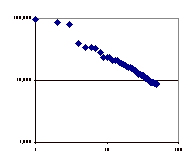
webvisitors.gif

Web traffic per site was the first place I noted a power law distribution in the web. Back then (1997?) Alexia used to have a chart showing this. This chart illustrates that. It’s taken from this data source, it’s the table in that press release labeled “U.S. Top 50 Internet Properties”).


The vertical axis is visitors per month, and horizontal is the rank. The top three, who are neck and neck, are AOL, MSN, and Yahoo. The top of the chart would be 100 million visitors per month!