Category Archives: politics

Go it Alone

One of the textbook examples of a network effect is the ATM network. The more ATMs in your network the more value your customers will perceive in opening a bank account with your bank. All else being equal customers will pick a bank with a larger network of free ATMs. For very small banks, those with only a hand full of offices, this became a serious competitive problem about a decade ago. To solve the problem these banks formed branded ATM networks. In my region, for example, a large number of very small banks formed a network known as SUM. The SUM network allows me to bank with a small bank but get the advantage of a large free ATM network.

So yesterday I stopped to get money and the ATM machine announced that the bank I was in had withdrawn from the SUM network. My first reaction to the bank

neocon history

facinating:,

History, Ismael Reed once said, is the story of warfare between secret societies. I’m not ready to go that far, but I think it’s fair to say the history of U.S. foreign policy over the past forty years has been the story of the war between two not-so-secret societies: the neoconservatives and the realists. And it now seems the realists have won another battle — although perhaps not the war.

…

The neocons may be down, but they’re not out — and aren’t likely to be, not as long they continue to enjoy the support of the ultras: the Christian conservatives, Sunbelt demagogues, Arab haters and hyperpatriots that constitute the Republican Party’s popular base. The realists may be the ones who have a clue about how to run a foreign policy, but the neocons are still the ones with the political juice.

more:

common themes that are generally identified with the neocons: contempt for international organizations and the concept of multilateralism; impatience with traditional balance-of-power diplomacy; a cultish devotion to the use of military power; an outspoken belief in the superiority of Western culture and political institutions; a messianic vision of America’s mission to “civilize” the world, which at times (Max Boot) makes them sound like caricatures of old-fashioned European imperialists. And of course: an intense identification with the state of Israel, and a willingness, even eagerness, to use American power to protect and further Israeli security interests.

Sunk Cost

Matthew Yglesias writting in response to Fareed Zakaria says:

This idea that if a project wasn’t worth doing it is worth abandonning halfway through certainly isn’t true as a general proposition. Say the government allocated a few million dollars to build a wasteful bridge, and now it’s almost done but before it can be opened they need $50 more in order to paint the lines on the road. It would be pretty silly not to support the additional money at that point, since not opening the bridge isn’t going to get you your money back.

The topic at hand is what reasonable people’s position ought to be regarding our commitment to Iraq – Do we stay, do we go?

This is a discussion that ought to be had, more carefully, more calmly. This comming year is going to be a lousy time for calm analysis though.

I like the bridge metaphore, in part because I use to help think about exchange standards. Exchange standards lower the transaction costs for two parties to move back and forth betwix each other. They create network effects the players on both sides of the bridge get locked into the habits of using the standard; i.e. the players climb the experiance curve. Complementary products and services pile on to make areas around the bridge more valuable. Thus London grows to complement to London Bridge.


LonBrtop.jpg

London Bridge – tourist attraction in Arizona

Of course it’s silly to even paint the lines on the bridge if the bridge doesn’t go anywhere.

So one part of the challenge in thinking about the cost of finishing the project in Iraq is figuring out what the upside is. Those that lead the charge into theis enterprise hoped it would create the hub around which the entire gulf and the middle east could be reframed. That’s a delightful, if hegemonic, goal. But does anyone believe that anymore? Few I think.

Lacking that clear benefit we seem reduced to more prosaic benefits. An unthreating, reasonably peaceful, and prosperous Iraq that provides a good example for others in the region – for example.

The problem with bridge building, standards creation, and other organized public goods is that it’s extremely hard. Many voices have to be convinced to sing the same song. That can only happen if you have reasonably strong leadership that people respect and follow and you can demonstrate clear benefits to all parties so they expend the effort to get there.

We seem to lack all these. In particular we pissed off whatever chance we had of grabing the reins of leadership going into the project thru our arrogant behavior. Of course if you can demonstrate sufficent cost/benefit people will follow even arrogant leaders. The tough nut is that nobody in this debate is currently providing a credible story that generates substantail cost/benefit. Mostly all we get are benefits that require far too much faith coupled with a general undercurrent of denial about the costs.
Ownership, Power, Votes

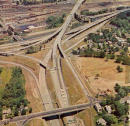
highway.jpg

I gather that some people think the distinction between a liberal and a leftist is that liberals believe that goverance demands the balance of many interest groups, while a leftist believes that discussion must be framed in terms of power. I guess that makes me a bit more of a leftist than a liberal.

I’m surprised that the recent problems that the European Union has had deciding on voting rules to embed in their constitution hasn’t given rise to more discussion around the blogging community. It’s a classic hard problem. How do your translate existing power and institutions into the voting power of new institutions? In the US we carry the legacy of that same debate in the disproportionate power of low population states in the senate. Which in turn is only reason our interstate highway are more grid than scale free network while our cities lack robust public transportation and good schools.

Meanwhile the Repulicans are revisiting the meme: “ownership society”. That’s such a transparent argument for voting rules based on wealth vs citizenship. People fall for that?

Frame busting

From Stuart Robinson‘s blog two contrasting posts. One about an absurdist satirical web site who’s maker has now disappeared after the Chinese authorities came to visit. One about how weblogs and email are giving the folks back home an upclose and personal window into the Iraq war. That reminds me how TV news did the same for the Vietnam war. Let’s not forget: the forces which be found a ways to defang TV news.

Broken Windows

I have a particular beef with the so called “broken windows” theory of policing. In brief it’s the theory that when the rich man abandons or fails maintain his property the police should round up the homeless and throw them in jail.

So I noted this quote: ‘Ali Omer, a young writer in Baghdad, commented, “I discovered the draw-back of democracy, it dirties the walls!”‘ from the Utne Reader

As well as this one from the New York Times (which has a very obnoxious tendency to move their articles inside their walled garden). The “I” in this quote is Frank Gehry, the architect.

I have my own version of the “broken windows” theory of urban decline. It’s called the “cheap glass” hypothesis. Both concepts deal with the power of small causes to produce big effects. The broken-windows theory, which got great play in the Giuliani administration, states that when smashed panes aren’t quickly repaired, it signals neglect and decline. Neighborhoods become targets for burglars, who beget drug dealers, prostitutes, muggers, murderers.

The cheap-glass theory states that when so-called “value engineers” are hired to reduce building costs, mirror glass quickly follows. Mirror glass induces low self-esteem, depression, poor citizen morale, reduced productivity, strained personal relationships and ultimately broken windows of the soul. This is not the way to go.