Category Archives: politics

WMD: Warming of Mass Destruction

vegitation.png

It would be sad if my blog became entirely political over the next few months, we shall see.

A friend of mine (Hi Claude!) points out that the Bush national security policy that holds that we can’t wait for a clear unambigous signal that X is a threat before we apply a can of preemptive wop-ass to X clearly leads to the conclusion that now is the time to get down and dirty on Global warming.

I suspect that this only goes to show that the current national security policy is missing the footnote explaining that these rules of engagement only apply if the experts happen to agree with our preconceived notions on the topic at hand. Actually I’m not sure that experts are required, just notions.

The picture at right shows the increase in vegitation over the last 20 years in the area north of the latitude 30 degrees north.

Terror, Spain, Elections

I do hope that nobody models the example presented by the terror and election in Spain. While it seems implausible that anybody could have predicted before hand the consequence of the terrorist act upon the election. Now that we have one example people maybe tempted to over generalize.

I wonder if there are procedures that could be introduced to buffer an election from such attempts to manipulate it. I can’t think of any off the top of my head.

Bleck.

The Demonstration

The Politics of Collective Violence (Cambridge Studies in Contentious Politics)Here’s something I found very thought provoking:

“So far as I can determine, no demonstration ever occurred anywhere in the world prior to 1760.”

That’s from Tilly’s book on violence; he goes on to say that the demonstration quickly spread as a common form of political action in the following century.

So it appears the demonstration is an invention that emerged in tandem with the modern democratic state. Which makes perfect sense in Till’s model of violence. I.e. that only high functioning democratic states can sustain a large range of political activities while at the same time avoiding contentious violence emerging from those activities. Of course a strong state that’s not democratic proscribes such activities – in fact in some points in history the authorities would have to officially set aside the law against assembly on market days. A weak democratic state might allow them; but they run a much higher risk of that they will turn violent.

In Tilly’s model any given society provides both assorted means affecting changes to the status quo and it forbids other ways.

  • Forbidden – for example just taking what you want.
  • Tolerated – making a petition to the king.
  • Contentious – public debate, violent demonstrations
  • Proscribed – for example the electoral process is highly proscribed.

Contrast these to two measures of state structure: capacity v.s. democratic. Tilly has this fun drawing that attempts to show how four kinds of states portion out the amount of what is tolerated, proscribed, and contentious. For example this drawing suggests that elections are more likely to be contentious in low capacity democratic state.
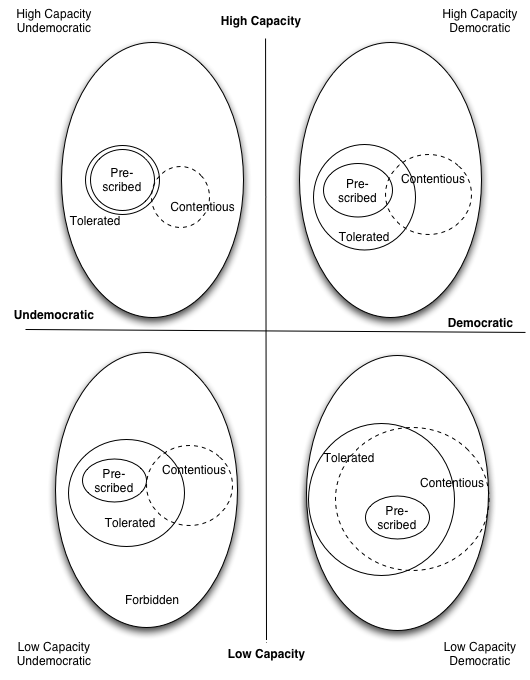
He doesn’t explicitly build the linkages between his curious historical fact about demonstrations and the model illuminated by that drawing. But let’s try. A demonstration is an activity right on edge of contentious, just barely tolerated, but so ritualized as to be almost proscribed. A demonstration is more likely to occur if you have a larger sphere of tolerated activities. You less likely to have the demonstration explode into a riot of violent contentious activity the smaller the sphere of contentious activities. Demonstrations are actually surprisingly ritualized; as we shall see in a moment, so the larger the prescribed sphere the better. All of these suggest that a demonstration is most likely to pop-up in a highly democratic state; but it also suggests what is likely to happen if it pop’s up in any of the other quadrants.

A state that lacks the capacity to regulate things will find that it has to tolerate a large range of activities, can proscribe only a few things and sadly it will host lots of highly contentious activities. A democratic state will strive to tolerate more and it will tend to provide a larger range of alternative, but proscribed, means of achieving your ends. Thus it appears that only as high functioning reasonably democratic states began to emerge that demonstrations became tolerated, and the means to proscribe them emerged that could avoid their becoming highly contentious.

It helps to think about example like Iraq, India, China, Massachusetts. For example I’m very impressed by the response in Spain to the recent bombings.

Demonstrations are surprisingly ritualized; a kind of a hybrid of the procession and the petition. He provides a nice concise definition of the beast: A) Gathering deliberately in a public, visible, and often-symbolic place, that B) displays membership in a politically relevant constituency so as to C) presenting a position on an issue; typically via voice, words, and symbolic objects; in a manner that D) proves by acting in a disciplined manner the group’s determination, and coordination (hence the marching).

He even provides a scorecard: Worthiness, Unity, Numbers, and Commitment to get a sense of the scale of a demonstration. “Five prisoners rhythmically beat their cups on the lunch room table before desert was served.” just isn’t as awe inspiring as “Four thousand veterans marched on the capital to spend the week lobbying.”


Senate Stock – Bogus

It is bogus; i.e. the report that senators make more money in their stock trading than the rest of us.

Yesterday evening I had to listen to a long peice on NPR about the recent propoganda that Senators do better with their investments than regular folks followed by a long unappolegetic slander along the lines of where their’s smoke theres fire.

There is a disturbing meme in the culture these days that nobody could possibly do anything except for reasons of self interest and greed. This creates contempt for our public institutions, encourages their distruction, and models a very bad behavior. Be careful what you wish for. If you announce that everybody in trade X is a crook pretty soon the crooks will all go into that trade.

The rational choice (aka greed) is not the only cause of human action. Maybe some people are talented.

No Boat for You!

Tune stuck in my head this morning.

The water is wide
I cannot cross over
And neither have I wings to fly
Build me a boat that will carry two
And both shall row
My love and I

marriage.jpg

Hard to coordinate the creation of public goods.

Strategic Voting

Modern life has too many questionaires. Marketing is always trying to “listen” to the customer voice and give the impression that they are somehow democratic. The hotel has a questionaire; as does the new tv; the car dealer; the magazine; the conference; the speaker; the employeer. I’m thinking of handing one out to my children. These are full of question where you are asked to rate on a scale from 1 to 5 how your feeling about the product or the experiance.

Strategic voting is somewhat disparaging term for votes that serve the long term agenda of the voter but might not reveal his actual feelings. For example if three cantidates are running and you are far to the right you might be tempted vote for the most far right cantidate; but you best strategic vote is to vote for the middle cantidate so as to temper the chance the far left cantidate will win.

So looking at these all these damn questionaires I find myself thinking that I have two choices. I could vote strategically or I could reveal my true feelings. For example the hotel form says “Do you like the minibar.” Now I would prefer that there isn’t a minibar, but it doesn’t particularly bother me. So I could check of 3. But if I actually want anything to happen then my strategic best choice is to vote the maximium.

In a sense each of those votes from 1-5 is a small vector force on actions that might be taken by other people. If I know what action I want them to take why would i ever not vote for either the minimum or the maximum?

Of course one reason would be if I know they have limited resources. For example if I know they will only work on one of the items then I should pick that one set the maximum vote, and then set all the other votes to their minimum.

Sometimes I get the results of surveys like this delivered to me. One thing I notice in that situation is that some people just vote their favorite number. I.e. they will go down the form and check off the #4 in every box. Since what happens with these surveys is that they are immediately fed into statistical analysis a vote like that just sifts the median of the population. Since the decisions about what to work are based on picking out the outliers it’s proably best if you try to get the maximum dynamic range in your votes.

I can’t see why it would be unethical to engage in strategic voting in these situations. I’ve noticed that people always seem to react to the discovery that some voters are doing it with distain. For example I worked on a conference once were the jury for papers had six members. Only one of them clearly understood that he should maximize his dynamic range and individual votes. The result was that the papers he wanted to have presented mostly got onto the agenda.

The world is just never as simple as it looks, but I’m not talking to anybody who votes for Nader in the next election.

Collective Efficacy

collectiveEfficacy.png

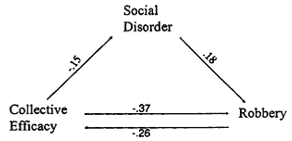
Felton Earls’ term for the single most important determinant of a neighborhood’s violent crime rate is “Collective Efficacy:” “Trust, reciprocity, and a willingness among people to look out for one another.”

“Our national ideology gets spun off in the direction of individualism,” says Earls. “But maybe the survival of our country demands that we balance that strong ethic with the admission that we’re in it together.”

It’s nice when $50+ Million of public health research returns something that’s solidly useful (example article: Science (pdf)}. “It is far and away the most important [crime] research insight in the last decade,” said Jeremy Travis, director of the National Institute of Justice from 1994 to 2000. “I think it will shape policy for the next generation.”

This same research program has finally shown the Broken Windows to be just a bunch of fuzzy thinking. Broken Windows was a very popular hypothisis that crime arises from disorder; for example the unrepaired broken window. It’s popular with authoritarians since it licenses them to demand that other people clean their desks and gives them an excuse to arrest the shabby or homeless. It confounds cause and effect.

This nice peice of research (pdf) both fails to substantiate the silly idea but also demonstrates that collective efficacy is a much more valuable predictive variable. Meanwhile the research is delightful because they collected so much data so very carefully.

(See also this:NY Time’s Article).