Archive for December, 2007

Popovers

Saturday, December 29th, 2007

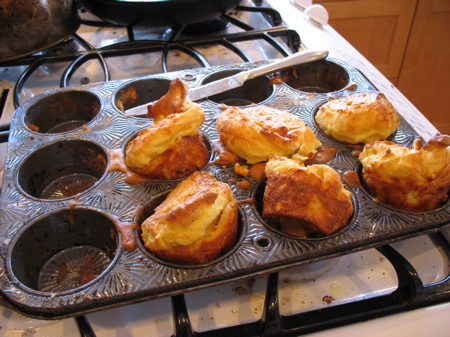
Back in college one of my schemes for impressing the women was to make popovers and more recently I have received (indirectly) a request for instructions. So.

1228popovers.jpg

My mother made this recipe for Yorkshire pudding; and in that variation you eat them with roast beef covered in gravy.

They are mind boggling simple. In a hot oven, 400F degrees say (convection is good too), you heat the muffin tin.

For six you mix: 1 cup milk, 1 cup flour, and 2 eggs. So, of course for 12 you double that; or you can also make 12 smaller ones.

Once the oven and tin comes to tempurature you cut table spoons of butter into quarters and place one bit into each tin to melt. Then pour in the thin batter and cook for 30 minutes.

Some recommendations that I follow but don’t actually put much faith in. When they come out, poke a hole  in the top of each one with a knife so they can crisp up a bit. Have all the ingredients warm before you start, i put the cold eggs into a bowl of warm water and microwave the milk a bit. Don’t obsess about how well mixed the batter is. Let the batter sit for a bit before you use it, but not more than an hour.

Taming Gorrillas

Thursday, December 20th, 2007

My thoughts keep turning to this effort by the publishers to update the robot exclusion protocol, i.e. ACAP. The current situation with the robot exclusion protocol certainly doesn’t look stable. We are going to get a revision, or substitute to that protocol. But who has the market power, the legitimacy, the technical and legal chops to create one? It just makes your brain hurt!

I think you could say … the current protocol is works. But why? A combination of factors? A gentleman’s agreement (that doesn’t sound stable). A concern that failing to conform would blacken your spider’s reputation. Why wouldn’t search engines wouldn’t associate with such spiders? That the protocol appears to work is surprising. These are very weak drivers.

It’s a great edge case in the world of protocols. It isn’t technically or legally enforced. It is impossible to enforce it technically; and any attempt to enforce it legally would rapidly bring a lot of issues out from under the rug.

It is a case study in the general problem: how to tame a pure public good. In this case information. So the usual circus of issues come to play. “Pee in the pool.” “Information wants to be free.” Copyright. Trade secrets. Privacy. Good manners. I guess it’s possible to imagine a perfect descendant of the robot exclusion protocol what would all me to mark a communication with some metadata that states exactly what purposes I license it for going forward.

Marking pages with permission metadata is exactly what the robot exclusion protocol is doing. Off to one side it says “sure index this” v.s. “no peeking!”. In that way it is almost identical to a copyright license, plus the convention that spiders tend to know where to look for it.

I suspect that something like ACAP is inevitable. I suspect it’s inevitable that the tie to copyright licensing will be strengthened. Spiders can look forward to some regulatory arm twisting.

With the big wealthy content owners on one side and the big wealthy search engines on the other it’s going to be fighting gorillas. That can’t be avoided. A shame really, given the ties to the privacy problem. Since it is tempting consider using copyright law as a lever in licensing limited use of one’s personal data.

Update: Andy Oram offers an interesting perspective.
Income Trends, by State

Wednesday, December 19th, 2007

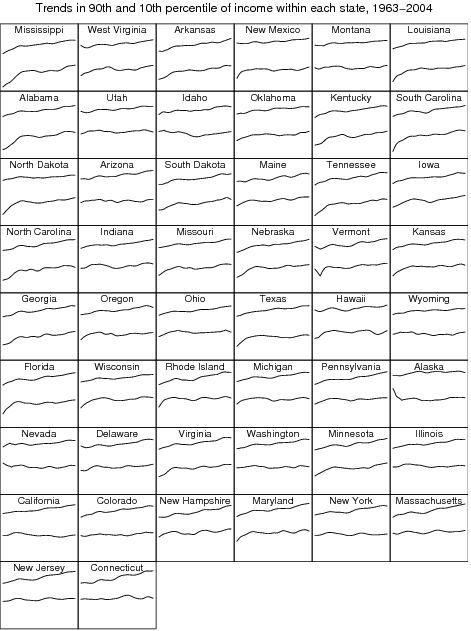
This chart is so cool, that I can’t resist in-lining it directly; I hope it’s creator doesn’t mine. The states are sorted poor to wealthy, vertical scale is log of constant dollars. The upper lines are the median income of the top 10% while the lower lines are the bottom 10%. Horizontally shows 40 years. If the lines grow closer together, as they do in some of the poor states, income inequality is declining. Contrast that to some of the wealthier states. Note that there are a number of reasons arising from the highly skew’d distributions involved that make this chart a poor lens for viewing the data. For example, most of the population lives in just the few largest states (51% in the top 9) and most of the income is actually captured the top 1%.
income_trends_by_state.png

Click thru to the original posting for some additional charts that play with this data set.

Studio Model

Monday, December 17th, 2007

180px-ua_logo1980s.jpgTim Oren sees a “studio model” emerging for Facebook Applications.  Interesting thought.

Take a Number

Sunday, December 9th, 2007

pleasetakeanumbersign_rainbowsigns.jpgWaiting the other day my thoughts turned again to coordination problems, since I was thinking about how the store needed one of those take a number, now serving schemes.  I don’t think I’ve seen a scheme like that in a software system, wonder why?  Wouldn’t be too hard, in the abstract, to add one to HTTP.  It would be a slight variation on the temporary redirect.  The server’s redirect would include the number, along with a time to delay before the retry.

Today I was tinkering with a Freebsd installation.  It includes a tool that fetches system updates.  The instructions advise me to invoke that tool in a mode that forces it to do a random delay before it actually fires off.  This is to avoid having the entire installed base of systems hit their upgrade server at the top of the hour.  It’s brittle since it depends on the users to use the right mode.  A scheme like the one above would avoid that risk, and it would could be used to help the server tune the load so it can run flat out when the bursts of users show up.

It is almost possible to do this without changing the existing HTTP spec.  For example you set up a Rube Goldberg device with three servers.  One to hand out numbers, one to queue up users, and finally one that actually provides service.   Say you want to sell concert tickets on a first come first serve basis.  As buyers arrive at your server you redirect them, providing a number, to a second server.  This server has only one purpose in live and that’s to make them wait.  A HTTP server configured to do that for a huge number of users is a bit odd to set up but it’s not particularly difficult.  This waiting server finally redirects them to the actual selling server at the appropriate time.  The nice thing about this approach is that it removes the incentive for buyers to attempt to poll as fast as possible.
Curious, I’ve mentioned take a number systems before (includes more amusing picture).