Monthly Archives: September 2008

Post Hole Digger


The future, it’s all about posting  efficiency!
This posting was born in my mail program and then sent to  post@posterous.com  where it, in all it’s rich text goodness, was converted into a blog posting at a yet another blog.  Yeah, you can never have enough blogs yeah?  Meanwhile this blog has the FeedWordPress plugin installed.  That fetched the RSS from my posterous blog, creating drafts from each posting.  Finally I added this final paragraph to that draft, and hit publish.  (I also choose to change the posting time.)
Posterous  is fun!  Try it!  It made me want a way to do email posting to this blog.  But WordPress support for email posting is lame, no SSL, no rich text, etc.  FeedWordPress, which was originally designed for managing planet blogs, works around that problem quite nicely.


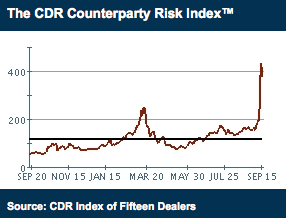
Counterparty Risk Index

This graph shows the the Counterparty Risk Index, or CRI.

That 400 is basis points, or 4%.

“Upfront spreads on CDS of 16% mean that investors seeking protection on $100 million of debt would need to pay $16 million upfront and $5 million a year.” — from a longer article at Marketwatch

As the risk rises the chance of any given transaction taking place falls.  I find it interesting to note that if you look after any venue where transactions are taking place you want this CRI to be low.  It doesn’t matter where, playground, office, eBay, farmer’s market, does it?  A trust thermometer.

Counterparty

Boy is it hard to learn all the vocabulary associated with this mess in the market, but I do find it all interesting.  For example, counterparty is a useful word.  It means: The other participant in a contract or swap.  So it is the union of buyers and sellers.  If  you’re  the seller the buyer is your counterparty, and visa versa.  It’s a particularly useful word when it becomes unclear who in the transaction is the buyer and who’s the seller, for example when your engaged in barter.  Pass a neighbor on the street, exchange greetings, and you become counterparties.  I like that there is a word for the participants in transactions where the commodities changing hands are harder to quantify.

When Mary smiles at Sally and Sally fails to return the greeting then Mary’s feelings are hurt. Mary took the risk that Sally would reciprocate.  That was her counter party risk.  A more concrete example of counter party risk: the local ice cream company recently went bankrupt and left it’s suppliers with worthless accounts receivables.  Those vendors might have purchased insurance to protect them from that loss.  I gather that in England you can buy insurance that your marriage won’t end in divorce.  I find myself imagining brats sitting on the playground wall placing bets on the chances Mary and Sally smile at each other when they pass.

Bets on the chances that a transaction between parties will go south for one reason or another go by many names.  One that’s in the news these days is credit derivatives.  As long as you can find somebody you sell you the insurance (or to make the bet with you) pretty much any counter party risk what so ever can be hedged.  Betting on the progress of Sally and Mary’s body language is at one end of the spectrum at the other end you can place bets on the chance a government will decline to pay back  its  debt.

The markets for those are signals about the reputation of a given counterparty.  Better than  eBay  reputation scores.  The German government has a better reputation then the US government for example.

Sense of Scale

One thing I’m finding particularly hard is getting a sense of scale for what’s unfolding in the markets, but here’s a run at the question.

Katrina was maybe a $80 Billion event, and it looks to me like Ike is probably a $30 Billion  one.  The Iraq war’s direct costs are probably 2 Billion a week.  The 9/11 attacks destroyed about $16 Billion in physical assets, and the clean up cost about $11 billion; lots more in the ripple effects.

Microsoft, Apple’s, and Google’s market cap are roughly $230, $119, and $140.

AGI’s market cap a year ago was around $200 Billion, today it’s around 10.  A year ago Fannie Mae, Lehman Brothers had market caps of was around $60 and $40 Billion each.  That’s $300 billion total, about twice the size of the numbers in the 2nd paragraph.

These are big storms. With about 100 million households in the US, $300 Billion is three thousand dollars each.

These estimates are all aweful rough.  I couldn’t quickly find estimates for the wealth distruction in the house markets, but here are a lot of write downs.  Nate Owan takes a run at a similar question.

Heavy Weather on the Street

While I’m still liking Paul’s metaphor, where in he points out that some firms are like the springs in the mattress the entire economy lies upon, Felix Salmon plays with a nice alternative, the weather.

Most of the companies listed on the stock market aren’t, and they should be able to weather a financial storm with relative ease.

On the other hand, that financial storm really does seem to be more of a heavy breeze than a major hurricane. The Standard & Poor’s financial-stock index is down by only 3.5 percent this morning-hardly a bloodbath. And the TED spread-a measure of distrustfulness among banks-is up sharply at 192 basis points, but is still below the levels we saw in the summer of 2007, and again in December, and again in March. Indeed, each spike upward in the TED spread seems to be lower than the last, which has to be a positive sign.

The big unanswerable question, though, is what happens next. Hurricanes start out as a heavy breeze, and then get worse-and the preconditions for a financial hurricane are very much in place. If a real hurricane needs high ocean surface temperatures and warm humid air, a financial hurricane needs generalized nervousness and a general lack of liquidity. Once those are in place, a few failed trades are all that is necessary to precipitate a very nasty chain reaction.

Unlike the weather we lack nice high resolution photos from space to show us what’s just over the horizon, all we have is pictures of what happened yesterday.  We can look at the temperature, check which ways the gusts are blowing, tap on the barometer.  He draws our attention to one of these simple instruments.

“How big is settlement risk right now? An indicator one might look at is the number of “fails to deliver” and “fails to receive” reported by primary dealers in U.S. Treasury bonds.”

That’s 20 year’s of data.  Squeek’s from the springs in Paul’s mattress.  That first peek is just after 9/11.  The last burst is so far this year; but the data ends on the 3rd of September.

Wiped Clean

As Ike approached landfall last week the National Weather Service warned “Persons not heeding evacuation orders in single-family one- or two-story homes will face certain death.”  I was quite shocked to hear various news sources question that.    Below is a picture of a portion of the Texas shoreline, Gilchrist, Texas on Bolivar Peninsula.  Galveston is south of the channel up to Houston and Bolivar Peninsula is north.  The eye crossed the tip of Bolivar Peninsula and the regions just north-east of there got the worst of it.  I gather 400 people did not to evacuate from the Peninsula.

That photo is one of the set at the Globe’s excellent big picture feature, go look!  Anybody know the address of that house?  I suspect that Google street view and Microsoft Live have pictures of the old neighborhood.