Archive for the 'open source' Category

Bill starts a dating service

Friday, July 20th, 2007

I had the fun a long time ago of being the first bidder on this auction:

Today Bill told a bit more of the story.

See, something else happened: During the sale dozens of people contacted me by email and telephone. They weren’t seeing it as a joke. They were anxious to bid. They regretted being unable to participate. The wanted to work with me on research, or with anybody on research, or have a chance to carry forward research they had started but lost….

They wanted to collaborate.

They were graduate students, and laymen, and people with Ph.D.s and M.S. and other advanced degrees in mathematics and science and engineering and humanities and social sciences and art. And they were busy, and focused, and full of ideas… and every one felt disenfranchised.

For one reason or another they felt unable to collaborate in serious research, to follow ideas through to completion with colleagues. They were stymied by sexism (MIT-trained female math Ph.D., forced into industry by uncollaborative peers), by the burden of diligence (graduate and undergraduate students, or industrial researchers ordered to focus and pay attention on their immediate work), by the walls of the many-siloed Ivory Tower itself. Or they were smart academics in the right position, who had nobody willing to collaborate with them in a culture that over-values competition and secrecy and primary authorship. Some were full professors, fully-credentialled but held back by service or administrative obligations, or funding hardships, or some other oft-voiced complaint. Some were in small ivy-covered undergraduate teaching institutions, or community colleges, and just out of luck for chances to do some work.

Nobody seemed dumb. Nobody sounded like they were trying to scam a lightened workload by foisting the hard part of their project over to me. Nobody was trying to cheat on their homework or thesis. Nobody was a creationist, nobody was astroturfing. They all made it sound as if finding a colleague was the best thing they could imagine.

I make it out to be very general, very broad, almost ubiquitous. There was diversity in the character of response, but I’m not exaggerating: nearly two dozen people contacted me. This expression of disenfranchisement was a shared trait of a stream of email correspondents, and people who called me directly on my business line. They didn’t really care how good or bad I was, and maybe didn’t care too much about my credentials. The fact that I seemed capable, and serious, and willing to give my time and energy to thinking and talking with them about something they were interested in… that was enough.

I have a catalog of insta-theories for Open Source, but that there is always a kind of desperate undercurrent of demand for quality collaborators isn’t in that catalog. I’ll go fix that.

Craft v.s. Art.

Saturday, June 30th, 2007

This is a very elegantly written posting.

Most people are not aware of the depths of the argument that between the fine craft establishment and the dominate fine art elite.  I used to think about that debate more; but I’m pleased to note something about it.

Fine art is at it’s core about scarcity; fine craft is much less so; and what has come to be called crafting hardly at all.  The fine craft movement, which weaves it’s way back through all of history and all nations, in it’s modern manifestation, I’m surprised to note, a lot like open source.

I hate to play that card.  The term open source has almost fallen dead for me.  So many people play that card in an attempt to grab a bit of legitimacy for what every scheme they are executing that involves sucking talent out of the vast pool of people on the other side of the internet; and don’t get me started on the neologism ‘democratizing.’

What is going on in the modern crafting movement, as manifested in the web, is the thing I think is coolest about the Internet.  First off it has a pool of people of common interest finding each other, like a giant pot luck dinner or a stone soup.  They are creating energy and knowledge that wasn’t there before; in an commons.  Secondly the energy of this movement comes from the periphery; the respect of the participants faces toward the periphery.

When this works you get the opposite of scarcity based activities.  In fine arts the entire community is polarized by the pervasive question of who’s at the top, who can command the premium prices, who’s hot, who’s not.  In a periphery facing community the tension, the anxiety if you wish, is where on the vast periphery the next insight will emerge, the next cool trick of the trade, the next breath taking bit of design.

Sharing as exercise

Thursday, May 24th, 2007

I hate most explanations for why people participate in Open Source. I care about this question.  I enjoy the game of puzzling out the answer.  In a reversal of the usual cliche I love the game and hate the players; the casual players who think they know the answer. After two decades of thinking about this question I love that I stumble upon new answers.

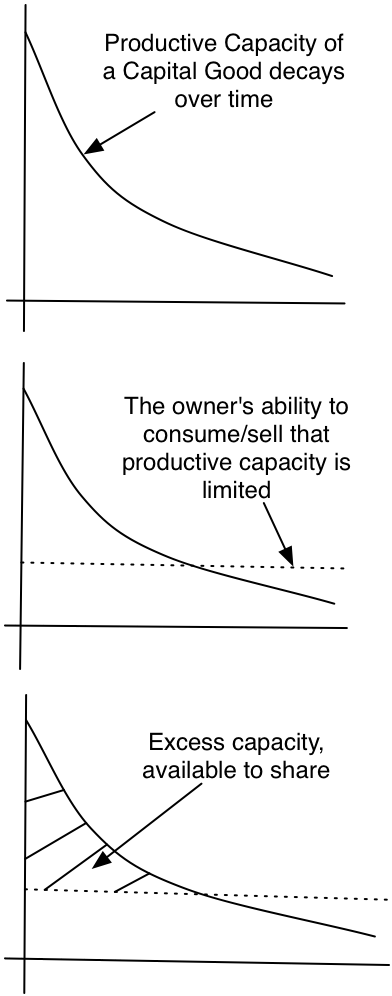
Owners of Capital Goods often have excess capacity that they might share.This morning I was attempting to read, yet again, Benkler’s essay on sharing nicely where in he argues that the usual dialectic framing of how to coordinate activities (hierarchy v.s. markets) has blinded us to a third scheme; i.e. sharing. He points out some huge coordination problems that are solved via sharing and he does the good and necessary work of constructing an economic model for why some problems are well solved by sharing.
Part of his model explains why owners have excess lying around, that is  suitable for sharing.  In that explanation I was excited to to notice a new motivation for sharing.

Benkler draws our attention to excess capacity that owners can not consume. Idle cycles on your PC or empty seats in your car as you drive hither and yon. He model for this is analogous to that seen in value pricing models - i.e. if you own a hotel full of rooms and as the hour grows late you should consider selling those rooms for less; since otherwise they will go idle an you will get nothing.

I found my self thinking at that point about the emotions an owner has about this excess capacity, for example the sense of of lost opportunity, leading to emotions of frustration, grief, guilt.  The hostess pressing left overs on her guests as the party wraps up is motivated by a horror at the waste shows how motivating this kind of sharing might be.

But the resource that drives open source is talent so the question naturally arises at this point does this model have something to say about sharing around the creation of these knowledge pools? This is delightful bit. If we think of skill as a capital good then talented people own building full of skills; and they lease out to earn their living. Of course most of the time they can’t find a buyer for all their skills.  The rooms are empty.  It’s not surprising that they are willing to share freely some of this capacity.

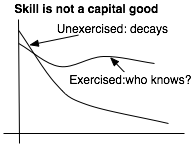
Skill, unlike capital equipment, can improves with use; creating an incentive for sharing.I had already noted many of the motivations outlined above for sharing one’s talents: countering the guilt for letting it go to waste, the positive emotions of generosity, the low cost of giving away the excess capacity. But I had not noticed something else: skills that are not exercised decay. While the hotel room left idle depreciates only slightly, a skill unused decays quickly. The skill demands that I exercise it, it’s survival depends on that exercise. If I horde it, it evaporates.

Personal Note from Richard Stallman

Monday, August 14th, 2006

June 1984:

The Lisp Machine is a product of the efforts of many people too numerous to list here and of the former unique unbureaucratic, free-wheeling and cooperative environment of the M.I.T. Artificial Intelligence Laboratory. I believe that the commercialization of computer software has harmed the spirit which enabled such systems to be developed. Now I am attempting to build a software-sharing movement to revive that spirit from near oblivion.

Since January 1984 I have been working primarily on the development of GNU, a complete Unix-compatible software system for standard hardware architectures, to be shared freely with everyone just like EMACS. This will enable people to use computers and be good neighbors legally (a good neighbor allows his neighbors to copy any generally useful software he has a copy of). This project has inspired a growing movement of enthusiastic supporters. Just recently the first free portable C compiler compiled itself. If you would like to contribute to GNU, write to me at the address above. Restrain social decay–help get programmers sharing again

From the preface of the Lisp Machine Manual.

The Liablity of Sowing one’s Oats Widely

Thursday, May 11th, 2006

This is great…

In a sense, Google, in its ADD-driven style, is building up a sizable engineering liability here, one that it will eventually have to ‘fess up to.” — at Infecious Greed

Is it true? For the life of me I don’t know.

Network effect businesses depend on running as fast as you can to capture a large a network as fast as possible. This is amazinlgy risky balance between capturing share and avoiding “engineering liability.” Nobody knows the right balance but we do know the trends. The share v.s. low-risk dial has moved consistently toward share wins. Microsoft’s ship crap fix it later strategy got them thru the transition to GUI, and quite a few other company killing upheavals. Open Source’s ship early and often strategy has enabled it to capture installed base and hence set standards faster than more conservative tactics.

I suspect that the author of the quote above is just peeved that he’s locked into more and more Google offerings while being frustrated that they aren’t becoming the robust software he desires. If these products were open source he could join in common cause with his fellow travelers and fix them. But since his vendor is a monopolist his only option is to plead, shame, and otherwise use voice rather than doing to resolve the problems.