Archive for May, 2005

OpenID - Part IV - URL as Global Identifier

Sunday, May 29th, 2005

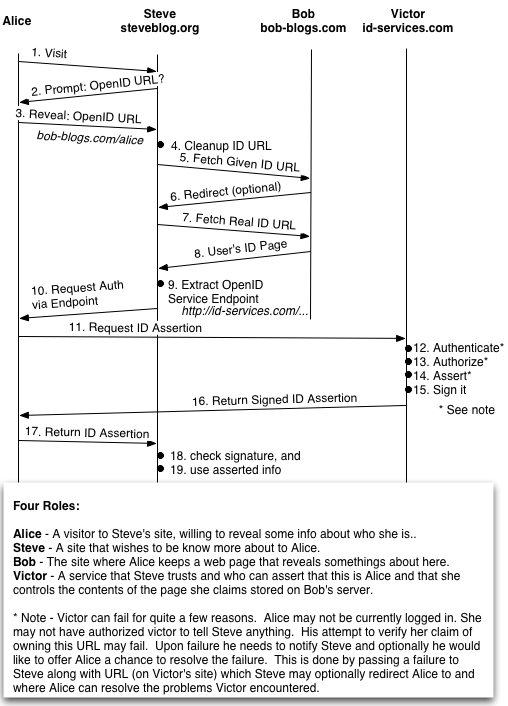
OpenID’s #1 feature is the decision to have a web page for every persona. For example my OpenID might be “enthusiasm.cozy.org” (well actually it’s http://enthusiasm.cozy.org/ but OpenID sanctions some shorthands). This becomes in effect a universal identifier, like an email address or a social security number.

Deciding to adopt a web page as the user’s handle is an interesting design choice. It’s not hard to see how they fell into this choice. The primary driver of OpenID is a blogging company. Their users all have blogs. Their users are pretty much defined by their blogs. It’s a natural choice. OpenID is unique among the identity systems I’ve looked it, it has only one use case. Leaving a comment on a blog in a way that ties that comment back to the author’s blog.

This isn’t an identity system, like Liberty, designed to support account linking and sophisticated data sharing between mutually suspicious firms on the behalf of thier supicious customers. Since the design’s core feature is a universal identifier for users no privacy advocate is likely to love it. The lack of encryption on the message exchanges is a red flag for large numbers of people.

That said there is a lot to like about OpenID.

The question one needs to ask: Will we have an identity system where user persona is represented by public web pages? Once you accept that that is extremely likely then OpenID becomes a lot more acceptible as a point in the design space of identity systems.

Clearly web pages are better than email addresses or a phone number because those have a obvious operation available on them which is open to abuse. The set of operations on a web page are more limited and more easily configurable.

Users already have a mental model for web pages that is reasonable accurate. This reduces the chance they will just assume more privacy than they are in fact getting.

One very nice aspect about web pages is that we already have a deep suite of tools for empowering users to configure them.

User know, or they ought to know, that web pages are public and durable. So what ever the user publically reveals on the page he uses for his OpenID becomes public information, probably forever.

Nothing about this choice precludes users from having many persona. Nothing about this choice precludes those persona from being reasonably anonymous. It’s a shame that persona management isn’t more carefully designed into OpenID; but at least the mechinisms for it are reasonably transparent for users.

As a choice the decision to adopt the URL of a web page as the corner stone of a public open idenity system seems enivitable.

It’s important to take OpenID on it’s own terms. In it’s heart of hearts it is really just attempting to tie contributed content back to authors; at least a little. That is a more central problem that it might at first appear. OpenID is not trying to solve all the world’s identity problems.

Chasing the Tail

Sunday, May 29th, 2005


I like this posting at Chris Anderson’s site. It’s some slides. They are good, but I want to pile-on a bit.

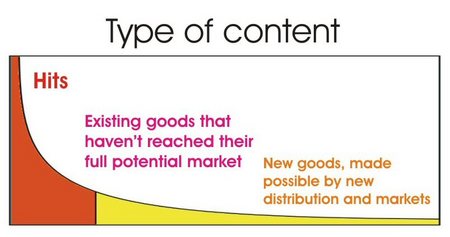
These slides all follow the same pattern, exemplified by this first one on products. They are the rows in a three column table.

The still bother’s me that Chris’s curve doesn’t particularly look like a power-law, it doesn’t cling to the axis. Gives the viewer a misleading impression about the middle class, it rarely captures as much of the energy in these these systems than it really does. It remindes me of the way politicians always pander to the middle-class. People seem to like to think they are in that class.

These slides all follow the same pattern, exemplified by this first one on products. They are the rows in a three column table. Here are the rows in Chris’ table.

Elite Middle Tail
Content Hits Existing Goods that haven’t reached their full potential market New goods, made possible by new distribution and markets
Incentives $$$ Reputation (leading to $) Expression
Status Pros Marketing/moonlighting Amateurs
IP Protection Copyright No Copyright Creative Commons

If we were talking about another power-law distribution we would find very different entries in the three columns. Study the distribution of wealth and you get a row with entries like: upper-class, middle-class, and the poor. Chris decided early to avoid some of these tar pits. Still, he as touched the tar baby. It will be interesting to see what he does with the issue of globalization.

I thought it would be fun to add more rows.

Elite Middle Tail
Wealth Upperclass Middle Class Poor
Nations G-7 Third World
Weather Hurricanes/Tornados Storms Zephyrs
Animals Birds, Reptiles, Mammals Insects Bacteria, Viruses
Settlements Cities Suburbs Towns, Villages, Rural
Vocabulary ? ? ?
Baby Names ? ? ?
Matter Solid Liquid Gas & Vacum
Firms Hubs, Markets, Platforms Classic Firms Small Business
Labor Politics? Capital Unions Worker
Standards Tail Light Chasing, Installed Base Migration Industry Consortium Bottom Up
Religion world religion Denominations nondenominational, and private faith

These tables could use some more columns. Chris, for example, is interested in how shifting distribution channels are changing how the finite available attention is distibuted across the content. I’m interested in how businesses emerge that act like drift net fisherman raking the ocean of small players for value; and in turn how that effects the ecology. I suspect we are all interested in how the elite manage, capture, and horde their power.

Powerbook Death Throws

Friday, May 27th, 2005

The only good part of the pending demise of my powerbook is that the “genius” at the Apple store found the diagnosis both facinating and obviously entertaining. It took us both a long time to figure out the following. When I came in the machine wouldn’t boot, and the battery was dead.

My battery only charges when the machine is asleep or turned off. When running the power from the adaptor is insufficent to run the machine. The battery slowly discharges when the machine is running. If the battery fully discharges; which happens if I don’t keep an eye on it, then it is impossible to start it. If fully discharged it doesn’t charge. At that point I need to find another machine of the same kind and recharge the battery on that machine.

The charging subsystem is on the main logic board; so that needs replacing. Since my case has a small dent Apple insists that both are fixed. Total cost of repair is the cost of both the case and th logic board, i.e. around $900. Machine’s is about two and half years old.

Looks like I’ll be buying a new machine and then disassembling this one and selling it’s organs one part at a time on eBay (except of course the failed main logic board).

I didn’t really want to be this kind of spending money at this instant, but I am grateful for firewire.

Nokia 770

Friday, May 27th, 2005

It must be a pain being Nokia, because you only have a handful of very very powerful customers. For example if the 3 or 5 largest phone companies don’t buy your phone then you don’t sell any. Which means you just build exactly what they tell you to build.

Meanwhile your technologist are telling you that Open Source, open platforms, and the end to end principle are not just cool, but so powerful that any business that tries to control the edge is toast.

What to do? Handspring tried a few different things. In the end they caved and now thier products are carefully obedient to the demands of the phone companies.

The Nokia 770 looks like an attempt an answer, an attempt to route around the damage.

It makes me wonder if bluetooth is the hole in the armor of the cell phone companies.

it comes around

Friday, May 27th, 2005

“Customers have a tendency to become like the kind of customers you treat them.”

That quote really goes to the heart of something I’ve observed in plenty of senarios, but then I don’t even like the word customer.

It really is true, you get back what you sow. For example I bought a hundred dollar item today. This purchase involved a price match, a rebate, a coupon and 15 minutes of waiting while various assistent managers sought ways to decline to deal. The three vendors involved treat the entire exercise as a form of gaming for the benefit of their advertising and discrimitory pricing schemes. The customer service people treated me if I was very likely a criminal. The entire relationship created by these games is a train wreck. No trust at all anywhere in the transaction. What a mess! Not really worth saving 40$ on a 90$ purchase; but they created the game and I’m playing.

One of the facinating things about Open Source is the how the people that consume the output of the projects are treated. No coddling customer support lines staffed by people who though they never ever loose their temper but sadly know little about the product. But instead the users are treated as peers. Always a hope that this user will become a contributor. Always the expectation that everybody is in this together. And yes, if you treat people like that they tend to grow into the role.

The quote also reminded me a bit of one company I work with: T-mobile’s prepaid cell phone service. When you call these guys it’s great. You always feel as if they are happy in their work. You always feel as if you have a bit of common cause with them against the mysteries of modern telecom systems. Not that your allied against the company, but that your allied against your joint problem. I don’t know how they manage this; but I like it.

Scott Lofftesness pulled it from an essay that otherwise didn’t greatly impress me. But that quote is exactly right and it runs deeper that it might at first appear.

Many many years ago I was working on a project and we were optomistic that a large firm might partner with us. It was going well until our contracting people got involved. Suddenly the folks at the big firm called up and announced that don’t work with people who worked like that. They were right, you shouldn’t. When you start to realize your going to have to mirror the behaviors of the other guy, and those behaviors aren’t constructive - well bleck.