Monthly Archives: October 2004

Make less, make more!

Many years ago my father advised me to avoid antenna design – “Too much black magic.” I took that advice; but I seem to have fallen into a similar trap, i.e. pricing.

Consider this pricing problem. You sell a product which two classes of people. One class, 10 people, would be willing to pay 100$ a unit. A second class with 90 people in it are willing to pay 10$ a unit. So if the vendor charges 100$ he will make $1,000; if he charges 10$ then he will also make a $1,000. If the the first class is willing pay a bit more or the second class is willing play a bit less then the vendor will profit if he makes only 10 units.

That story is a bit bloodless so let’s put some adjectives on these classes. The first class is desperate if they are willing to pay so much. We might say the first class is very loyal to the vendor’s product and nothing else will do. We might say the first class is locked in.

Early in the Bush administration a handful of electricity vendors in California realized they were in exactly this situation. They could make money if they sold less electricity. So they shut down some generating plants. They called it maintenance and complained about excess regulation. The first class of buyers, unable to switch, locked in, and addicted to electricity then drove up the price to amazing heights. At the time experts knew exactly what what was going on but the regulatory organization had been entirely cooped by the industry and so nothing was done. Amusingly the Bush folks talked about how we needed more supply which was true, and suggested we should open up new oil fields which was irrelevant.

There is a picture in my local paper of a long line in front of a pharmacy down the street from me. Long lines are a symptom of a group of folks in the first. They were queued up to get flu shots. The supply of flu shots has fallen sharply. The price is up. Clearly this market is just like the one in the model above. There is a core of desperate buyers willing to pay a lot; as demonstrated by their willingness to wait in extremely long lines. I’m suspicious that it’s also an example of the kind of story shown above.

What’s fascinating about some of these scenarios is how the trigger of the mode switch could come from anywhere. For example an investor in firm A might strive to get firm B shutdown; say by reporting safety violations to a regulator. Then when the firm B gets shutdown and the large class of low price buyers go looking for an explanation the regulator gets blamed.

The California electricity debacle shown how deeply the pro-business Republicans have undermined the regulatory systems in this country and sadly it makes me terribly suspicious about the current flu vaccine situation.


Meanwhile the Bush administration thinks scientific fact is a special interest group, and certainly not part of their base.

Could your phone number be identity?

Interesting post on identity, phone numbers, etc. over at the most excellent Telepocalypse.

It includes the delightful paragraph that I will have to work into a blog posting some day:

Now, the following is so vital, I’m going to put it in large red bold. It’s the only large red bold ever posted on Telepocalypse, and I promise not to do it again unless something even larger, redder and bolder is being said. Which isn’t likely.

What comes next? Well this (emphasis removed):

What’s the core purpose of a telco? A telco joins the physical world to the virtual world.

My first thought after reading that was: “Hm: so Orange isn’t really a color or a fruit, it’s just the peel.” (Orange is a telecom company in Europe).

It’s hard when talking about the architecture of the net to decide what to emphasis. I, for example, tend to emphasis the how exchange becomes standardized and that leads to consolidation of power in the hands of middlemen. Other people emphasis empowering the ends; or advancing the client; or toolkits for distributed apps; or distributed data models.

Martin’s bold red words insist that we take note of another thing. The telcom industry has a lot of control over the border crossings.

The first time I ever say the “cloud” drawing was in a phone company document. You know the cloud drawing right? It shows mom on the phone, and the butcher on another phone. Little lines run from their phones over little telephone polls and then disappear into a fluffy cloud. Sometimes that cloud is labeled “the phone company.” These days the drawing shows mom’s browser on one side and eBay’s servers on the other side; and the cloud is labeled the net.

The cloud drawing implicitly says – “Don’t worry your pretty head about what’s inside this ball of fog. We will take care of it.”

Martian’s bold red word? Yeah the phone companies lost control of the cloud; now all they have is the rine. Of course, controlling the border can be a very profitable place to be.

Collectively the telecom industry is a fascinating beast. Historically the industry was very granular; each major player existed inside a safe geographic bubble where they had captured the regulator. Set aside how that empowered them to frustrate progress for so long that now that the damn has burst all hell broken loose. The granular structure created a set of peers who didn’t threaten each other. Those peers could then work collaboratively to look for joint gains. One of the forums for that was the International Telecommunications Union. The ITU of the old gorillas in the standards setting world.

When big disruptive change washes over an industry they can existing players can only fight back with the muscles they already have. Martin is arguing that if the telecom industry knew what they were doing they would be using their standardization muscles to get a handle on the identity standard – possibly by evolving the phone number.

It’s an interesting thought. They industry has fought so hard to avoid number portability. A fight that is all about defending the old obsolete granularity of the industry. Now just maybe they need to turn around and strive to make the numbers even more pliable.

Consider this concrete example. I’ve been forwarding a VOIP number to assorted phones; and I give it out as my “mobile” number. This causes a bit of trouble when I call from one or another cell phone – the guy on the other end doesn’t know it’s me because I can’t annotate my outgoing phone calls with my “mobile number” persona. (Well at least not until I absorb even more of the functions the phone company provides.) This trick as tree advantages. I can use a real phone for more calls. I can avoid cell minute costs on some calls. I can grab the cheapest mobile service and switching carriers when ever the sign up incentives of the last carrier run out.

In any case; Martin’s post is an it’s an interesting view of the identity problem from the point of view of just one industry. It suffers a bit from failing to admit how many other industries are similarly waking up to the value of their “relationship asset.”

Hording and Exploiting

Tilly’s book “Durible Inequality” argues that the group forming emerges almost entirely because the creation of a group boundry helps to lower the transactions costs of inside the organizational activity.

It is easier on a moment to moment basis to use existing catagory boundaries to quickly solve organizational problems. For example answer the question “What search engine will I use to look up X.” with the reply “Google” than it is to pause and select from Google, AllTheWeb, A9, or Ebay. It is a time saver to join the Google club, to shun the other search engines. Club loyalty.

But wait. Tilly is writing a book about inequality. Casual use of category boundaries has another name – prejudice. He is interested in the cases where this process goes both bad and becomes rigid.

He states that groups capture two powers which may lead to abuse.

  • The ability to engage in Opportunity Hording.
  • The power to Exploit others.

Efficiency isn’t on that list. Efficiency isn’t about the abuses that may occur. The abuse doesn’t arise from one group out performing another.

Hording opportunities is a game all groups can and do play. Even very weak groups. One of his examples is immigrant cleaning ladies. When knowledge of job opportunities arise they tend to pass then along the social networks of their immigrant community. That alone, tends to lead to each city having one ethic group that is renown as having the knack for house cleaning. Polish ladies in Chicago; Brazilians in Boston.

Exploitation is the means of the powerful. The powerful can force it’s will on other (by definition subordinate) groups. Exploitation is not limited to opportunity hoarding. It is the use of force to actively deny the options to other groups. To force their choices.

Consider the classic scenario where 90% of a town’s business deals are made is the all while, all male, golf club. Is that opportunity hoarding or exploitation?

Just insert a translator

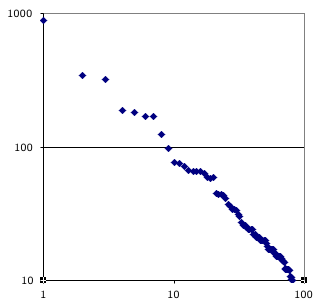
Distribution of the top 80 languageThe chart at the right shows has a dot for each of the most popular languages spoken on the planet. It’s plotted on a log-log graph; the vertical axis is millions, the horizontal is rank. The top language is Mandarin, though there are seven other Chinese langages in the top 30. English and Spanish are neck and neck for second place. The data is from here, though originally from here.

This posting is the complement to the posting on the cost of free trade born by the subordinate culture using which side of the road you drive on as well as the argument being made in my recent advocacy posting regarding RDF/N3 v.s. XML that translators can gloss over the difference.

As global barriers fall this distribution will grow more severe. Like an industry condensing toward a monopoly. Smaller languages will expire; larger languages will thrive. Rankings will shift because there are other forces in play; like control over economic exchanges. Anybody got a babble fish?

Fowler on Humor

I was pleased to rediscover this table today.

  Motive or Aim Province Method or Means Audience
humor
Discovery Human nature Observation The sympathetic
wit Throwing light Words and ideas Surprise The intelligent
satire Amendment Morals and manners Accentuation The self-satisfied
sarcasm Inflicting pain Faults and foibles Inversion Victim and bystander
invective Discredit Misconduct Direct statement The public
irony Exclusiveness Statement of facts Mystification An inner circle
cynicism Self-justification Morals Exposure of nakedness The respectable
the sardonic Self relief Adversity Pessimism Self

That’s lifted from the entry on humor found in Fowler’s Modern English Usage (1927). Now I need one for the various forms of physical and visual humor.

Homework: Print copies for all. Take to dinner with the day’s comics. Categorize.

Notation 3

Stefano brought N3, or Notation 3, to my attention – it’s a good thing!

I hate XML. It’s a mess. Wrong on so many levels. But getting the industry to switch is now nearly impossible. XML has played almost all the cards you can to make a standard sticky and lock-in users. For example it’s extreme complexity. Just like that of the Window’s API. That makes people extremely reluctant to abandon their sunk costs after learning it.

That said I keep hoping that something better will emerge.

One possibility is that something will emerge that provides overwhelmingly improved UI. Making users smile can be a powerful force for change. So cool UI might be the lever. Things like SVG and Lazslo are examples of folks making a run for this exit. On a lesser scale the evolution of HTML/Javascript just keeps on hill climbing.

A less plausible possibility is that we will all rendezvous around one standard from for storing our documents, our data. This idea has been a fantasy of the ivory tower crowd since beginning of time. There has been a cool up and coming normal form at every stage of my life. I still have some stacks of punch cards. I wrote programs to convert IDL databases into suites of prolog assertions. I can’t count the number of times I’ve forced some data structure to lie down in a relational database or a flat file that sort/awk/perl would swallow.

After a while one becomes inured to hearing the same tune, the old enthusiasm returned again new clothes. You wish them the very best of luck because of course you remember how hopeful one once was that this could all come together. As a result I’ve have been treating the Semantic Web work with a kind of bemused old fart’s detachment.

But! Step past all the self indulgent ivory tower talk of one world data model. Skip the seminar on how soon we will compute the answer to everything. You don’t need to know from reification, or Mereological Ontological.

This stuff is actually useful.

Look at this:

:dirkx foaf:based_near  [
            a geo:Point;
             geo:lat "52.1563666666667";
             geo:long "4.48888333333333" ].

That tells us where something named here as :dirkx is lives. That’s it! No wasted tokens. Easy to parse. That’s why I like N3. Easy for humans, easy for computers. XML is neither.

    <foaf:based_near>
       <geo:Point rdf:nodeID="leiden">
         <geo:lat>52.1563666666667</geo:lat>
         <geo:long>4.48888333333333</geo:long>
	</geo:Point>
    </foaf:based_near>

XML is good if your getting paid by the byte.

I’d love to see XML displaced by something more practical. Something that lowers the barriers to entry so that you don’t need a few meg of code just to fool around. I believe that XML’s complexity is good for large players and bad for small players. I want to see the small players having fun – and frustrating the large players.

N3 is neat, but what about RDF?

RDF is just fine. You need to clear way all the overly serious ivory tower presentation. get past all that righteous marshmallow fluff and down at the core you find a nutritious center of practical and simple useful good stuff. How nice! It’s going to drive the marshmallow men in their tower crazy if this thing takes off!

When I look at RDF I notice two critical things. It is much easier to stack up new standards in RDF than it is in XML. Look the example above. It’s using a standard called geo and one called foaf. Click on those links to see how straight forward they are.

In XML if you want to define a new standard it takes extremely talented labor. Only a handful of people can both understand XML Schema and think in practical terms about real world problems. In RDF any fool can do it; which means that anybody with some data to move can get on board without having to go thru some gauntlet of heavy industry standardization.

The second thing I notice about RDF is actually a blind spot.

Above I mentioned two ways that XML might get displaced. One on the supply side (data normal form) and one on the demand side (presentation). There is a third – data exchange. Exchange is where the powerful network effects are – always! RDF is better for data exchange than XML. It’s easier, it’s simpler, and it is far better for layering, mixing, and creating new standards.

This trio, and the standards around them, are key to making anything happen in the net.

  • Supply: writers, data, storage, normal forms, etc.
  • Demand: readers, presentations, ui, etc.
  • Exchange: messaging, subscriptions, polling, push, etc.

The RDF folks think that the demand side is where the leverage is. That’s wrong. Content is not king! Exchange is king. In the world of ends, the middle rules.

Open Laszlo

Cool, Laszlo has played the open card.

I am not surprised, but I am very pleased.

It’s tough creating the buzz of activity and complements around a tool like Laszlo. Worse, if you don’t create that good-olde network effect then your stuck. You maybe able to have a certain level of success but that even that’s not durable over time.

Laszlo is a very elegant work. For example: play with the examples of constraints that appear on this page in the manual.

Opening up Laszlo could create bloom of new UI. There are some huge pools of data out there that could get a new presentation skin. Google, eBay, delicious, movable type, word press, … it’s not a short list. There are early examples of this kind of UI out there. Go look at flicker for example.

I had been hearing VC talk about how flash was going to disrupt the client side; i had been discounting that – self interested speakers an all that. I need to revisit that chatter.

Putting on my health of the industry hat, or my paranoid CTO hat, the thing I notice about Laszlo is the dependency on Flash. It really is amazing that the folks at Macromedia have managed to get such a huge piece of real estate on the installed base of client side machines. How did that slip past the guards at Microsoft! Adobe tried, with SVG, but that certainly didn’t work out. I tip my hat to them!

For years and years the GPL community was very careful to avoid standing on top of Motif because they didn’t perceive it as being sufficiently open. A similar careful critique should now be made of the Flash platform. We have suffered a lot because the client side fell into the hands of Microsoft; handing it over to Macromedia would be better but it wouldn’t necessarily be good.

Recently I have been looking at RDF. I blame Stefano. RDF strives to displace the HTML/XML as the canonical data model. That’s a tall order. HTML seized that turf because it was simple enough because it was presentation oriented. XML hides behind HTML’s success. RDF, well it’s not clear what “go to market” benefit is.

One of the wonders of the HTTP/HTML bloom has been how it created a huge amount of casual revealing of information. The presentation standard, HTML encourages casual revealing in a form that automation can swallow. This created the landscape (the platform) for the search engines. It’s not clear if that landscape will survive a transition to a richer presentation platform. Data hides behind UI. It’s not clear if that landscape will survive a transition to a richer data exchange protocol – particularly if it’s name is SOAP.

Data hides behind UI.

Undecided

Some times a postings just take my breadth away. … Let’s leave it at that.

Well no.

This is another posting about the logic people use for justifying their not engaging with American politics. It is written in response to this posting.

The value of a platform of public goods is that you don’t have to negotiate everything. As you drive down the street you don’t need to negotiate how to pass the oncoming driver. Why? Because the social contract has a subparagraph about that. When you go to the hardware store and buy a length of rope you don’t need to bring your own measuring sticks because society has internalized a set of weights and measures. Should the exceptional cases arise and bad or deeply confused people abuse the social contract then, we can hope, society’s institutions will correct the problem.

Living inside a strong social contract gives the actors access to a deep pool of public goods. The economists would call that a club. Inside the club boundary so much seems to be free.

It is not free!

Each of us inside the social contract pay something toward it’s maintenance. We pay with our taxes. We give our attention to the maintenance of civility in the public square. We occasionally contribute to the commons. We give some our attention to good governance of the public institutions. We donate our conformance to societies norms. These contributions, in a healthy society, are amply rewarded.

While it is not free, but you may freeload. There are two standard justifications for freeloading.

One of these is the rational man justification. The ethics of the so called rational man dictate that everything is a negotiation. Always capture the discount. Always minimize your cost. Drive a bit over the speed limit. Cut the corner on the road. Never hold the door for a stranger. Capturing 5% here, 20% there; it is a pretty good return on the investment. Don’t vote; it’s not cost effective. Don’t engage in the political process it might dirty your ethics. The rational man lives inside the club and then declines to pay the dues. He is a parasite. He considers those who labor maintains the public goods to be irrational, possibly delusional, and at worse dishonest. He projects his nature onto them and assumes that their motives are similarly parasitic.

The parasite has a few additional decorative elements he usually deploys to decorate his self justification. He likes to argue that his taking is synonymous with thrift. Thrift creates economic value. He likes to argue that he was coerced into club membership and so it isn’t fair to hold him to it’s norms; the short form of that is ‘I don’t recall signing a social contract.” He likes to deploy the word freedom to mask his abuse of the social contract.

There is another justification. Attention management. Nobody can devote attention to all the clubs of public goods we draw upon; that is just impossible! The list of public goods we draw upon is infinite: the public library, the public street, the public park, the ecology, the peace and quit, the public school, the rules of the road, the language, etc. etc. etc. One will have to freeload on most of these.

So people focus. They pick their club(s) and they do what they can. This justification does not make you a parasite, it makes you humble. You are grateful to those who do maintain the public goods you use; you respect their work and you are grateful.

So back to the topic at hand. American politics. Some of the pool of undecided-voters or non-voters presumably fall into each of these camps.

Some are just parasites – they freeload on the public goods created by strong good governance. They reveal their allegiance to the rational-man/parasite world view when they project evil motives on those who do participate. Getting these people back into the political process is a bit of mixed bag; since if they assume that the political process exists to serve the rational man’s continuous striving to capture the best possible deal for his self interest they are very likely to participate in a way who’s emphasis is taking from the pool of public goods rather than creating a yet more vibrant pool.

Some undecided or non-voters presumably fall into the second rational. Their attention is elsewhere.

So what brings them back. One thing that brings them back is their sense of responsibility. Some come back because it’s a ritual like church on Sunday or parent’s night at the school.

Some come back because the word goes out from those they trust: ‘We need you now!”

This is a common pattern around public/club goods. On the good days a few caring souls can keep the boat afloat, but then a bad day comes and the call goes out. Funding for the public library is about to be cut. The traffic light at the corner of 12th and main has gotten really lousy. Somebody is trying to take private your open source project. The call goes out. People come out of the woodwork. People who care enough to come forward when they are needed.

For those who labor at the center of a public good’s maintenance it is always a little hard to understand why more people don’t step forward to help. Since there is always plenty to do, always the threat of a crisis. One is always making the call for help, to some degree.

But, for those of us involved with American politics it is particularly hard to imagine how anybody could still be undecided at this point.

The call has gone out. The voices are horse from pleading. The other side calls this shrill. American, that shining city on a hill, the hope of the planet, has fallen into the hands of the parasites. They are writing themselves checks and putting their idiot sons in the mayor’s office. It’s not clear if we can stand another four years of this.

The time has come for all good men to come to the aid of their party. Come out of your walled gardens. Duty calls.
Aggregating the long tail.

This article is important.

“…a digital jukebox company whose barroom players offer more than 150,000 tracks…”

“….The average Barnes & Noble carries 130,000 titles. Yet more than half of Amazon’s book sales come from outside its top 130,000 titles. …”

“… successful businesses on the Internet are about aggregating the Long Tail in one way or another. Google, for instance, makes most of its money off small advertisers (the long tail of advertising), and eBay is mostly tail as well – niche and one-off products. …”

Go read it.