Category Archives: General

eBay Politburo?

Great article about the companies that inhabit the niches around eBay. Provocative. I bet this got the author a call from the eBay PR department.

“And the eBay economy doesn’t exactly work like a free market. It’s more like a Soviet-style planned economy, with eBay chief executive Meg Whitman serving as the head of the Politburo. EBay determines the prices that so-called “third-party” companies must pay to interact with its website, and it occasionally threatens or pursues litigation against companies that it believes are misusing information from its auctions.”

Isn’t there a variant of Goodwin’s law about that?

Then the author turns around and rains on the parade of the company that is the hero of the piece.

“In many ways, it’s the exact inverse of the business model that made eBay so successful. EBay operates a website, leases no retail locations, and never takes possession of merchandise. Its sellers handle the hassles of packaging items, shipping them, and communicating with buyers. AuctionDrop, on the other hand, is a labor-intensive model that requires retail and warehouse space and copious customer service. I’ll be astonished if it’s still in business this time next year.”

I hope the author’s got call waiting.

it’s very refreshing to see a business article that get’s it. EBay has a beautiful business model. They captured just the right amount of the transaction; the finding and the closing. Meanwhile it’s surrounded by complementary companies. Some of these will be quite marginal operations. Others like UPS or Paypal maybe quite large. Such is the power-law curve. Managing the ecology of complements around a big business is an art. The big complements tend to develop market power that constrains your flexiblity (which is why Microsoft had to acquire a word processor) while the little ones solve problems for you.

Love of Technology

One of my top 10 or 20 books is Aramis, or the Love of Technology; this review is just excellent!

… Rather, he believes, Aramis is to be thought of as a living being, whose interactions with its environment determine its viability.

This belief is a recurring theme throughout the book. The intern engineer is not quick to accept Norbert’s insistence that a technological project be understood as a living thing. It isn’t that he disputes the claim but rather that he finds it a difficult principle to keep in his grasp. …

…all explanations drawn after the fact now that we know Aramis died, with the wisdom but also the freedom of hindsight. In hindsight, many explanations gain plausibility simply because they support a conclusion that we know to be true, that Aramis died. …

As he says:

Aramis had not incorporated any of the transformations of its environment. It had remained purely an object, a pure object. Remote from the social arena, remote from history; intact….

…If the Scrabble player holds onto her letters, hoping to make her dream word, her opponent will rack up points while she is waiting and waiting for the perfect opportunity to deploy her masterpiece. The successful player negotiates and deploys her pieces in a long-term, evolving strategy in partnership with what is happening on the board…

Culture, Structure, Rational

More from Market and Community.

CSR.png

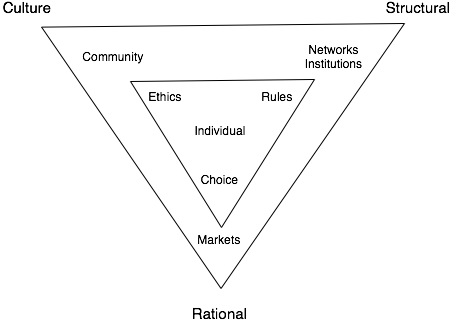
This delightful drawing explains it all. This outlines three approachs for how to explain the way that individuals select their actions. In one model culture via communties guide individuals to make ethical choices about what they do. In a second model rational self interest intermediated by markets allow folks to select from a choice of actions. In a third model rules established by institutions (or in my view networks and groups) frame up the behaviors of individuals.

EVL.png

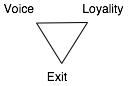
All that reminds me of a number of three ways of paritioning the world; for example Hirschman’s book Exit Voice and Loyality with

  • Exit -> Market
  • Voice -> Community, and
  • Loyality -> Structure.

Markets and Community then goes on to introduce this nice little framework:

Television

Catagories are a kind of precursor for violence. In Tilly’s book about violence he enumerates three precursors for violence one of which is to invent catagories. All three means are used sharpen the boundry between groups. Before you can get Canadians to fight with each other you have to sharpen up a catagorical division. What to start a fight? Invent a category, say French Canadians.

You can see Dave Winer playing this game when he writes:

Sifry must think weblogs are like television. Shirky sure does. What is it about people with two-syllable names that begin with S and end with Y. I think I’m going to publish a law about this and go on the speaker’s circuit.

I’m willing to give Dave the benefit of the doubt that he’s only trying to be cute when he does that. Given my last name and Dave’s last name I think I can say that it’s a tacky ploy. That cute device obscures what is a more important dispute. He writes:

You know what’s always bothered me about Technorati? I don’t care about millions of blogs. I’m going for quality not quantity. Sifry must think weblogs are like television. Shirky sure does.

Is the blogging universe “like television”?

Dave attempts to dismiss the question by framing it as obviously false. But is it? The presumption in his statement is, of course not. I can be cute too: Dave’s the man that brought us a product call Radio.

The real question in dispute here is about concentration of power (or wealth). What the power-law distributions in blog linking and traffic suggest is that even with an architecture that is peer to peer (one that doesn’t treat the distribution channel as a scarce resource) you still get extremely high concentrations of power.

The few to many audience topology found in the 20th century broadcast media is emerging in the 21st century peer-to-peer media! We certainly didn’t see that comming! But denial is a mistake. Our presumption was that a peer-to-peer network architecture would assure an highly egalitarian outcome. Compelling data to the contrary makes clinging to that optomistic bit of logic a mistake. A dangerous mistake.

This is the arguement at hand. One side, the power-law fans, have noticed that what we want is not what we are getting. That side thinks we should be worried. The other side – the build it right and we won’t need no stinking regulatations side – is sticking to it’s design principles; if not it’s goals.

I’m in the first camp. So, I think the otherside is mostly engaging in denial and minimization. While I think the design principles are good, their outcome seems quite unfortunate. We need to think deeply about why, and what to do next.

One last point. Dave’s Scripting News is #15 on technorati. Does anybody think that’s because Dave’s got the one of the best blogs on the entire planet? It is beyond ironic to realize that Dave has become a vested interest. “I don’t care about millions of blogs.” Who’s the television now?

Big Bang!

Comp01.jpg

Group forming! Planet Apache joins the universe. I predict a group blog forming website startup before night fall.

Looks like mr. planet needs to get to know mr. tidy.

I’m in western Massachusett’s this morning. Tonight we are forecast to get -20F (-29C). ek!