Monthly Archives: March 2004

New York Metro Region

It was experiances like this that most loved when I lived in NYC

“…Upstairs (and to the side…it’s weird, hard to visualize; it is not completely of this Earth) you’ll find International Food Warehouse (370 Essex St, Lodi, NJ; 201-368-9511). It seems to be squatting in an extra wing of warehouse space.

The Demonstration

The Politics of Collective Violence (Cambridge Studies in Contentious Politics)Here’s something I found very thought provoking:

“So far as I can determine, no demonstration ever occurred anywhere in the world prior to 1760.”

That’s from Tilly’s book on violence; he goes on to say that the demonstration quickly spread as a common form of political action in the following century.

So it appears the demonstration is an invention that emerged in tandem with the modern democratic state. Which makes perfect sense in Till’s model of violence. I.e. that only high functioning democratic states can sustain a large range of political activities while at the same time avoiding contentious violence emerging from those activities. Of course a strong state that’s not democratic proscribes such activities – in fact in some points in history the authorities would have to officially set aside the law against assembly on market days. A weak democratic state might allow them; but they run a much higher risk of that they will turn violent.

In Tilly’s model any given society provides both assorted means affecting changes to the status quo and it forbids other ways.

  • Forbidden – for example just taking what you want.
  • Tolerated – making a petition to the king.
  • Contentious – public debate, violent demonstrations
  • Proscribed – for example the electoral process is highly proscribed.

Contrast these to two measures of state structure: capacity v.s. democratic. Tilly has this fun drawing that attempts to show how four kinds of states portion out the amount of what is tolerated, proscribed, and contentious. For example this drawing suggests that elections are more likely to be contentious in low capacity democratic state.
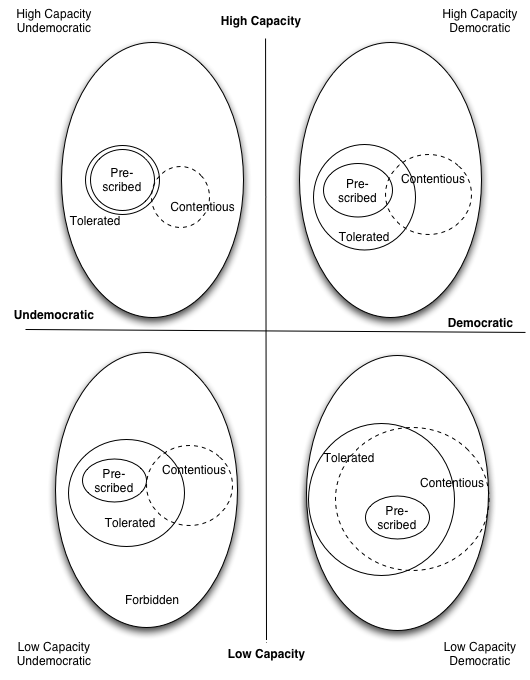
He doesn’t explicitly build the linkages between his curious historical fact about demonstrations and the model illuminated by that drawing. But let’s try. A demonstration is an activity right on edge of contentious, just barely tolerated, but so ritualized as to be almost proscribed. A demonstration is more likely to occur if you have a larger sphere of tolerated activities. You less likely to have the demonstration explode into a riot of violent contentious activity the smaller the sphere of contentious activities. Demonstrations are actually surprisingly ritualized; as we shall see in a moment, so the larger the prescribed sphere the better. All of these suggest that a demonstration is most likely to pop-up in a highly democratic state; but it also suggests what is likely to happen if it pop’s up in any of the other quadrants.

A state that lacks the capacity to regulate things will find that it has to tolerate a large range of activities, can proscribe only a few things and sadly it will host lots of highly contentious activities. A democratic state will strive to tolerate more and it will tend to provide a larger range of alternative, but proscribed, means of achieving your ends. Thus it appears that only as high functioning reasonably democratic states began to emerge that demonstrations became tolerated, and the means to proscribe them emerged that could avoid their becoming highly contentious.

It helps to think about example like Iraq, India, China, Massachusetts. For example I’m very impressed by the response in Spain to the recent bombings.

Demonstrations are surprisingly ritualized; a kind of a hybrid of the procession and the petition. He provides a nice concise definition of the beast: A) Gathering deliberately in a public, visible, and often-symbolic place, that B) displays membership in a politically relevant constituency so as to C) presenting a position on an issue; typically via voice, words, and symbolic objects; in a manner that D) proves by acting in a disciplined manner the group’s determination, and coordination (hence the marching).

He even provides a scorecard: Worthiness, Unity, Numbers, and Commitment to get a sense of the scale of a demonstration. “Five prisoners rhythmically beat their cups on the lunch room table before desert was served.” just isn’t as awe inspiring as “Four thousand veterans marched on the capital to spend the week lobbying.”


The Evil Bit

I see that Gartner has suggested that Cisco should take over control of the internet. Should this attack on the end to end principle make progress I hope they follow the suggested standard outlined back in April 2003 here in RFC 3514. That involves an enhancment to IPv4 header.

The bit field is laid out as follows: 0 +-+ |E| +-+ Currently-assigned values are defined as follows: 0x0 If the bit is set to 0, the packet has no evil intent. Hosts, network elements, etc., SHOULD assume that the packet is harmless, and SHOULD NOT take any defensive measures. (We note that this part of the spec is already implemented by many common desktop operating systems.) 0x1 If the bit is set to 1, the packet has evil intent. Secure systems SHOULD try to defend themselves against such packets. Insecure systems MAY chose to crash, be penetrated, etc.

Really, when will people learn that appealing to a private intermediary to save you rarely works out in the long run?

While we are on the topic of evil. I’m getting link parasite attacks on my server’s log files. Presumably the idea is that by stuffing the list of refererer pages or the list of pages not found with the evil dude’s page names I might create back links to them, by mistake. In this case the lession once again is that if you let outsiders cross the wall around you site content without moderationation; some twit will abuse that. The answer to these puzzles is not to make the wall infinitely high. An even worse answer is to hand off responsiblity for the wall to a central authority.

We see this same pattern in the standards war between the telecos and the internet; i.e. between the garden wall smart network model of the telcos and the dumb network end-to-end model of the Internet. The business advantage of a the garden wall model is, of course, that you can deploy all kinds of discrimitory pricing on along the gates in the wall. (editor: Did you say “Gates”?)

So look: Telcos would like to create their on top level domain. To quote Martin Geddes: “Very, very evil. I’m impressed.” Some of my best friends are telco employees.

With today’s insight we can see that the telcos ought to have started by having Gartner rail at them for failing to create a top level domain of their own. Then sheepishly they could have gotten back to work repointing the bricks in their garden wall.

Punishment

There is an odd grain of truth in the punisher’s statement: “This hurts me more than it hurt’s you.”

For example your driving down the street and you make a minor driving error. Another driver gives you the finger. Clearly he has just shown himself to be a jerk; i.e. the cost of the gesture (intended to push you) on his reputation is larger than any value he can possibly hope to capture (i.e. none).

He is making a sacrificing his reputation as a reasonable pleasent guy to help encourage a better regulated traffic system. This kind of behavior is deeply wired in we primates.

“Waal trained capuchin monkeys to take a pebble from them; if the monkeys gave the pebble back, they got a cucumber. Then they ran the same experiment with two monkeys sitting in adjacent cages, where they could see each other. One monkey still got a cucumber, but the other one got a grape

Bloody limit cases

hand-it.jpg

Keiran posts
a nice essay about a speciality of his: the world of human organs exchange. Since I know that Keiran is a fine humorist I’m confident that he has wandered into this line of research because it is so rich in outrageous amusing edge cases. Examples where the symbolic structure of the situation crosses over into physical humor. Slapstick. In these situations the humorist has the pleasure of watching his audiences eyes roll.

I see these all the time when reading the economic liturature about public goods. I just wish I was confident that the economists were aware of how amusing their work is. For example yesterday I read the following parable of about social goods.

A grenade is tossed into the trench. If one man throws himself upon it all the others will survive. But, if he doesn’t then he retains the chance that he might just survive. Hence nobody leaps upon the grenade and all the soldiers die.

Therefore public goods are unworkable and Libraries don’t exist.

While I suspect there is some varient of Godwin’s law about this kind of thing it does entertain both the speaker and the audience. The micro-motives of story telling.

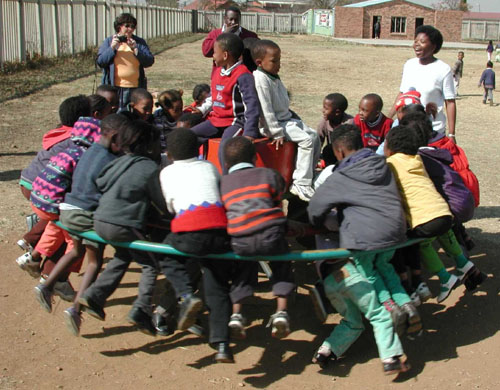
Turntable – network effect toy.

When I first started thinking deeply about network effects I was very pleased to realize that there are some little examples: pot luck dinners, flea markets. And one of my favorites was the turntable, a toy found in playgrounds.

kidsonround3-s.jpg
These days I’m more interested in how you get these network effect things to start, or how you create new turntables. How you draw off something from the resulting energy that assures they can be self sustaining, maintained.

So I just can’t believe how wonderful this example is. Via Rebecca Blood; a turntable that taps the energy in children’s play to pump water. What a tour de force! There are 500 of these in South Africa.

Senate Stock – Bogus

It is bogus; i.e. the report that senators make more money in their stock trading than the rest of us.

Yesterday evening I had to listen to a long peice on NPR about the recent propoganda that Senators do better with their investments than regular folks followed by a long unappolegetic slander along the lines of where their’s smoke theres fire.

There is a disturbing meme in the culture these days that nobody could possibly do anything except for reasons of self interest and greed. This creates contempt for our public institutions, encourages their distruction, and models a very bad behavior. Be careful what you wish for. If you announce that everybody in trade X is a crook pretty soon the crooks will all go into that trade.

The rational choice (aka greed) is not the only cause of human action. Maybe some people are talented.

eBay Politburo?

Great article about the companies that inhabit the niches around eBay. Provocative. I bet this got the author a call from the eBay PR department.

“And the eBay economy doesn’t exactly work like a free market. It’s more like a Soviet-style planned economy, with eBay chief executive Meg Whitman serving as the head of the Politburo. EBay determines the prices that so-called “third-party” companies must pay to interact with its website, and it occasionally threatens or pursues litigation against companies that it believes are misusing information from its auctions.”

Isn’t there a variant of Goodwin’s law about that?

Then the author turns around and rains on the parade of the company that is the hero of the piece.

“In many ways, it’s the exact inverse of the business model that made eBay so successful. EBay operates a website, leases no retail locations, and never takes possession of merchandise. Its sellers handle the hassles of packaging items, shipping them, and communicating with buyers. AuctionDrop, on the other hand, is a labor-intensive model that requires retail and warehouse space and copious customer service. I’ll be astonished if it’s still in business this time next year.”

I hope the author’s got call waiting.

it’s very refreshing to see a business article that get’s it. EBay has a beautiful business model. They captured just the right amount of the transaction; the finding and the closing. Meanwhile it’s surrounded by complementary companies. Some of these will be quite marginal operations. Others like UPS or Paypal maybe quite large. Such is the power-law curve. Managing the ecology of complements around a big business is an art. The big complements tend to develop market power that constrains your flexiblity (which is why Microsoft had to acquire a word processor) while the little ones solve problems for you.