Archive for the 'happiness' Category

Markup

Thursday, July 17th, 2008

There is a lesson here:

Abstract. Individuals who are unaware of the price do not derive more enjoyment from more expensive wine. In a sample of more than 6,000 blind tastings, we find that the correlation between price and overall rating is small and negative, suggesting that individuals on average enjoy more expensive wines slightly less. For individuals with wine training, however, we find indications of a positive relationship between price and enjoyment. Our results are robust to the inclusion of individual fixed effects, and are not driven by outliers: when omitting the top and bottom deciles of the price distribution, our qualitative results are strengthened, and the statistical significance is improved further. Our results indicate that both the prices of wines and wine recommendations by experts may be poor guides for non-expert wine consumers.recommendations by experts may be poor guides for non-expert wine consumers.

From: Do More Expensive Wines Taste Better? : Evidence from a Large Sample of Blind Tastings

You should pay me to buy your wine, scrap off the prices and replace them with tasty robust high price labels.

Positive/Negative Emotions

Tuesday, September 4th, 2007

funny-kittenspreview.jpgI read Seligman’s Authentic Happiness some time ago.  He has an interesting hypothesis. The idea is that the negative emotions (fear, envy, greed, etc.) are about scarcity (win-lose) while the positive emotions are about more collective constructions (win-win). It is a bit difficult to discern which ideas in this book are well validated by good studies; it appears that this idea is closer to the insta-theory end of the spectrum than most. But I like it. Collective good, selfish bad.

Even if you can puzzle out exactly which ideas and techniques he suggests are well tested you still get difficult confusions between cause and effect. Happy people have larger social networks, but how can you tease out the causality?  In another example; it is will known that marginal increases in your wealth have a weak but positive correlation with happiness. That weak link suggests we ought to strive to earn more. Much less widely reported though is the trajectory of happy people tends toward higher wages and positions.  I think that a cheery affect tends to generate the wealth, not the other way around.

The studies did show some interesting effects. Your various traits (humor, punctuality, cleanliness, etc. etc.) do tend to be genetically inherited and they don’t tend to be strongly effected by circumstance. I particularly liked that they know that older siblings do often have higher IQs than younger ones. How much? One IQ point!

He has a few pages devoted to dismissing the Freudian idea that childhood trama creates an emotional blockage which latter blisters out in ugly behaviors. Those ideas have been extensively tested and they came up wanting.

The Freudian idea that emotions are like water, e.g. if you represses them up they will leak out elsewhere turns out to be extremely wrong. Repressing is fine, and effective. Bottling up doesn’t cause them to stew. No, stewing on them makes them fester. If you nurture a grudge you can turn it into a monster. Living with those is a bummer. If you nurture gratitude, satisfaction, forgiveness, confidence, optimism, etc. etc. you can fill your inner life with kittens.

Search Frequencies/Person & A Public Service Announcement

Monday, August 7th, 2006

AOL recently released a huge sample of search engine queries. In a highly questionable move they tied these queries to reasonably anonomous user identifiers; for example we know that user known as #724 searched for “how to install a glue down floor”, as well as “carbol tunnel” etc. He did 366 searchs between March 1st and May 5 2006.

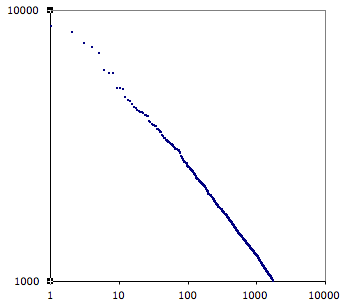
Unsuprisingly the distribution of search generators is power-law distributed. This is a log-log chart. Each dot on the chart represents one AOL users. The vertical axis is how many searches they did; for example the highest dot, aka user 2263543, did 8695 searches. This is only the most active 20 thousand users in this data set, the least active of whom did 313 searches. The complete data set has 657 thousand users, 57 thousand of whom only did one search.

Actually I dropped the most prolific searcher, user #71845, who made over a quarter million searchs; and totally messes up my nice straight line.

Today is national mental health day. I think the most disturbing thing I’ve noticed as I browse this data is the number of people searching for information on how to commit sucide. There are effective treatments for depression.

Stuff Addiction II

Wednesday, October 5th, 2005

I haven’t posted anything in my happiness category for a long time, isn’t that sad?

One of those postings is about a syndrome I named stuff addiction. News on that front. It might be worse than I thought:

the brain systems for liking and wanting are separate. … a drug like nicotine produces much craving but little pleasure.

A good advertisment induces craving. Golly, the distinction between use and signal value runs deep.

That’s from a Sunday supplement article on happiness research that appeared in the Times of London. That’s light and fun to read.

One teaser in the article is the mention of a 100 “interventions” for building happiness; and even that 40 of these have now undergone at least some clinical testing.

Not that these interventions would necessarily be fun in and of themselves. This frightening one is outlined:

A third technique involves writing a long letter to someone you’re grateful to but have never properly thanked, and visiting them to read it out in person.

Seligman and his graduate students weep tears of joy when they do this exercise, but most Brits would probably rather be miserable than do it.

Same in New England I suspect. Thank goodness! That one’s not particularly effective.

These get higher marks:

In one internet study, two interventions increased happiness and decreased depressive symptoms for at least six months. One exercise involves writing down three things that went well and why, every day for a week. The other is about identifying your signature strengths and using one of them in a new and different way every day for a week.

Of course what’s the point of a Sunday supplement if your not selling something.

Seligman speculates that doing more exercises for longer would bring greater benefits. Hundreds of thousands of people have registered with his website www.reflectivehappiness.com — where, for $10 a month, they are given a happiness programme including instruction in a package of positive exercises.

Cheaper than cable!

Professional Grade Humor

Friday, May 20th, 2005

A friend of mine floated a cool idea regarding humor. We all know that humor comes in various species: irony, farce, slapstick, etc. etc. But we lack a scale of how skilled a bit of humor is. There is a world of difference between the appropriate bit of humor inserted into a cocktail party and the art of finding the humorous thing to say in the midst of a funeral.

Humor, like enthusiasm, is not self-moderating. A classroom of high school students can trivially be drawn into an escalating chain reaction. It’s ironic; teachers who labor to nurture wit find it necessary to quench even the slightest fission of humor because their charges are such ill-trained humorists.

Of course all emotions run the risk of running off into exaggerated forms. Stress, panic, depression, etc. etc. The wonder of humor is its ability to call them back down out of the stratosphere. It’s a high art of getting it just right. A skill we have all observed in talented people around us. Injecting just the right bit of wit into a situation, diffusing at least a portion of the escalating emotions.

If this talent had a name you could put on a job description! Awards could be granted: “Best pun used in an IRS audit.” High school councilors could advise students join the guild. An international society could be formed. States could grant and revoke licenses. Weighty text books and complimentary multi-media virtual world educational games could be sold at great cost to state school boards.