Monthly Archives: March 2008

Scoring the Class War

Wow.

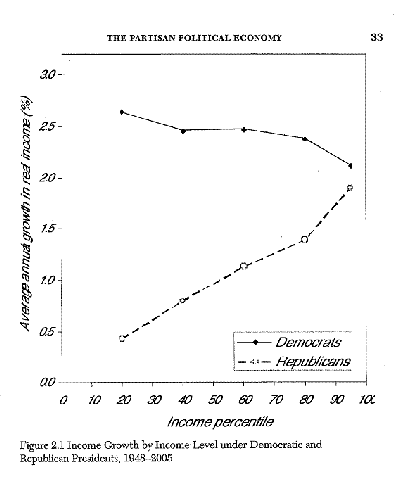
classscore.gif

The chart shows the income growth for differing income classes: one line for Republican presidents, one for Democrats. Income growth is lower when Republicans rule vs Democrats. The growth is sharply less equitable when Republicans rule than Democrats. There is a slight shift toward lower income groups when Democrats rule.

This chart re-enforces the point highlighted by the Vote View work, i.e. that the primary divide between the two parties is economic issues; with the Republicans laboring on behalf of large economic entities.

Don’t ever forget this chart. Don’t ever pretend it’s not the single most fundamental issue in American politics. Don’t tolerate diversions, this is it. It’s not about war. It’s not about race. It’s not about religion. It’s about who gets the spoils of economic growth. One side is fighting a class war and the other side is not.
More here, and here.

Just in Time Rule Making

I have a bank account designed like a game at a casino.  They bet me about 70$ a month; if I lose then I pay then about 20$, if I win I get about 50$.  Winning the bet requires that I run an obstacle course of their design.  For example in one step I must use their debit card N times. This is not unlike those deals where you have to mail in a rebate.  Companies offering rebates know most people are not as competent as they think they are.  These are pretty evil marketing techniques. Unsurprisingly given the excitement in the credit markets the bank has decided to rejigger the rule of the game.  The penalty is the same.  The prize is now smaller, 30$.

They write “we felt strongly about notifying you before the rate decrease takes effect” in an email dispatched 14 hours before the rule change goes into effect.  This reminds a bit of a game my brother once played with me where in he would change the rules after each round.

clbuild cl-xmpp ejabberd

Assorted brush clearing.

Adding additional libraries to a clbuild setup is easy. Just add lines to your wnpp-projects file. For example:

cl-json get_darcs http://common-lisp.net/project/cl-json/darcs/cl-json

Give it a try and add additional things until everything you need is included. I’ll admit to editing the dependencies file by hand.

Sooner or later you get to things for which this doesn’t work. You can teach clbuild about additional projects by just adding them to the source directory and then using the register-asd command on that project. Given that your stuck doing that you will need to tell clbuild not to attempt to download them. You the command called skip marks the project to prevent any attempt to download.

That scenario arises if you want to use cl-xmpp, which depends on cl-sasl. Cl-sasl uses yet another source control system, GNU arch, which clbuild doesn’t handle yet. Clbuild is really pretty awesome at dealing with the excessive diversity of source control systems members of the Lisp community have embraced. We do love our exceptions.

I did try using get_tarball, which is deprecated, but that didn’t work out. Possibly because the tarball filename is cl-sasl_0.3; and that code appears to want it to be cl-sasl. I didn’t look further.

Cl-xmpp did not work, out of the box, with my ejabberd. That problem appears to be explained in this archive of the development mailing list. The resolution involves passing :mechanism :sasl-digest-md5 to xmpp:auth, but it also requires a patch to ejabberd to improve it’s xml conformance. I haven’t made the ejabberd patch yet, or maybe I need to upgrade ejabberd.

Ben Laurie recently observed “people don’t really talk much about the experience of writing and debugging code.” I suspect if that void were filled we would see many dull postings like the above; or more likely postings like the ones Jason S. Cornez makes in the archive above.

This posting is, in part, triggered by Ben’s comment. But it’s also provides a checkpoint. I need to context switch to other activities at this point. I certainly didn’t expect to devote quite so much time to this when I added this to my wnpp-projects file Saturday afternoon.

cl-xmpp get_cvs_clnet

Update: ejabberd is probably doing the right thing (see here)… Hm, looks like the code forked and a better version is to be had as so:

cl-xmpp get_git http://www.lichteblau.com/git/cl-xmpp.git/

Maybe I should always read the entire transcript of the development mailing list before I start anything.

Pink-themed Monitoring

Managing the selective revealing of fine grain private information marks one border in the Fantasy land of Internet identity design.  My preferred use case: Authorizing your barber to reveal your hair color to your bespoke tailor.  Far on the other end of the imaginary continent are systems that distill statistics from the incidental revealing.  Those are much easier to pull off, Amazon’s been doing it for years.  I think this may now be my favorite use case:

“Female CIOs spend 32% more time tracking federated identity transactions through pink-themed monitoring applications.”  — Paul Madson commenting on Wakoopa

The trick with the incidental revealing schemes it getting access to a large flux to eyeball.  Amazon and Google can do that by contemplating their own traffic logs.  Double click does it by negotiating their way into the click stream.  Sites like Delicious, Flickr, and Stylefeeder do it by getting users to reveal their preferences in exchange for helping them manage and share their collections.

Wakoopa provides self monitoring.  It records what applications your using.  Interesting how the intent of that can be framed in three ways: revealing your private data (as above), consumer empowerment (met other users), or as a self control tool.

Which ties this into the Breakdown of Will thread. Tools that help with self monitoring here for example are hardly different than what Wakoopa is doing.  Naturally they accumulate private data.  Naturally they involve the introduction of another party, since that party can enforce the control.

talk about the weather

Over at 43 things, a site where people can clot together around random common goals, I see that two thousand people have revealed thier desire to “become better at small-talk.” The “learn to make polite empty chit chat” group has only 59 people. I’m a bit distressed that only one person wants to learn how to banter.

The books on small-talk advise one to talk about the weather. Though they rarely mention that it’s critical to avoid being drawn into the ongoing dispute about why nobody does anything about it. Even the origins of that particular dispute remain contentious: Mark Twain or Samuel Clements?

Talk about the weather is one of the seed crystals of group forming. It’s surprising how far you can go. When ever I’m trying to explain how much I enjoy lurking in esoteric enthusiastic groups on the internet I always mention Tornado chasers; since I was lurking in that group back in the 1980s.

All this is really preface to a shout out.

Some folks in Iowa have created Jabber chat rooms for each national weather service office. What’s sweet about these chat rooms is that they pump real time weather alerts into the rooms. So even if nobody else in your area cares to join the room this is still the best way to get real time weather alerts for your area.

For example zzboxcat@muc.appriss.com is the Jabber ID for the Boston area weather office, who’s mnemonic is BOX. Just replace that mnemonic with the appropriate one for your area.

This is easy, well it’s easy once you puzzle out a) how to find your area’s weather office, and b) how to join a jabber chat room.

Levy Walks

Search in a space requires poking around. In fact random search is the canonical strong method. Presuming you have time, can cover the search space, and recognize a solution it can solve any problem. Of course, drunken random walks are well known to result in repeatedly bumping into the same parking meter. So it is with some pleasure that I stumble upon a different kind of random walk. Better yet these walk’s principle feature is that their moves are power law distributed.

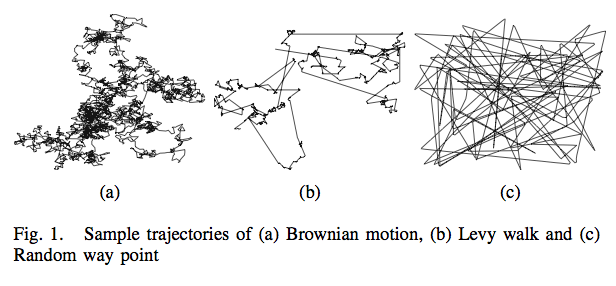
Levy walks are observed in nature. Searching animals have only a limited awareness of where food might be found. Outside that awareness they are reduced to random search. But they don’t move randomly in the sense of Browning motion, nor do they randomly select some destination and then move to it. Rather they appear to draw a random number from a highly skewed distribution and then make that move. If you browse the literature on Levy walks you can see that monkeys, humans, and many marine animals all use Levy walks to organize their search. Here’s a picture showing an example of those three kinds of walks.
randomwalks.png

I find this fascinating. As an engineer I’m surprised that I don’t think I’ve ever saw seen a search algorithm using this method. Looking down from above, this means you could observe the trajectory of any object and this simple statistic would tell you if it was alive. Looking out from within, since this is presumably a largely scale free phenomenon it’s quite suggestive about the trajectory of one’s life.

Sausage Making

I enjoy bantering, Its a New Yorker’s pleasure. It doesn’t go over well in Boston. Puritans and Academics, what can you do?

I buy my sausage from a butcher in the North End. The North End is a rare urban neighborhood, at least in the US. Dense, old, somewhat unchanged by time. Jane Jacob’s argued that it had survived because it was walled off. Walled off from capital and walled off from the rest of the city by a butt ugly raised superhighway. She made that arguement as part of suggesting that one of the forces that kills urban neighborhoods is fast money.

They have torn down the ugly super highway, and money is flowing fast into the North End. The good liquor store has shut down, a bank will step into it’s shoes. Across the way the amazingly small two story pub where two dollar beers were sold to next to the vegetable market has been bought and a posh faux Irish bar has taken it’s place. Condo’s are going on top.

I joke with my butcher that the sausages are loosing their flavor now that his supply of road construction waste has dried up. He assures me he’s got a stockpile in the back; but I doubt it. I point out that the cat that sleeps on the freezer appears to be getting fat.

How the sausage is made is a surprisingly fascinating topic. When you buy stuff it’s full of ingredients who’s provenance you can’t hope to fully know. And there are always surprises. The securities you bought turn out to be full of badly originated mortgages. The blood thinner dad’s taking turns out to kill him, and the press discovers that poor families in China scrape sausage casings to gather a key ingredient.

Markets, firms, and societies solve the inherent quality control problem that arises from are long and confusing supply chains with various quality control schemes. My butcher has a variance from the health inspector pinned up on his wall. His tiny store is too small to conform to regulations about how far this should be from that. I don’t doubt his cat is, officially, a problem too. I was fascinated by how far the US’s drug administration’s reach goes, i.e. all the way back into the homes of those families in China.

That the world is all about sausage is delightfully frame busting. For example consider web sites. Back in the day we assembled the web pages on the server; using PHP or Perl for example. Talk about sausage!

PHP is case study in sausage making. PHP’s vitality comes from how wonderfully easy it is to paste together all kinds of bits and pieces; particularly C code libraries. It’s a wonderful – almost all bubblegum and bailing twine holding together this vast array of really nice C libraries. The only problem is quality, those libraries aren’t particularly secure. Expose those libraries on the open internet and your moments away from a security breach.

These days we don’t make the sausage on the server any more. We mix the final page up only at the last possible moment, in the browser, using Javascript. These days many suppliers can feed into the final product. I can recall a time when web masters would forswear that kind of thing, since they didn’t want their uptime dependent on 3rd parties. No doubt some Luddites still say that. But I don’t see how that attitude can stand. It’s like trying to live an entirely self reliant existence, growing your own food, cutting your own firewood. Romantic but impractical. So this is a very different dynamic; one where the quality of your suppliers becomes much more nuanced. I’m finding it fascinating to try and think through it’s implications. For example, just to pick one, how can you possibly archive pages like these?