Monthly Archives: September 2007

Arbitration Trap

Oh my this is quite a report!  It’s about those mandatory arbitration clauses which have become so popular in various terms and conditions.  This is a perfect example of how difference between left and right is how benefits from societies institutions; small economic entities v.s. large.  Unsurprisingly the arbitration system favors the large.

The report is one outrage after another, so it is difficult to pick one thing to highlight.  For example one of the arbitration companies had a press release saying 55% of the cases are settled for the consumer, neglecting to mention that they selected only those cases filed by consumers (a few hundred); a vanishingly small slice of the cases (tens of thousands) that move through the system.  Contrast that statistic to one arbitrator they look at closely, 96% of the cases he handled were settled for the credit card company.  On a few days they mention he handled half a million dollars worth of cases a day.  Later Schwarzenegger made this guy a judge.

Good olde unix tool – at

I can’t believe I’ve never thought of this, Ask writes:

… used the at daemon to automatically recover ... as root enter:

at "now + 5 minutes"
service iptables stop

You can type a whole list of commands and when you're done, press ctrl-d to stop.

It will look something like:

# at "now + 5 minutes"
service iptables stop
job 6 at Tue Sep 18 17:53:03 2007
#

I'm particularly surprised I'd not thought of that since  I often use at for watch dog timers, in Rube Goldberg devices that automate workflows, and before I got my Treo I'd do this all the time:

$ at 18:32
mail -s "put money in parking meter!" ask@example.com < /dev/null
^D
job 8 at Tue Sep 18 18:32:00 2007

I used to use it for lots of such pests. send messages like "back out esting patch," "discard experimental foo install,"  "submit rebates,"  "check check cleared," but I do such things with my Treo now.

Bizzare

This article is totally weird.  To begin: “scheduled pipeline maintenance in Colorado reduced the system’s capacity to export out of the Rocky Mountain region”.  So then what happened? “gas supplier Colorado Interstate Gas dropped the price”  I have no idea why they did that.  And there were buyers, in particular the city owned utility in Colorado Springs.    Now this stuff “normally trades at $3 to $4” but the utility did pretty well: “2.6 cents”.    Sadly most of their storage was already full; so they only managed to save a few million dollars.  Too weird.

Housing: sense of scale

Consider this quote: “about 320,000 foreclosures – or repossessions – were begun in each of the first two quarters of 2007 he said, against an average of 225,000 per quarter in the past six years.” What are we to make of that? Some easy calculations: thats up 92 thousand per quarter or 42%; or from .9M/year to 1.28M/year.

To do more we need some other numbers.

In 2000 (pdf), there were 115 million housing units, and 105 of those were owner occupied. So 1.28M/year is about 1% of the total installed base of housing.

But it’s is probably better to look at the housing market flows, not the housing installed base: 6.4 millions homes were sold in 2006 in the US; so that 1.28M is 20% of that, up from 14% of home sales over the last 6 years. We can also look at inventories; and I find those numbers interesting. In 2004 there were 2.3 million houses on the market and in July 2007 there were 4.6 million. Makes for interesting times in the housing markets.

Of course this effects real people, displacing them from their homes. That 1.28M/year is a lot households displaced. Unemployment is another significant displacing event for households; a 1% shift in that rate effects 1.5 million people; over the last 16 years the typical year to year swing in that rate has been .55% so this 2-3 times that. It’s rude comparison, but you can compare this to international displaced people counts. I wonder how many people were displaced by Katrina?

Do you feel lucky, Punk?

Brad DeLong picks up some postings arguing that Google destroy’d the garden wall revenue model that the New York Times was using for Times Select and that others (e.g. the Financial Times and the Wall St. Journal) aren’t long for this world.

My first nit to pick here is that it wasn’t Google, but the tsunami of disintermediated content that blew up that business model. If you looking for the institution to blame it was the internet and it’s end-to-end design principles. Google had nothing to do with it. Well maybe it had a tiny bit to do with it; but it pains me how people are unable to distinguish the value of Google from the value of the content it is now the intermediary for.  This is like confusing the card catalog for the library, or Sony for the Shastakovich.
Brad then goes on to say something much more interesting to me.

I suspect we are headed for a winner-take-all situation here as well: journalists who acquire reputations as experts will do very well as they become draws for advertisers. Institutions–not so much. Anybody who trusted the New Republic under Michael Kinsley and then encountered the New Republic under Andrew Sullivan, Michael Kelly, and Peter Beinart learned a very painful lesson about focusing on institutions rather than people.

That is indeed the pattern. Winner take all maybe a bit exaggerated, but the pattern is clear; and this is the yet again the question of what the highly skew’d distribution of economic entities will look like going forward. As we skew more severely we end up with fewer intermediaries and everybody else cast into the role of a solitary player. Institutions fail, certainly, but it is ironic that in a single paragraph Brad can suggest that we should expect a single institution, Google, to win it all and then advise us not to focus on institutions; just on the solitary players.

Panama

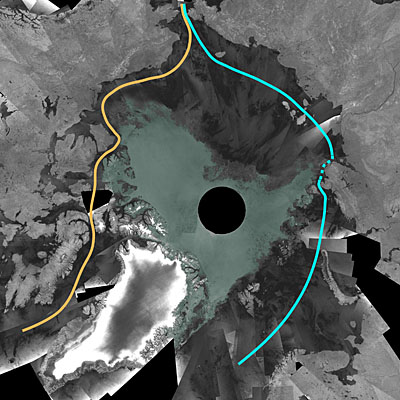
Who needs it? Northwest passage open.

envisat_asar_gm_sep2007_2_passages_and_mask_l.jpg

The canal intermediating between two oceans is the perfect example of a monopoly exchange hub. Routing around it will have tremendous disruptive effects. Immediately this changes the pricing situation. The Panamanians collect 600 Million a year in revenue on tolls, a price that is presumably set in “consultation” of the US government. I have no idea what we spend a year on “their” “security” and we have, of course, invested a bit in that area over the years. Adding Canada to the pricing discussion will be complex, but probably not intractably so. The Panamanians are currently engaged in a 5 Billion dollar canal upgrade. Canada faces some significant startup costs to govern their alternate route. The world hasn’t ever managed to eliminate piracy in the south china seas.

Governments aren’t the only players.  The shipping business has a dominate player, it’s Walmart/Microsoft/Saudi-Aramco/what-have-out, i.e. Maerk Line. They are currently building a set of 10+ container ships able to hold 14 thousand standard shipping containers (TEU). When those go by on the superhighway one guy is driving the truck. These ships have a crew of 13. These are the largest cargo ships in the world, but yet they conform to the standard dimensions required by the canal. Maerk has 1.7 Million TEU of shipping capacity.

I bet some people are rerunning the numbers on a lot of projects: that one, the canal upgrade, the cost of regulating a new route.

Nations whose funding runs through a single bottleneck have a tough time dealing with disruptions to that bottleneck. Which is why one worries about Mexico’s stability as their oil run out. I guess we can add Panama to that list.

When disrupting an existing exchange hub it’s de rigor to leverage each way your alternative is maximally different from the competitor. I wonder what can be made of the near term seasonality of this new route. I bet we will see a lot of PR about how environmentally beneficial the reduced energy usage of this new route is. Should be quite interesting for ship design, since presumably you don’t have to fit through the canal anymore.

Surprise Hurricane

Two words you do not want to see together: Surprise Hurricane.

“A surprise Hurricane Humberto ripped into Texas near the Louisiana border this morning, bringing winds of 85 mph and torrential rains to the coast. Humberto didn’t even exist yesterday morning, and grew from a tropical depression at 11am EDT to a hurricane just 14 hours later.” — Jeff Masters

Hybrids make you fat!

Sometimes a scientific paper makes me giggle.  The paper by Charles Courtemanche which I’m skimming this morning has a few examples of this.  For example it says that people tend to under report their weight and over report their height; but more the former than the latter.  It also includes this phrase “the food variables are left-censored at zero” – which means to say that the French fries don’t come out of your mouth, they only go in.  This formula where on term is aproximately salads and another term is meatloaf is a hoot.

food_formula.png

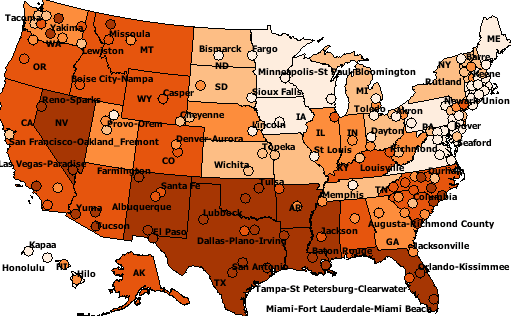
I don’t know were this guy get’s off announcing that meatloaf isn’t health!  The author took two large data sets, one for prices (that’s gas price in the formula) and one for health behaviors.  The health behavior data he used is collected by the Behavioral Risk Factor Surveillance System of the CDC.  It’s a telephone survey conducted by state health departments.  That survey is full of interesting facts, for example here is a map showing the states and metro-regions where people lack health insurance.

no_health_ins_2006.png

In anycase, he was looking to see if there was some corrolation between gas prices and obesity; and yes cheap gas makes us get fatter.  Given that the next question is “How so?”  The behavior data has lots of info about various things people are doing he can look for patterns there too.  Thus we can can learn the valuable and amusing fact that “A rise in gas prices appears to increase the frequency of hamburger consumption…” and “a small increase in salad consumption”.  From now on when ever I see that the price of gas has gone up I’m going to think “hamburger?”  Generally higher gas prices don’t lead to healthier eating.

People lost weight when gas prices rose for two reasons.  Where they ate changes; they ate more at home.  And they walked more.  I.e. higher gas prices reduced driving; displacing driving to the resturant and increasing walking as a substitute.

His conclusion:

In this paper, I provide evidence of a causal link between gasoline prices and body weight. Using data from the BRFSS, I find nd that a $1 increase in gas prices would, after three years, reduce U.S. obesity by approximately 15%, saving 16,000 lives and $17 billion per year, a  magnitude which offsets 16% of fuel consumers’ additional expenses. I also estimate that 13%  of the U.S.’s rise in obesity over the period 1979-2004 can be attributed to falling gas prices  during that time. Finally, I find that a rise in gas prices increases exercise and decreases the amount people eat out at restaurants, explaining their effect on weight.

This paper is actionable on a personal level.  Lose weight, buy a gas guzzler! But then it is probably twice as effective to buy a car you hate.

The paper is here (pdf), and a nod to the ever facinating Paul for his post about it.

Sharing Cell Phones

In Yochai Benkler’s essay “Sharing Nicely” about large class of institutions where people solve problems by sharing rather than market clearing or regulatory frameworks he blocks out a rough model of what enables that them; e.g. a large pool of excess capacity (empty seats in the car, idle cycles on your PC or your head) and ownership at the periphery.

With that model in hand you can begin to look for them.  And there are lots and lots: in the ride share space; the community wireless movement; around the P2P, mesh networking, craig’s list, freecycle, leave-one/take-one book exchanges, etc. etc.  There are lots of little examples of which the pool.ntp.org is a great one.  And given that you start to see them you can try to get to the next level and see if you can find opportunities to create new ones; e.g. entrepreneurial opportunities to create new sharing institutions.

This is fun! It’s like three other periods in my life when I developed an eye for a new pattern.  For example at one point I started to realize that marketing people had an eye out for empty niches in your house and tried to slip products into them: the fridge door, the medicine cabinet, your pockets.  That each of these was a competitive landscape.  For example at one point I noticed that there were components which were so widely used for one function that they created a near discontinuity in the price curve for things of their kind and that they then created options to repurpose them: the magnets in disk drives, or the motors and lasers in cd players are both examples.  The sharing nicely examples are analogous to both of those.

So, it looks to me like wifi/bluetooth equipped phones are an almost perfect example of a substrate for Yochai’s sharing systems.  If they were sufficiently open and sufficiently dense upon the landscape it should be possible to route around the Telcos.  That would be fun.  I don’t doubt this idea has already brought a smile to a lot of engineer’s eyes inside of the handset manufactures.  Makes me wonder, is Apple planning on doing just this to escape the relationship with AT&T?  Makes me wonder if you couldn’t to this today with some of the Linux based cell phones.

Pricing Ethics

Somebody over at Crooked Timber drew my attention to “Moral reasoning and Higher-Education Policy” written by two high-end liberal arts college president types. They get things rolling by stating “even students who pay full tuition receive sizable subsidies” and it goes onto revealing some of what goes on behind the scenes as schools try to manage their pricing in a system that “rests on a set of ethical judgments” and is “heavily regulated by the federal government.”

Portions of the essay are just great, particularly if you enjoy scandalous paranoia.

The colleges in effect say, “Share with us these quite intimate details of your personal financial situation, and we in turn will use that information, to identify those who need our help”

Yet our current situation is rather troubling. The colleges still get families to provide that information, but the idea that they will not use that information for competitive advantage is largely obsolete. Many institutions use it, for example, to exclude students whom they can’t afford to aid. They … try to charge … highest “net” price they will be willing to pay.”

That phrase “willing to pay” is the touch stone of a discriminatory pricing; the means to garnering the maximum profit for the goods your selling is always a question of discovering what the maximum the buyer is willing to pay. This behavior is good self interested economics and it is a lot easier if you can get him to reveal more private information. Of course if buyers catch you then a “A good deal of trust has been drained from the system…”

They mention some particularly thorny examples of information, conveniently available, that an economically rational school is tempted to use and which they suspect some do. For example signing the admission’s guest book signals an increased desire and so should raise the price offered. Same story if your parents attended the school.

Having just read that I was amused by this similar example from the payment’s industry. It’s an Ad show’s the consumer getting a coupon on their purchase because the payment system knows their payment habits, that they are shopping with a competitor, and so a discount is in order.

Pricing games are deeply entwined with privacy and secrecy. So for some reason it seems only right that that paper on ethics in university management is behind garden wall where the consumers won’t see it. But that’s sad because it is a very good very nuanced essay.