Archive for October, 2006

Missing the Train

Sunday, October 29th, 2006

I spent a huge slice of my life writing toolkits for graphical user interfaces. The primary tension in that work is between supply and demand; the software engineering knowledge available and the interfaces you wish to build.

Strong opinions on both sides. Engineering loyalists prefer more objects in the design. Have a chart? Give every point on a chart it’s own object. Customer loyalists wanted it implemented quickly (more objects can help there) and very very fast (more objects are no help there). A more difficult tension from the customer side the desire for pretty, easy, and powerful.

Both camps have factions within; the most striking one is between professionals and practitioners, e.g. those who study the problem and those who build commercial systems to actually solve the problem. Few commercial system builders are aware of the work done in labs on constraint based UI tool kits. Intellidraw was a shining exception. Few people working in the labs have a clue about the elegant architecture of the Apple Newton’s UI toolkit.

I haven’t working in this domain much for more than a decade now. I moved on. The UI toolkit design space seemed to be largely mined out. Worse, powerful network effects had locked in solutions patterns.

I moved onto the open source puzzle, i.e. how to leverage the infinite pool of talent on the other side of the internet. A much richer vein of opportunities to mine. Still is!

Has the academic UI community come to this new party? The answer appears to be no and that is so weird!

I don’t see these applications through the old paradigm. Model on one side and user on the other and the designer’s job is to fill the gap with view & controller. Meanwhile the researcher stands off to one side attempting to make the interaction more … whatever, more efficient, more fun, more smooth.

These days I see an artifact on one side and a group on the other. The artifact plays a key role in the group dynamics; as a point of rendezvous, the manifestation of it’s common cause. View/control is no longer a particularly useful way of thinking about that problem. I have other ways I now think of it: coordination, community rituals, games, limited warfare, etc, etc.

While there are numerous practitioners of this new craft with thousands of examples of wonderful systems already built (source control, wikis, forums, bug trackers, IM systems, etc.). So where, damn it, are is the professional faction? This train left the station a while ago; and with a few very specialized examples it looks like they missed the train entirely.

Darwin and Platform Tyranny

Wednesday, October 25th, 2006

“Tyranny consists of the desire of universal power beyond its scope.”

One of the nice things about having a blog is that you can spit out those damn brainstorms before they do too much damage to your equilibrium or worse or are extinguished by your daily life.

I’d not noted before that the evolved animal is like a software platform.

One of the curious facts about software platforms is that they aren’t good for anything. You have to pile an application on to the platform before it solves real problem. That is a useful right first approximation. Of course platforms are good for something, they are good for solving some space of problems. They allow you to build things.

There is a gap between a platform and a problem solution. In platform system design, where we don’t solve problems we just design more platforms, we think of these as layers.

For example the end-to-end principle suggests that the layers should be thin, so that the lower layers are windowed down to a kernel of necessary function and no more. In business theory where platforms go by other names like toolkits, standards, rule sets, and are observed in numerous guises such as major commodities on supply chain, we know that a platform creates an options space of further commercial activity. There is always a lot of competitive to and fro about who gets to capture that value. Suppliers often covet value created down stream from them in the supply chain. That’s no different than how platform vendors often fold high value innovations back into their platform offering. A move that is contrary to the end-to-end principle but is quite rational in a commercial mindset. When we complain about a supplier, say Microsoft, overreaching, say by bundling the web browser with the operating system, we call that monopoly; but as the quote above suggests it’s a kind of tyranny.

Reading and thinking about “Breakdown of Will” has been triggering some very surprising connections to all that. Animals are wired to manage their attention in a way that is at odds what we believe to be the optimal way to manage the attention of a rational man. There is a gap between the platform, i.e. the animal, and the problem to be solved, i.e. to be a rational man. It is into this gap that we humans pour our clever rationalizing schemes. Applications on the platform.

So that was my brainstorm. What triggered it was some stuff at the beginning of a book from the anthropology library about trying to explain religion. The introduction was working it’s way through the necessary dross and was talking about Darwinian explanations for religion. My reaction was “The platform can only tell you so much about the applications that run on it.” Darwinian ideas are a major supplier in the explaination of animal systems, but there is a tendency for people to let these ideas overreach their natural scope. You see a similar overreaching by the ideas that come of economics. At this point in my thinking about the ideas in “Breakdown of Will” I’m more inclined to put religion in the application layer as part of our struggle to create useful solutions atop the worse is better legacy platform.

Self Binding

Tuesday, October 17th, 2006

In Arizona you can relinquish your right to go into Casinos by signing an agreement after which the Casino operator can toss you off the premises. That’s presumably a sign that you don’t trust your self to avoid the temptation. In California there is a town where you can relinquish your right to drive your car at night. I guess that’s a sign that you don’t trust your teenagers? Maybe it’s a sign that your really are paranoid about thieves. Or maybe it’s a scheme to keep mom from sneaking out the craft supply store. When you buy real estate in a gated community you sign away a vast range of freedoms, as you do when you move into a carefully zoned neighborhood. Of course there is the movement to have young people sign pledges that they will behave in a particular ways ranging from behave in class, through do their homework, up through abstain from sex until marriage.

All these are strategies to control the behavior of the parties involved. We all know that short term pleasures do tend to displace long term benefits. These schemes are necessary because we don’t trust our neighbors, our children and most interestingly ourselves! Optimal impulse control is extremely hard.

We all make “personal rules” that mimic the systems above because we don’t trust our future selves. This lack of trust is based on experience; in what makes for a variation of catch 22, if we had kept to our personal rules in the past we wouldn’t need them.

Mark Twain decided to limit his smoking to one cigar a day, for his health, and found that over time his cigars grew larger until the rule lead to the added benefit that he could use his cigar as a cane should the need arise. One of W.C. Fields characters, a temperance lecture would explain that he keep a bottle of liquor at close at hand. For snake bits only! He also kept close at hand a snake.

Neighborhood Car goes to Town

Wednesday, October 11th, 2006

I wrote about neighborhood cars a while back. Those go upto 25 mph and can be used on any avenue in the US posted at 35 or less. Meanwhile according to reports from the continent if you charge sufficently severe congestion charges people will start buying these little electric cars. Apparently they can go 40 mph and cost about 14 thousand dollars.

Here’s the Problem

Wednesday, October 11th, 2006

Ben Franklin changes his mind:

I believe I have omitted mentioning that, in my first voyage from Boston, being becalm’d off Block Island, our people set about catching cod, and hauled up a great many. Hitherto I had stuck to my resolution of not eating animal food, and on this occasion consider’d, with my master Tryon, the taking every fish as a kind of unprovoked murder, since none of them had, or ever could do us any injury that might justify the slaughter. All this seemed very reasonable. But I had formerly been a great lover of fish, and, when this came hot out of the frying-pan, it smelt admirably well. I balanc’d some time between principle and inclination, till I recollected that, when the fish were opened, I saw smaller fish taken out of their stomachs; then thought I, “If you eat one another, I don’t see why we mayn’t eat you.” So I din’d upon cod very heartily, and continued to eat with other people, returning only now and then occasionally to a vegetable diet. So convenient a thing it is to be a reasonable creature, since it enables one to find or make a reason for everything one has a mind to do.

The mind is not a particularly consistent thing. I like that: “a reasonable creature” because it is a more modern framing of this puzzle than the classic, i.e. Greek, where in the the rational man does battle with his animal self, typically thru the medium of will power. Franklin is more modern, he reasons cheerfully amoungst his multiple interests.

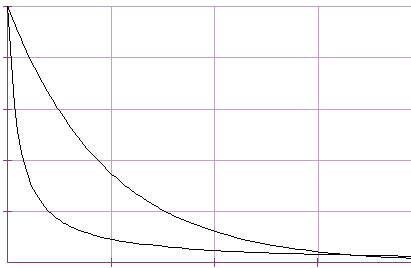
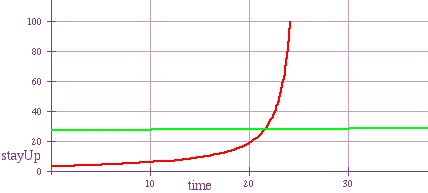
I gather we can now be quite exacting about what’s going on when we change our minds. Below we have two ways that we might weight the value of future rewards. The upper curve is that prescribed by the rational man beloved econ 101 text books. The lower curve is the result of experiments on pigeons, children, and undergraduates.