
Monthly Archives: September 2005

Crisis, Safety, and Standards

It is often only after the horrific event that the standards and regulatory systems necessary to create a resilient safe society finally fall into place.

So some standards emerge out of post-crisis analysis. My favorite is the standards for bricks after Boston had a fire. Another classic example was a fire in Baltimore that lead to the adoption of national standards after the neighboring communities arrived only to discover that their hoses couldn’t hook up with the fire hydrants in Baltimore. After a series of recessions showed how brittle the US car industry was the Society of Automotive Engineers was able to introduce standardized parts so the supply chain had more redundancy built into it.

This story about how the San Francisco earthquake set in motion a series of events that lead to a worldwide recession and finally the creation of the Federal Reserve can be added to my collection.

… London fire-houses insured San Francisco during this period. The payment of claims by British insurance companies following the quake and fire produced a large capital outflow in the fall of 1906, forcing the Bank of England to nearly double interest rates and discriminate against US trade bills. These actions pushed the US into a recession and made markets vulnerable to shocks that otherwise would have been transitory in nature. World financial markets crashed in October 1907 …

There is what appears to be a precursor of that paper here, outside the peer reviewed journal garden walls.

The quake triggered some significant capital flows. Money flowed into the city from insurance claims, yes. But money also flowed in because the quake destroyed capital investments and created an green field that was inherently attractive to fresh capital. Presumably there are some very attractive investment opportunities left behind by Katrina. Finally these capital flows created new connections (knowledge, relationships, etc) and additional capital flowed into the region; what the paper calls sympathy capital.

Some firms left San Francisco entirely; which was good for Los Angeles. I’ve been wonder what New Orleans institutions other cities might now be courting.

Nuts, Criminals and PR Flaks sighted on Internet!

Tom Zeller’s article on various nuts on sighted on the Internet isn’t sufficiently bemused. The net is full of odd balls; it’s part of the architecture. Even so I’m bemused by his archetypical New York Times retorical style: “…a host of other, more colorful agendas are being burnished at the Internet’s fringe – with Katrina serving as chamois”

Tom should write another article about the amusing traffic on the PR Newswire regarding Katrina. Those PR flacks can manage to taint the most well meaning efforts of their employers by writing them us in self serving press releases. My favorite PR wire item is this one:

ATLANTA, Aug. 27 /PRNewswire/ — As Hurricane Katrina prepares to make landfall on the U.S. Gulf Coast, residents and businesses are encouraged to keep a copy of The Real Yellow Pages close by for critical information on hurricane preparedness, survival and aftermath resources.

Tom’s article about post-Katrina scams is interesting. The low barrier to entry makes the Internet a fine venue for nutters, scammers. “Federal Bureau of Investigation put the number of Web sites claiming to deal in Katrina information and relief – some legitimate, others not – at ‘2,300 and rising.'”

Sooner or later we are going to introduce some serious infrastructure that help innocent people from thinking that nutters represent a widely held belief or that scammers are a legitimate organization. But it’s going to take a while because we have so many powerful institutions that would love to volunteer to do the job; none of which trust each other.

Meanwhile I’m reminded of this story.

…he told Johnny Carson four years earlier about his chimney-building days.

During his 1981 appearance, Arnold (Schwarzenegger) explained to Johnny how his bricklaying business worked. Franco and Arnold would call on a homeowner. Arnold, always good with the public, would keep the homeowner busy, discussing prices and such. “In the meantime,” Arnold recounted, “Franco climbed up on the roof to check the chimney-and he, of course, is a very strong guy and a [weight] lifter-he pushed all the chimneys over so they fall down. So these people come and say, ‘Oh, thank you so much for helping us. This could have fallen on somebody’s head, you know. Thank you for doing it for us.'”

Johnny was impressed. “What a racket,” he told the immigrant with a dream in his eye. “You go and push chimneys down and then rebuild them.”

“Exactly,” Arnold replied.

You don’t need the Internet to be a nut or a criminal.

Priceline

I am not a happy Priceline customer this morning. Here are five numbers: $42.00, $29.73, $27.00, $35.00. One is what I bid. One is the fees. One is the amount I was charged when I got to the rental counter so my wife could drive. One is how much I was charged for ariving 45 minutes late, but 15 minutes before the check counter agent told me to return. What a screw.

In Praise of Tweaking


In Praise of Tweaking: A Wiki-like Programming Contest by Ned Gulley, The MathWorks, Inc. is very very cool. The folks at MathWorks make a programming platform for scientists and engineers. So they have a developer network that they manage consciously. Like most developer networks they have contests. Contests can be great for generating some excitement around your platform. If done right they they can cause the community to discover and reveal innovations that might have otherwise remained hidden.

This paper is neat because is shows a really cool hybrid of open source collaborative development, wikis, massively multiplayer games, and objective based management techniques. (I think I deserve a very high score in for that sentence of buzz word bingo!)

What they have set up is a way to run the contests where the entries are like pages in a Wiki. Moves in the resulting game consist of revisions to an existing entry; or possibly the creation of an entirely new entry. Because they can set up a simple score (say number of lines and CPU time) each entry can be scored instantly. This creates a kind of stadium were players and spectators can rendezvous.

Let’s look at some of the ways this solves canonical problems in the open source design space. For example one model of open source says that the work proceeds in two phases; the developer refines the existing code to achieve a benefit that is local and then in a second phase he reveals the work publicly. Open source projects have trouble creating a climate where the second step happens. In this example you can’t play the game unless you reveal your work; so an incentive is created to reveal. But better yet there is an incentive to reveal as soon as possible because somebody else might reveal faster. It creates both a incentive to reveal and a bias for action.

Unlike an eBay auction where bidding last is best this is a game where bidding early and often is your better strategy. Interestingly sooner you enter the game the more chance your entry will become the basis for later entries. Since entries show their pedigree there is an interesting additional bais for action that early movers may become the basis for a large portfolio of entrants. That large portfolio means you have an increased chance of being a contributor to the winning entry.

Another standard problem in Open Source is how to avoid having the project’s core group establish a membrane around the project that rejects contributions from the outside. This is the other side of the how to encourage developers to reveal their contributions. The core group’s problem is how to balance the maintenance of various qualities (design, safety, limited forking, etc.) against the need to make the cost of revealing very very low for outside developers.

This example is a delightfully extreme case. The single naive metric used to compute the score becomes the only definition of quality; so that doesn’t need to be computed using social processes. The question of forking is solved by turning the knob to eleven – forking is the default. Every entry is a fork. At any moment in the game the entry that becomes best might evolve from any of the older entries. Crazy! It’s yet another example of how source control and the nature of information goods make these systems so different than real world ones.

One of the questions around open source is how much of the value in an open source code base flows from the contributions of a few v.s. from the many. People who think that status games are a key salient element of open source tend presume that a few status seeking contributors make the majority of the contributions. This is a question about the statistics of the contribution flows. I assume and there is some data to support that the contribution flows are power-law distributed. I.e. they are highly skewed with a few contributors doing a lot of work and a huge population of contributors doing small amounts of work. I also assume that the severity of the skew is due, in part, to how successfully the projects solve the problem of lowering the barrier to revealing your work back to the core.

One sweet aspect of this paper is that given the simple metric of quality they use to score the game they can cough up some kind of answer to this question. The paper’s title “In Praise of Tweaking” gives it away. Most of the improvement in the final score emerged out of tiny tweaks. But that’s really too simple. I love this bit: “Long stretches of tweaking battles can be suddenly punctuated by dramatic shifts in the code. When one of these big shifts occurs, it also opens up fresh opportunities for tweaking, and swarms of curious competitors descend upon and begin tightening up the new leader.” That pattern happens, of course, in real open source projects just not a quickly.

Well, read the paper! There must be hundreds of places around the edges of open source projects were these techniques could be tried.

Flooding the Network

Cities are a geographic solution to the matching problem. Want to find a spouse, a model train caboose, a slide rule, a bar were they play music but not too loud, huitlacoche? At the same time cities aggregate webs of links that last over time. These networks of links sustain the urban residents and attract the rural. Economically vibrant cities like Silicon Valley or New York furiously generate new links. They build on top of the deep complex mesh of existing links. Economically weak and declining cities sputter along creating a fewer new linkages while their underlying networks are hoarded, decay, or depart.

The term social capital was introduced a few decades back in an attempt to give a name to some of that. The original idea of social capital was that you could sum up the value of a person’s connections if you sum up the capital equipment they had access to thru those connections. For example if I can borrow a hammer from my neighbor that’s part of my social capital. If I can borrow the company’s trunk when moving my apartment then that too is part of my social capital. If the boss will lend me his plane in crisis that part of it too.

Events that make and break links add and subtract from the net worth of your social capital. While you may lose a lot of capital worth when your house burns down you can lose a lot more when you move between cities, exit a club, switch proffessions, graduate from college.

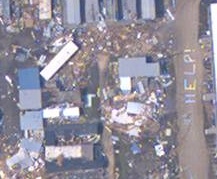
There is a picture in today’s paper that show how people in the Astrodome have put up huge signs in an attempt to find other people in their social network. It says they ring a bell each time one link is reconnected. It boggles the mind to imagine what’s involved in re-stitching the social web of an entire city. How would I ever reconnect with the butcher that makes my sausages?

The demand to recreate these connections is one of the reasons why we will rebuild something around New Orleans. The desire to reclaim the social capital is extremely strong. It will work in tandem with the necessities of the physical capital. New Orleans is a distribution bottleneck for a whole range of goods. Distribution bottlenecks are very analogous to cities; a web of supply mets a web of demand and flows thru them like the food flows thru Paris.

One feature of New Orleans economy is how capital intensive it’s distribution flows are. It’s not like New York, Boston, or Silicon Valley where the goods that are flowing are practically weightless. The oil, grain, cement, automobiles that flow thru New Orleans depend of extremely expensive installations. Consider Henry Hub where the price of natural gas futures is fixed; 15 natural gas pipelines that reach out across the entire nation and a sea of storage tanks. Or consider the refineries any one of which would take Billions of dollars to reproduce. Or the oil terminal where one pipeline carries 20% of the US oil ashore. These distribution networks are very hard to move. Moving Howard’s Hub would require rerouting all those major pipelines.

The nodes and links in both the social and the physical networks range across various key metrics. Their value for example. My neighbor’s hammer is less valuable than my employer’s truck. Their resistance to breaking. Moving a pipeline is harder than changing where a shipping container goes.

When the hurricane comes it strips all the leaves from the trees; when the flood comes the weakest links are dissolved. But these are the vast majority of the links; and so that it always the greatest loss. It is very hard to imagine that those billions of dollars we are spending on relief and rebuilding will be focused on regenerate those. Yesterday I read about the engineer asked about the environmental effect of pumping out the city and he said; we have higher priorities right now. New Orleans has always been a city with a severely skewed wealth distribution. This is only going to make is worse.

Business Plan

I love that illustration. The canonical business plan! The article is good too. I’ve been stewing some on how the mobile phone is a coordination problem solver; and that their pricing, i.e. per minute pricing, reflects to a large degree how often the usage consists of very short calls; each one of which solves a tiny coordination problem. I.e. where are your, where shall we meet, I’m going to be late, call Harry, etc. etc.

The article points out that some businesses have noticed this and as they look for substitutes for cell phones they quickly found Wifi capable phones. Of course the family radios solve the same problem. You see those wired, Borg like, to the retail store employees of most big box stores now. The term “family” was always a diversion from the real target market for these; though I have seen some kids in malls with them in hand. The boys in the back room saw to it that family radio wasn’t regulated so it may not be used to place phone calls.

Apparently somebody dropped the ball on Wifi. The carriers have had to drop back and try defend the network by pressuring the handset manufactures and declining to certify handsets that puncture their garden walls.

It must frustrate the cellular carriers that they haven’t found pricing plans to reach these applications effectively. Maybe the pressure to introduce them hasn’t arrived yet. But much as family radio wasn’t about families I’ve presumed that mandatory location sensitivity for cell phones isn’t about emergency services; it’s about enabling pricing plans that are extremely location sensitive.

But maybe not as small in radius as a toilet bowl plunger.

Weather v.s. Law Enforcement

Art Botterell wrote an interesting email to Dave Farber’s venerable Interesting People mailing list giving a bit of his impression of how FEMA has evolved over the years. It’s very interesting from a number of perspectives. They apparently learned a lot from the experience around Hurricane Andrew, learnings that went missing in recent years.

One thing he mentions in passing I found particularly thought provoking. “And then came 9/11. FEMA was subsumed into a law-enforcement dominated Department of Homeland Security” That’s a fascinating dialectic; between the problem of how respond to an emergency v.s. the job of law enforcement. In law enforcement there is a bad guy; so much of your energy is directed to, as Pat Robertson says, taking him out. In emergency management geology, weather, and the bad guys that get away are your problem. One is all about individual actors, while the other is all about probabilities, scenarios, and rapid response after the fact. I suspect that people have a natural tendency toward one or the other world view.

A skills of law enforcement seem pretty clearly bogus for tempering the risks of hurricanes and earthquakes. What really caught my attention though was that I suspect that they are far less effective for tempering the risks of terrorism than one might think at first blush.

Take for example the risk of terrorist acts against critical distributed systems; like pipelines, highways, power grids. The pool of bad actors is everybody on the planet with a grudge and the target has a immense perimeter. The chance of the vile deed is a statistical modeling problem; like weather forecasting. There are only a few ways to temper the risk. Three examples: find ways to reduce the energy of hate being pumped into the system. Find ways to configure the systems so they are less fragile; for example by finding choke points in these networks and distributing them. And finally being ready react quickly to limit the damage when it happens. I’m sure that law enforcement experts use these techniques; but they aren’t at the core of their craft.

I’m not a great fan of one dialectic to rule them all; but this is certainly an interesting one to throw in the pot. I think of the terrorism problem as more like the weather while I think a lot of people I disagree with tend to think it’s a law enforcement problem.

One risk of getting all excited about a single dialectic is that you tend to project it casually onto lots of other problems. But you it’s clear that what you see in New Orleans is very different if you see it as the breakdown of public order or the a vast messy coordination problem gone horribly wrong. What you do over the coming months is very different depending on your mind set. Law enforcement or emergency management?