
Monthly Archives: July 2005

52 Card Pickup

More on peer to peer. Recall that what’s cool about peer to peer is that it allows a publisher to reach a bizillion consumers while only expending a few units of bandwidth. He shifts the distribution costs onto the consumers. It makes for a wonderful example of the classic standards problem – “If everybody would just…”

One aspect of this that I’ve been playing with is how the publisher might frame the game to encourage the swarm to collaborate. The BitTorrent technique of this kind is to fragement the content and scatter it into the swarm.

At that point the publisher sits back and says “Oh boys, you sort it out.” It’s a variant of 52 card pickup. Coordinating the resulting card game is the trick. In BitTorrent an entity known as the tracker helps along that coordination. There is a lot of design space to search around how to orchestrate the coordination.

At the same time it’s a special class of market making and clearing house design. Part of the cost born by the consumers is the cost of keeping the market liquid. For example can you design the system so it welcomes and forgives poorly behaving swarm members while at the sametime holding onto the generous ones?
Usability but not presence

This, of course, …


checking foo.h usability... yes
checking foo.h presence... no
configure: WARNING: foo.h: accepted by the compiler, rejected by the preprocessor!
configure: WARNING: foo.h: proceeding with the compiler's result

… happens when your configure.in sets CFLAGS where it ought to have set CPPFLAGS.

Startup

Oh this made me snort!

I worked for a company who’s plausable premise was that lots of CFOs are terribly unhappy because nobody in their firms actually computes the NPV (Net Present Value) of the various projects they are considering. The software was an expert system that the CFO could give/demand that everybody use as part of the project approval process. The premise, while plausable, was wrong.

It’s easy to over estimate the demand for good practice. Particularly if your an expert in said practice.

Emily update


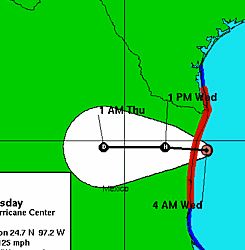
It looks to me like Emily is managing to go ashore just far enough south so the concentrated population along the border will be spared the worst of the wind.

… a strong Category 3 storm … 125 mph … The eye of the storm came ashore just before dawn near San Fernando, a town about 80 miles south of the U.S.-Mexico border. The National Hurricane Center in Miami said hurricane force winds extended outward 70 miles. Tropical storm-force winds blew over south Texas.

I think this side looking radar image (pdf) of the Brownsville-Matamoros area is very cool. You can see how the river has grown more convoluted over time, and also how occationally it folds back on it’s self so that an entire loop is then abandoned. (more maps).

On a more serious note.

expect rains to swamp the low lying ramshackle settlements known as colonias which line the Rio Grande, many of which have no drainage systems…. “It is going to be a very dangerous situation. We could easily see 15 inches of rain in some mountains areas and that will cause flash floods and mudslides,” said Stacy Stewart of the U.S. National Hurricane Center in Miami. …Many fretted over the fate of their modest corrugated iron homes.
(more)

Headless Chickens

This is an amusing this attempt to label strategic approaches to Open source available to the software vendor.

  1. The truly committed
  2. The mixed-codebase
  3. The pragmatics
  4. The anti-strategist
  5. The headless chickens
  6. The in-denial
  7. The anti-OSS

Open Source has upset the apple cart of consensus about how to run a software company. Just consider a handful of the sources of risk (from Porter’s classic list). Open Source totally changed the nature of buyer power. Buyer can now engage much more deeply with the vendor, collabratively evolving the product for joint gains. That change is rough for both sides.

The inputs to software firms have changed, i.e. what Porter calls supplier power. The open developer community is a vast resource that you ignore at your peril. The software components you stand on have changed and many are now open. Even if you avoid the viral power of the GPL the culture of development has changed.

While not particularly unique to open source (i.e. it’s happening all across the information/knowledge industries) new entrants face much lower barriers today. That increases velocity as well as uncertainty.

In classical industrial frameworks a industry seems to sort it’s self out into a clear pecking order. It then settle into a kind of low key rivalous behaviour along the lines of that ordering. Buyers and sellers rondevous around the resulting arguement.

In a disruptive period the rules aren’t clear. The argument is always changing. In businesses where industries don’t emerge them never do.

I’m amused that list reflects an attempt to impose ordering on the vendors. To frame the measures of quality for CIO/CTO buyers. In that PR frame it’s clearly biased toward the author’s firm. That’s typical, it’s part of an argument that unfolds whenever an industry is in flux. What measures of quality will define the industry’s peeking order after things get sorted out is the key issue during the disruptive phase. So of course every vendor clueful vendor is desperate to make sure that whatever they have in the way of strengths become the leading attributes of quality.

Emily, a Quiz


How many people live just south of the Texas border with Mexico? Which side of a hurricane is more dangerous?

update: A lot of people. In 2000 just Tamaulipas, Mexican state in the north east corner of mexico had 2.75 Million people. The cities along this border have been growing very fast over the last two decades. By way of comparison the New Orlean metropolitian area’s estimated population in 2000 was 1.33 Million.

Hurricanes spin counter clockwise. Where the forward motion and the spin combine creates the most dangerous region. In this example that would be the north side of the storm.

Ice

New England used to ship ice all over the world. To store the product they build palaces in India. To assure that they got nice clear ice each fall they would dump poison into the lakes. In the winter they would cut blocks of ice and store them in huge buildings insulated with sawdust. Sometime after the industry collapsed these building burned in spectacular fires.

It’s hot and muggy here. I got to thinking about using ice for air conditioning. Apparently you need a big 25 foot cube of ice. The phase transition, liquid to solid, stores most of the calories. I gather that block has about 130 million BTU of cooling stored in it.

Converting that into the emerging standard unit of energy; 1 barrel of oil (5.8 million BTU each) that’s 22.5 barrels of oil. At 50$ each that’s $1,120 worth of energy. How big is a barrel of oil?

I wonder how hard it would be to convert my garage into an ice house? Can you be an eccentric if you don’t have a grand scheme involving ice. Maybe the Tammany Ice Trust will rise from the grave.

Plausible Premise

In a posting over at Gobal Guerrillas there appears this phrase “plausible premise”, like so: “Remember, al Qaeda (and to a lesser extent the US) set this new organizational structure in motion by providing a plausible premise for the war.”

My first thought was that’s a nice way to describe what your doing in a start up. Such enterprises are held together by a plausable premise in spite of unlimited uncertainty and risk. For many years people’s reaction to open source was that they found the entire premise implausible.

This seems like a phrase that would be fun to add to my toolkit. But you can get in trouble adopting a phrase casually. For example while I love the phrase “bias for action” I was discomforted to discover it’s roots. So, I poked around in various venues (google, google print, Amazon Amazon’s SIPS).

Apparently it lacks a strong bloodline. Sometimes it’s used in describe the premise in the plot of a bit fiction: “It’s an all too plausible premise of what would happen if Earth was visited by a superior, technologically, alien race.” It’s used in philosphy to get a premise introduced early and casually. It is very occationally used to describe a marketing process – “the email must create plausible premise that persuades the recipient to divulge personal information”. There is something called plausible reasoning, an alternative to deductive reasoning. But, I don’t see any use of this term plausable premise in that vicinity.

Some enterprising airplane book author should domesticate it and breed up a purebred. Meanwhile, you find the wierdest phrases at Amazon: existential foothold.