Monthly Archives: July 2004

LENS

I’m making a collection of model aggregators; i.e. firms that collect information about a group of people from many parties and then turn around and reveal that to another group.

The New York State driver’s license system is interesting. The regulations that govern the revealing of driver’s license information are found in a law: DPPA or Driver Privacy Protection Act. “Permissible use” enumerates who’s allowed to get the data. Boy! They permit revealing to a lot of parties.

I was particularly struck by LENS; or License Event Notification System. It appears that you can get a speeding ticket on the way to work and before you get into the office your boss’s Human Resources department can know about it. And people complain about inefficient government!

Here some other examples:

I’d love to know about other examples!

Making a collection of members of this species is helps in discovering a list of what attributes they tend to have. Here’s a very short list, as an example.

  • Event notification.
  • Permissible use.
  • Dispute resolution.
  • Foo Privacy Protection Act (i.e. DPPA, HIPPA, …)

A future so bright there is no place to hide!

Tasty Redux

New improved version of the Tasty? bookmarklet!

Instead of bouncing off my server this one bounces off the del.icio.us server using a newly revealed (at least to me) mechanism. This is better, you’ll only be revealing your curiosity to del.icio.us rather than to both me and del.icio.us.

Drag this to your bookmark bar, discard your old version if this doesn’t overwrite it.


        Tasty?

Upgrade today!

Earlier posting here.

Cool! Version in pure java script.

Oh piffle, the Tasty bookmarklet above is messed up by wordpress. You need to strip two characters off the front and the back after you install it.

Yield

Tim Oren takes a poke at simplistic applications of Reed’s law. I’d love to see a careful attempt to enumerate a long list of the barriers that frustrate the pipeline between Moore’s law and his friends and the economic productivity improvements that so pop out much much latter.

It takes a long time for society to puzzle out how to harvest the opportunities generated by these guys. It often takes even longer for the society to figure out how to fold them into culture.

Tim’s critique, while entirely valid, reminds me a bit of those famous quotes from the first few decades of computing about the upper limits on demand for computing. Will we think much the same thing about the arguments that there are limits on group forming in a few decades?

Tasty!

Update! See here.

If you drag this bookmarklet into your bookmark bar: Tasty?

Then when visiting a page you can click on it to see how many people thought it was interesting enough to bookmark at del.icio.us. You can read their comments and category assignments.

That bounces off my server; so I’ll be keeping an eye you you :-).

The cgi redirect script is simple. This script is an earlier draft that runs on the command line and opens a url passed as an argument – well on the mac it does.


  #!/bin/bash
  HASH=`echo -n $1 | md5`
  exec open "http://del.icio.us/url/$HASH"

As you can see they just take the MD5 hash of the url. You could avoid the bounce off a 3rd party server by using a bookmarklet along these lines:


   javascript:void(location.href='http://del.icio.us/url/'+hex_md5(location.href))

But you’d have to inline the entire of hex_md5 and that’s a lot of code!

My redirect server comes with no warranty of any kind. Enjoy.

Textuality

Since reading about alibi clubs I’ve been subscribed to Textuality.org a blog about text messaging on cell phones. New technology collides with society: sparks fly. The template for these stories seems to be you take a distinct preferable subordinate group and text messaging and out pops a story!

Here some examples:

  • The Unemployed, text them:”Mango picking jobs available. Run!”
  • Truants: “Jr. didn’t show up for school!” I think that one needs the knob turned up. Text all the adults in town: “Bobby, Susan, and Timmy didn’t show up for school! Get ’em.”
  • Old Folks: Workshops how to text message!
  • Innocents Abroad: Watch dog timers! Send a text message that announces you have gone missing if you don’t cancel it’s delivery upon arrival at your destination.
  • Rude People: Cell phone users feel they are more courteous than other cell phone users!
  • Nostolgia: Payphone used to have doors! Isn’t that quant?
  • The Lascivious: News, cell phone owning youths more promiscuous! This is complemented a few days latter by cellular company announcing cell phone owning youths more sociable. Meanwhile some researchers are concerned about cell phone radiation affecting sperm counts while some other researchers are concerned about men losing their confidence if you take their cell phones away from them. Which makes sense since yet other boffins have noticed that men use cell phones like peacocks use their feathers.
  • Call Girls: Pretty much required to have phones! This is news?
  • Hackers: Cell phone viruses!

The fun never stops with new technology!

Growing Powerlaw Networks

I note two other processes that grow a power-law distribution in Newman’s survey paper. The first is a variation of the preferential attachment model. I think of that as a shopping model. New nodes shop for what to connect to. The first of these two models has a different method of shopping.

The alternate shopping model fixes a problem with the preferential attachment model. If you look at the simulation for the preferential growth model it works by drawing a random existing connection and them mimicking that. This is not really credible. The new nodes don’t have a view of the set of all the existing connections to draw upon. Newly arriving nodes presumably can only see some local region of the network.

The alternate shopping model replaces the random draw with a bit of search. The new node starting from a random existing node proceeds to either continue searching (shopping) at a neighbor of that node or it stops shopping and mimics a connection on at that node. Each round of the search has some chance of terminating v.s. iterating. Like the preferential attachment model this shares a random draw from the universe of the whole graph. I’m particularly pleased because simulations of this model can easily be modified to include other attributes of the nodes the shopping visits – i.e. merit.

The second model might be called the acquisition model. Newman reports that if create a network by randomly adding edges between random nodes there comes a time when the network very quickly becomes entirely connected. They call that a phase transition. As we approach the phase transition the nodes form a slurry of components of various sizes. The distribution of these sizes is power-law. I think of that as an acquisition model because it mimics to a degree what happens in as an industry matures. At first there are numerous small entrants into the industry each solving local problems. Later as the industry becomes more standardized these firms begin to merge. This model helps to suggest why we see a power-law distribution of firm sizes in many industries. Industries that complete the phase transition become monopolies.

I particularly like this model because it helps to inform my thinking about what happens when one of the Porter’s barriers to a industry consolidationis eliminated.

Identity/Privacy – This week’s model

I’ve spent much of the week playing with different model of the identity problem than I usually use. This model arose because I wanted to draw some pictures to help people visualize how an Joe’s internet identity is the union of models held by the firms: your bank has one, DoubleClick has another, etc.

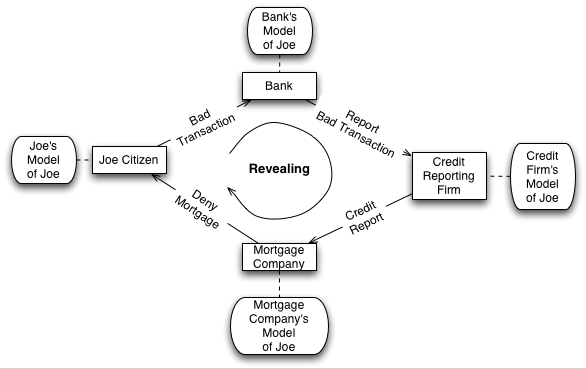
I spun this story: Joe couldn’t get a mortgage from Mort, his mortgage company.  Mort found something that in his his credit report. Mort bought that report from Cret, a credit reporting firm. Cret got the troubling information about Joe from his a bank.  Seems Joe opened an account at the Bank and then immediately had a NSF (no sufficient funds) event.  I happen to know that this happened because the bank charged Joe for his new checks before this very same bank had cleared the funds for his initial deposit; but yeah Mort and Cret don’t know that.
Now initially my plan was just to use that story to point out how there were four models of joe in the story. Joe’s, the bank, Cret, and Mort’s.  But, my attention wandered.  I drew the picture below of the relationships. At that point I got interested in the relationships, the transactions flows, and the governance rules around them.  Notice how Cret has no relationship with Joe.
JoeMortgage4Players.png
This helps you to think clearly about the rules the privacy puzzles in this story. For example Joe, probably unknowingly, licensed the bank to reveal information when he signed up for his account. In addition to the contracts that govern the relationships between pairs in that drawing there are the laws and regulations of various governments and industry consortium in play; for example my state has laws on the books to give Joe at least a chance to deal with Cret. Of course there are also ethical and cultural norms.
We can also add in the various models and the cycle of revealing that got Joe’s mortgage request declined.
JoeMortgageWithModelsEtc.png
When thinking about problems like this I try to sympathize with each of the roles. The mortgage company, for example, is seeking to do due diligence, or a background check, on Joe. They are looking for a trusted third party or at least a disinterested third party.  Notice how Cret’s lack of a direct relationship with Joe adds to their claim of being a disinterested 3rd party.

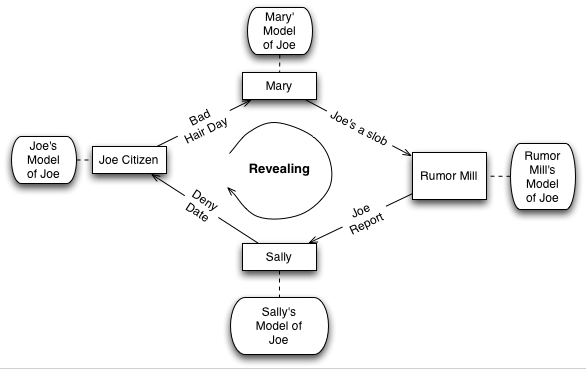
I also like to engage in various exaggerations of the model. See what turns up when you look at edge cases. So here’s another story. Later that day Joe got turned down for a date with Sally. Sally asked her friends about Joe. The rumor mill reported back that Joe was a slob. Since this is my story I happen to know that the rumor mill came to know this because fastidious Mary once saw Joe when Joe was having a particularly bad hair day. This story has the same four players and the same schematic as Joe’s tough time with the mortgage company.
JoeDate.png
Joe’s desired to fix the model of the credit reporting firm. Now he want’s to fix the model the rumor mill has of him. Joe’s got some real challenges ahead! My state has rules and regulations to help him with the first. My culture, the American one, has rules too – we love to hand out second chances.

In the dating story the rumor mill fills the role of disinterested third party when Sally goes off to get a background check on Joe. Joe’s model of that is that they are talking behind his back. Which they are.

As a break from the fun of playing with the stories these are possible names for the four roles shown in these examples.

  • Model Revealer – aka Joe’s Bank, or Fastidious Mary.
  • Model Aggregator – aka the credit reporting firm, or the rumor mill.
  • Model Builder – aka the mortgage company, or Sally.

Then I read this article about alibi clubs (see also). Average Joe’s solving these problems for them selves!

So a third story, this time with an alibi club. Joe turns out to be a jerk. In fact he’s married! His wife suspects he’s running around. She accuses him of trying to get a date with Sally. But wait! Joe is a member of an alibi club. He sends a text message to the club. “Quick need alibi!” and one of the members volunteers and gives him a call. They work out an alibi and later as the argument with his wife proceeds he says. “Look you don’t trust me? Call the garage! They’ll back me up. Here I’ll, damn it, I’ll even get you the damn number.” Wife calls ‘garage’ and alibi is delivered.

In this story the alibi club has captured the role of trusted disinterested third party. Joe and his friends in the alibi club have cut out the middleman and fraudulently simulated the top part of the revealing cycle. Oh my God! It’s another example of the Internet disintermediating!

As one of my friends pointed out at about this point; this model is an excellent generator of stories and crimes.