Monthly Archives: May 2004

One for the team.

One of the easy moves when doing PR damage control is to identify a scape goat; pile as much of the responsiblity as possible on his shoulders and then kick him out. If your lucky; the outraged public will then take a deep breadth and give you time to do something more substanative; or better yet they will just wander off and stop bothering you.

Obviously Rumsfeld should go. But it would be a huge mistake to pretend that the cancer who’s symptoms those photos reveal will go with him. It’s going to take some very serious surgery to cut that cancer out. Not until we as a nation suffer that operation will there be any hope of reclaiming our historical role in the room of nations.

I am afraid we will never reclaim that honorable position. Damn them. Damn them all. Have they no honor? Have they no conscious? Apparently they have no ideas what they have done to our nation.

When the learning dries up.

When the playing stops and the exhortations begin the learning dries up.

Five (well six) ways to learn.

  • Trial and Error; playing with the material.
  • Perception of the Object; study of the material.
  • Perception of others using; watching their reactions as they use the material.
  • Modeling; mimicing the performance of others with the material.
  • Exhortation; being directed to utilize and how to use the material.

These are pretty clearly in rank order. The first is far more powerful a learning method than the last. The last is most popular with those that would instruct others.

There is a sixth method.

  • Instruction

But it is assembled out of the others along with all the thousands of other frameworks for how to teach.

I’m bemused by how this illuminates the problem of herding cats. In open source you can almost always tell that things are going down hill when folks stop playing with the materials and start attempting various kinds of exhortations. It’s amazing to me how many organizations attempt to put a lid on the playing.

Bridge Collapse

bridge_collapse.jpg
Over the last few years it has become clear that if you begin with a homogenous substrate, like the Internet with it’s peer to peer architecture, what emerges is a network with a power-law distribution. I.e. there is an entirely natural mindless meritless mathematics that drives level playing fields toward terrible unequal outcomes.

In turn that makes it clear that thinking about the topology of the networks that a platform enable is the the key challenge facing designers in this generation.
That if we want to maintain some degree of equality as the world captures the benefits of one vast uniform platform for communications and trade we are going to have to mighty careful.

One extreme topological form in this design space is the bridge, or two sided network. For example eBay is a bridge between buyers and sellers. The village marketplace was the old example of this. Google, another example, bridges between searchers to those that wish to be found. The yellow pages was the old example of that. Platform vendors, a final example, bridge from diverse hardware to diverse applications.

The power-law distributions emerge because some players in the network become hubs; and a few of these hubs become very very large. I suspect that the bridge topology is only one way that a hub can function – it’s a design that helps the hub manage both to scale and to remain durable. I yearn to see if there are others kinds hubs – for example is there one that is analagous to the train yard.

In anycase I was amused by this paragraph about this cool tool that visualizes social networks.

LJNet puts social networking on crack – but this might actually have some negative side effects. My primary concern is worsening the potential social side-effects of ‘bridge-collapsing’ – allowing my friends to connect to other friends of mine without going through me as a bridge, a moderator, a contextualizer, etc can have some unpleasant side effects. Thus I’m considering a password-protected version of the LJNet system that only allows users to see their own networks, and to anonymize the 2nd degree friend nodes so that if I see that my friend has another friend with many interests in common with me, I’ll have to ask my friend to meet this person. Of course this wouldn’t be fool-proof, but this is my other concern before releasing it publicly.

Most people think the middleman is a somewhat dubious role; i.e. the whole problem of agency. But, what about the risks of “bridge collapse?”

VOIP – Part II

I have no idea why I’m playing with this stuff, but apparently I still am. The little psuedo phone company (Free World Dialing) that I’ve been using gave us phone calls this mother’s day weekend for free.

I had fun chatting with Ted; it sounded pretty good but suffered lots of misc. tiny drop outs. It would probably work better if I had a real microphone. Ian mentions more examples of how all this is not quite there yet.

Back in the good old days phone calls were routed by operators who’s answer the phone and then rearrange cables so that the caller and the callee were connected.

These days a box usually sits in the phone closet at work and does something similar. That’s called a PBX – for “private branch exchange.” There are about a dozen open source projects that will let you run your own PBX on commodity hardware.

I noticed that I could install one of these on one of the FreeBSD boxes in my basement by typing make install in the right directory; so I did.

That was Asterisk. Golly. Configuring this thing is a lot like a combination of writing microcode and snobol. I sense that it’s got the legacy of years and years of craft knowledge beloved by phone engineers. I mostly found it to be a little odd. It does all kinds of cool things; voicemail, conference rooms, etc. etc.

But a couple wasted hours of fooling around and I can call out thru my own PBX and incomming calls can get routed to voice mail. The voice mail is fun, it get’s emailed to me.

This makes me my own pseudo-phone company. Look out VodaFone!

It appears I can arrange to have my little phone system connect to other little phone systems; like the one I used to talk to Ted. Following the directions seemed to work; but my voice mail prompts don’t get thru.

Apparently if I by a card to stick in the computer in the basement I can hook my little phone system up to the old fashion phone system. But I probably ought to mow the lawn or get that squirrel out of the eves instead.

Learning thru Modeling

Another specimen for the frameworks collection. This is a social science one (i.e. why do people do dat?) framework. In this case how do people learn to do dat.

From Social Learning Theory; one of the mechinisms that primate learn is by observing the behaviors of other primates “Monkey see monkey do.” This is called “modeling.” Not to be confused with life modeling.

We can break that into four phases bridging from modeled events to matching performances.

  • Attentional Processes: first you gotta notice the behavior you might model.
  • Retention Processes: then you need to store it in your noodle.
  • Motor Reproduction Processes: then you gotta figure out how to do what you saw.
  • Motovational Processes: finally you need to have a reason to bother.

We can dive down a bit into each of these four, naming mechinisms that might get used to implement those.

Attentional Processes:

  • Modeling Stimuli:
    • Distinctiveness
    • Affective Valence
    • Complexity
    • Prevalence
    • Functional Value
  • Observer Chracteristics:
    • Sensory Capacities
    • Arousal Level
    • Perceptual Set
    • Past Reinforcement

Retition Processes:

  • Symbolic Coding
  • Cognitive Organization
  • Symbolic Rehersal
  • Motor Rehearsal

Motor Reproduction Processes:

  • Physical Capablities
  • Availability of Component Responses
  • Self Observation of Reproductions
  • Accuracy Feedback

Motivational Processes:

  • External Reinforcement
  • Vicarious Reinforcement
  • Self-Reinforcement

This framework is lifted from Social Learning Theory by Bandura.

Presumably if you wish to learn something, or you wish to teach something you’d be wanting to use this framework to structure the situation. With that in mind this is an interesting list to contrast with the coercive techniques used by cults were such structuring gets entirely out of control.

Need more learning theories; here areĀ  more than fifty more.

Accessory to a Sin

Another specimen my collection of explain it all frameworks.

By way of Making Light this list of nine ways to you can be an accessory to a sin.

  • By counsel.
  • By command.
  • By consent.
  • By provocation.
  • By praise or flattery.
  • By concealment.
  • By partaking.
  • By silence.
  • By defense of the ill done.

This is actually one of a family of frameworks from the Catholic community; ways to keep the conscious vigorous.

For example here’s another your seven capital sins.

  • Pride
  • Covetousness
  • Lust
  • Anger
  • Gluttony
  • Envy
  • Sloth

Just by intersecting those seven with the first nine you get 63 ways to get into trouble.

Generally Americans are a forgiving lot. Nixon can be McCarthy’s righthand man or Bush can waste his youth and latter we make them president. It’s almost required that our celebrities spend time in rehab so we can forgive them and welcome them back on the stage. We tend not to keep score about this stuff.

Sometimes, though!

good neighbors scoop

As I was walking down the back alley where this sign appears I was thinking about how you might go about organizing the community to get it paved. It’s a muddy pothole ridden thing today. About 300 to 500 people would benefit. It wouldn’t be expensive per person. It would make the alley more pleasant in the winter and the rain.

Then I came upon this sign.

GoodNeighbors.jpg

My rule of thumb is that signs are a kind of social hacking, an attempt to get the system to work a bit better. They usually appear in response to some undesirable event. I’ll leave it to your imagination which one triggered this nice big sign.

Some times the sign order you. Sometimes the signs warn you. This is a nice one. It’s just an announcement. It’s announcing the poster’s opinion about how community member’s are selflessness and do their communal duty. Actually I like the way that it’s a little ambigous who’s speaking; i.e. how legitimate their opinion might be.

It’s like the difference between a sign that says “Vote!” and one that says “Citizens vote.”

Work: Where? and When?

A friend recently shared with me a paper from the dark ages (i.e. 15-20 years ago) on the changing nature of work and the tools people were hacking up to support these bizzare new forms of work.

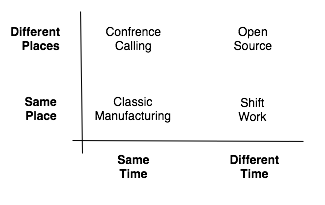
It had a chart like this one; except that I’ve put some points on the chart.
whereWhen.png

That’s the kind of chart that B School professors can make an entire consulting practice out of.

One of the things I’ve been noticing recently is that the locus of work is moving toward the upper right hand corner. The folks working on a given peice of collective action rondevous less and less in time or space, sometime never. Other points of rondevous are replacing those; e.g. the code repository, the mailing list, etc.

Some kinds of work are stuck in the lower corner. For example the Congress only lets those people in the room at the time vote; so they are stuck having to all be in the same place at the same time.

I sat on a board of directors once. The lawyers wouldn’t let us hold our board meetings in the upper right corner and insisted that we do them on the phone. The phone thing was still pretty innovative.

As you move around in this space you encounter different practices. For example a group of graphic designers working in the lower left will sketch and toss bits of paper back and forth across the table. Once there work moves away from there they loose that; which makes them sad. But it begins to allow practitioners that don’t excell at rapid interaction to join in.

I’m convinced that lots of people and groups are very confused about all this. If some of the players moves to one point in the space and some of the players stay in another part of the space it provides all the raw materials for boundry making and conflict.

More interestingly I’ve seen situations where the work moved into the upper right while some number of people clinge to the lower right – staying in their comfort zone – so that the community is paying the cost of supporting two complete infrastructures for coordinating work.

That’s similar to the way that if you want to introduce the next generation standard you need to inter-operate for a very long time. Thus televisions are still ready and willing to recieve a black and white signal, my office has a fax machine, a mail room, and the old office had a hitching post outside.